Lohman David J, Peggie Djunijanti, Pierce Naomi E, Meier Rudolf
Department of Biological Sciences, National University of Singapore, 14 Science Drive 4, Singapore 117543, Republic of Singapore.
BMC Evol Biol. 2008 Oct 30;8:301. doi: 10.1186/1471-2148-8-301.
Evolutionary genetics provides a rich theoretical framework for empirical studies of phylogeography. Investigations of intraspecific genetic variation can uncover new putative species while allowing inference into the evolutionary origin and history of extant populations. With a distribution on four continents ranging throughout most of the Old World, Lampides boeticus (Lepidoptera: Lycaenidae) is one of the most widely distributed species of butterfly. It is placed in a monotypic genus with no commonly accepted subspecies. Here, we investigate the demographic history and taxonomic status of this widespread species, and screen for the presence or absence of the bacterial endosymbiont Wolbachia.
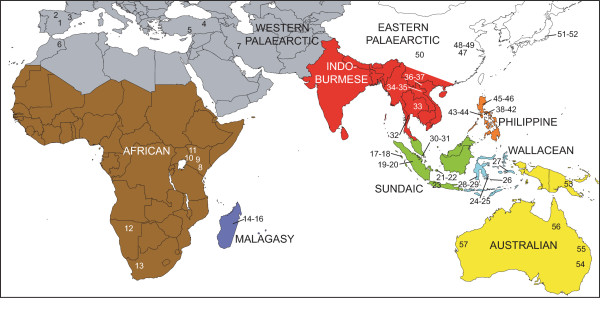
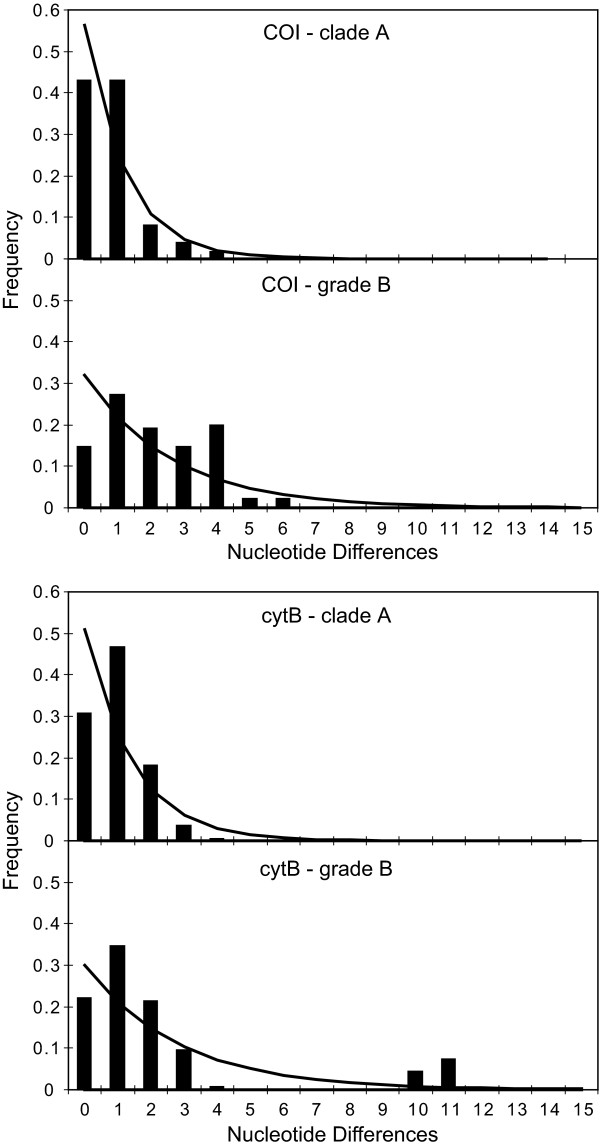
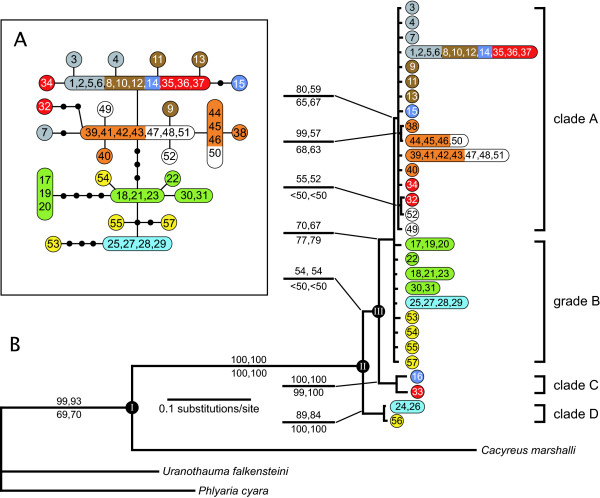
We performed phylogenetic, population genetic, and phylogeographic analyses using 1799 bp of mitochondrial sequence data from 57 specimens collected throughout the species' range. Most of the samples (>90%) were nearly genetically identical, with uncorrected pairwise sequence differences of 0-0.5% across geographic distances >9,000 km. However, five samples from central Thailand, Madagascar, northern Australia and the Moluccas formed two divergent clades differing from the majority of samples by uncorrected pairwise distances ranging from 1.79-2.21%. Phylogenetic analyses suggest that L. boeticus is almost certainly monophyletic, with all sampled genes coalescing well after the divergence from three closely related taxa included for outgroup comparisons. Analyses of molecular diversity indicate that most L. boeticus individuals in extant populations are descended from one or two relatively recent population bottlenecks.
The combined analyses suggest a scenario in which the most recent common ancestor of L. boeticus and its sister taxon lived in the African region approximately 7 Mya; extant lineages of L. boeticus began spreading throughout the Old World at least 1.5 Mya. More recently, expansion after population bottlenecks approximately 1.4 Mya seem to have displaced most of the ancestral polymorphism throughout its range, though at least two early-branching lineages still persist. One of these lineages, in northern Australia and the Moluccas, may have experienced accelerated differentiation due to infection with the bacterial endosymbiont Wolbachia, which affects reproduction. Examination of a haplotype network suggests that Australia has been colonized by the species several times. While there is little evidence for the existence of morphologically cryptic species, these results suggest a complex history affected by repeated dispersal events.
进化遗传学为系统地理学的实证研究提供了丰富的理论框架。对种内遗传变异的研究可以发现新的假定物种,同时有助于推断现存种群的进化起源和历史。细纹凤蝶(鳞翅目:灰蝶科)分布于四大洲,遍布旧世界的大部分地区,是分布最广泛的蝴蝶物种之一。它被置于一个单型属中,没有被普遍接受的亚种。在此,我们研究了这个广泛分布物种的种群历史和分类地位,并筛查细菌内共生菌沃尔巴克氏体的有无。
我们使用从该物种分布范围内收集的57个标本的1799 bp线粒体序列数据进行了系统发育、群体遗传和系统地理学分析。大多数样本(>90%)在基因上几乎相同,跨越>9000公里地理距离的未校正成对序列差异为0-0.5%。然而,来自泰国中部、马达加斯加、澳大利亚北部和摩鹿加群岛的五个样本形成了两个不同的分支,与大多数样本的未校正成对距离为1.79-2.21%。系统发育分析表明,细纹凤蝶几乎肯定是单系的,所有采样基因在与用于外群比较的三个近缘类群分歧后很好地合并。分子多样性分析表明,现存种群中的大多数细纹凤蝶个体源自一两个相对较近的种群瓶颈。
综合分析表明,细纹凤蝶及其姐妹类群的最近共同祖先大约在700万年前生活在非洲地区;细纹凤蝶现存谱系至少在150万年前开始在旧世界传播。最近,大约140万年前种群瓶颈后的扩张似乎取代了其分布范围内的大部分祖先多态性,尽管至少有两个早期分支谱系仍然存在。其中一个谱系,在澳大利亚北部和摩鹿加群岛,可能由于感染影响繁殖的细菌内共生菌沃尔巴克氏体而经历了加速分化。对单倍型网络的检查表明,澳大利亚已被该物种多次殖民。虽然几乎没有证据表明存在形态上隐秘的物种,但这些结果表明其历史复杂,受到反复扩散事件的影响。