National Nursing Research Unit, King's College London, Florence Nightingale School of Nursing and Midwifery, 57 Waterloo Road, London, SE1 8WA, UK.
Hum Resour Health. 2008 Oct 31;6:22. doi: 10.1186/1478-4491-6-22.
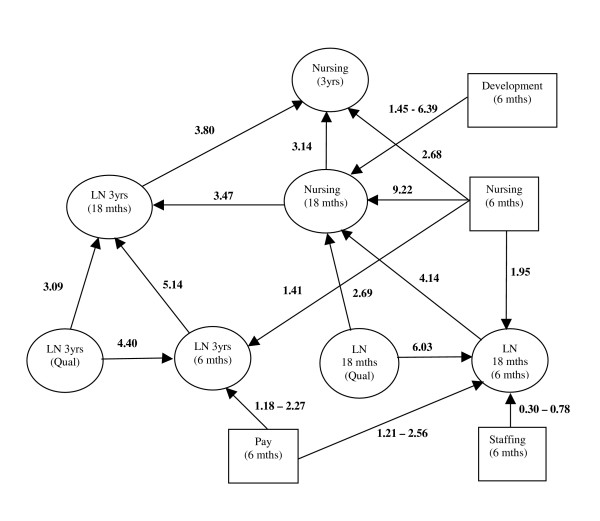
The theory of planned behaviour states that attitudinal variables (e.g. job satisfaction) only have an indirect effect on retention whereas intentions have a direct effect. This study uses secondary data from a longitudinal cohort of newly qualified nurses to test for the direct and indirect effects of job satisfaction (client care, staffing, development, relationships, education, work-life interface, resources, pay) and intentions to nurse on working as a nurse during the 3 years after qualification.
A national sample (England) of newly qualified (1997/98) nurses (n=3669) were surveyed at 6 months, 18 months and 3 years. ANOVA and MANOVA were used for comparison of mean job satisfaction scores between groups; intentions to nurse (very likely, likely vs. unlikely, very unlikely and unable to say at this stage); working (or not working as a nurse) at each time-point. Indirect and direct effects were tested using structural equation and logistic regression models.
Intentions expressed at 6 months to nurse at 18 months were associated with higher scores on pay and relationships, and intentions at 3 years were associated with higher scores on care, development, relationships, work-life interface, resources, pay respectively. Intentions expressed at 18 months to nurse at 3 years were associated with higher scores on development, relationships, education and work-life interface. Associations with actual nursing were fewer. Those working as a nurse had higher satisfaction scores for development (18 months) and relationships (3 years). Regression models found significant associations between the pay and staffing factors and intentions expressed at 6 months to nurse at 18 months, and between pay and intentions to nurse at 3 years. Many of the associations between intentions and working as a nurse were significant. Development was the only job satisfaction factor significantly associated with working as a nurse and just at 18 months.
Results partially support the theory of planned behaviour. Intentions expressed by nurses are stronger predictors of working as a nurse than job satisfaction. Retention strategies should focus on identifying nurses showing early signs of departure with emphasis on developmental aspects, mentoring and support.
计划行为理论指出,态度变量(例如工作满意度)仅对保留有间接影响,而意图则有直接影响。本研究使用一项针对新获得资格的护士的纵向队列的二次数据,测试工作满意度(客户护理、人员配备、发展、关系、教育、工作-生活界面、资源、薪酬)和护理意图(非常可能、可能与不太可能、非常不可能和现阶段无法说)对资格后 3 年内从事护士工作的直接和间接影响。
对 1997/98 年新获得资格的(英格兰)全国样本(n=3669)护士进行了 6 个月、18 个月和 3 年的调查。使用方差分析和多元方差分析比较了不同组之间的平均工作满意度得分;护理意图(非常可能、可能与不太可能、非常不可能和现阶段无法说);每个时间点的工作(或不从事护士工作)。使用结构方程和逻辑回归模型测试了间接和直接影响。
6 个月时表示的护理意图在 18 个月时与薪酬和关系的较高得分相关,而 3 年时的意图与护理意图相关更高的得分与关怀、发展、关系、工作-生活界面、资源、薪酬分别相关。18 个月时表示的护理意图在 3 年时与发展、关系、教育和工作-生活界面的较高得分相关。与实际护理的关联较少。从事护士工作的人对发展(18 个月)和关系(3 年)的满意度得分更高。回归模型发现薪酬和人员配备因素与 6 个月时表示的护理意图与 18 个月时的护理意图之间存在显著关联,以及薪酬与 3 年时的护理意图之间存在显著关联。意图与从事护士工作之间的许多关联都是显著的。发展是唯一与从事护士工作显著相关的工作满意度因素,仅在 18 个月时相关。
结果部分支持计划行为理论。护士表达的意图是从事护士工作的更强预测因素,而不是工作满意度。保留策略应侧重于识别表现出离职早期迹象的护士,重点关注发展方面、指导和支持。