Kennard Betsy D, Emslie Graham J, Mayes Taryn L, Nightingale-Teresi Jeanne, Nakonezny Paul A, Hughes Jennifer L, Jones Jessica M, Tao Rongrong, Stewart Sunita M, Jarrett Robin B
University of Texas Southwestern Medical Center, Dallas, TX 75390-8589, USA.
J Am Acad Child Adolesc Psychiatry. 2008 Dec;47(12):1395-404. doi: 10.1097/CHI.0b013e31818914a1.
We present results of a feasibility test of a sequential treatment strategy using continuation phase cognitive-behavioral therapy (CBT) to prevent relapse in youths with major depressive disorder (MDD) who have responded to acute phase pharmacotherapy.
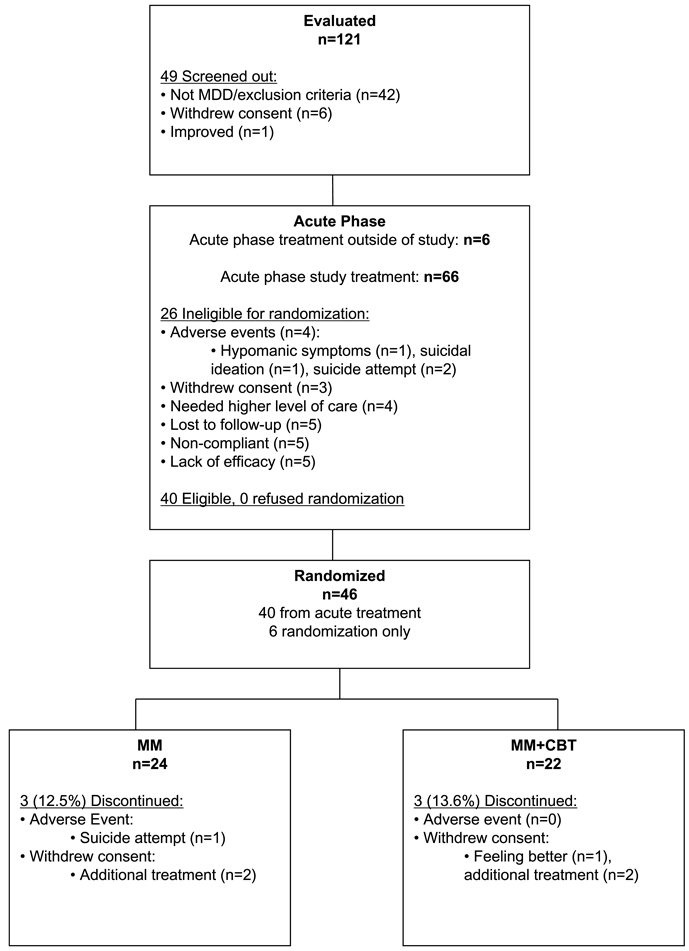
Forty-six youths (ages 11-18 years) who had responded to 12 weeks of treatment with fluoxetine were randomized to receive either 6 months of continued antidepressant medication management (MM) or antidepressant MM plus relapse prevention CBT (MM+CBT). Primary outcome was time to relapse, defined as a Childhood Depression Rating Scale-Revised score of 40 or higher and 2 weeks of symptom worsening or clinical deterioration warranting alteration of treatment to prevent full relapse.
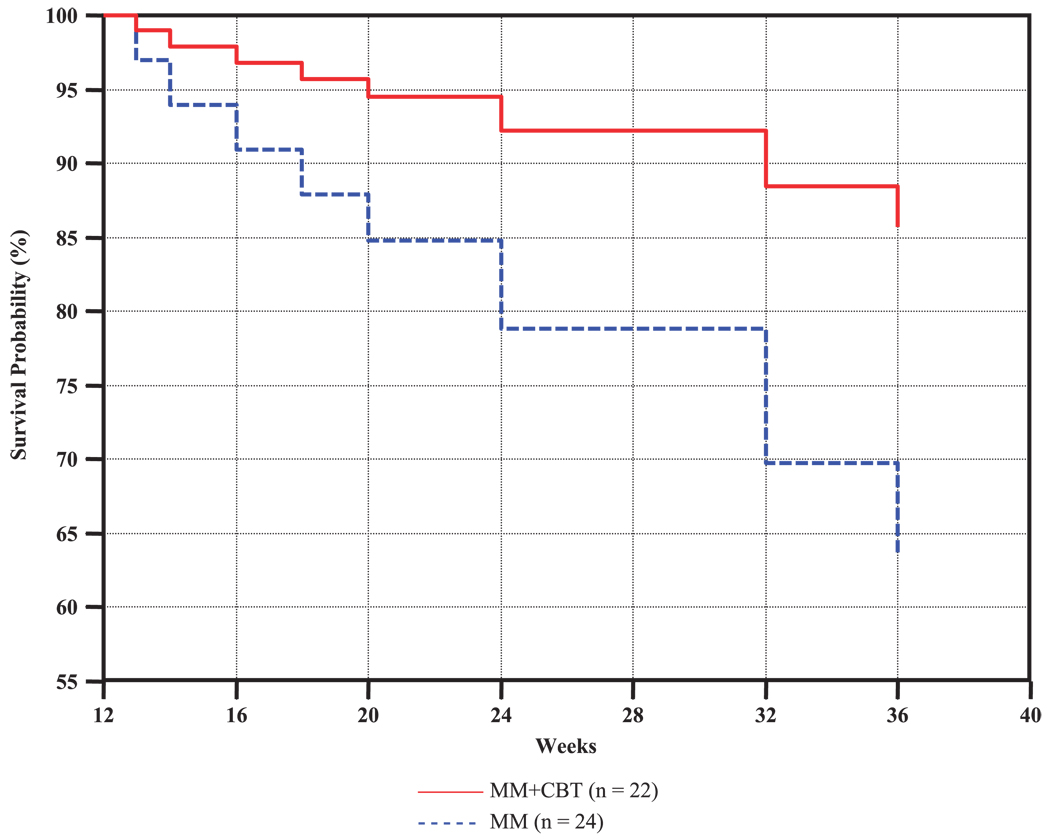
Cox proportional hazards regression, adjusting for depression severity at randomization and for the hazard of relapsing by age across the trial, revealed that participants in the MM treatment group had a significantly greater risk for relapse than those in the MM+CBT treatment group (hazard ratio = 8.80; 95% confidence interval 1.01-76.89; chi = 3.86, p =.049) during 6 months of continuation treatment. In addition, patient satisfaction was significantly higher in the MM+CBT group. No differences were found between the two treatment groups on attrition rate, serious adverse events, and overall global functioning.
These preliminary results suggest that continuation phase CBT reduces the risk for relapse by eightfold compared with pharmacotherapy responders who received antidepressant medication alone during the 6-month continuation phase.
我们展示了一项序贯治疗策略可行性试验的结果,该策略使用延续期认知行为疗法(CBT)来预防对急性期药物治疗有反应的重度抑郁症(MDD)青少年的复发。
46名对氟西汀12周治疗有反应的青少年(年龄11 - 18岁)被随机分配接受6个月的持续抗抑郁药物管理(MM)或抗抑郁药物MM加预防复发CBT(MM + CBT)。主要结局是复发时间,定义为儿童抑郁评定量表修订版得分达到40或更高,且症状恶化或临床衰退持续2周,需要改变治疗以防止完全复发。
在调整随机分组时的抑郁严重程度以及整个试验中按年龄计算的复发风险后,Cox比例风险回归显示,在6个月的延续治疗期间,MM治疗组的参与者复发风险显著高于MM + CBT治疗组(风险比 = 8.80;95%置信区间1.01 - 76.89;卡方 = 3.86,p = 0.049)。此外,MM + CBT组的患者满意度显著更高。在两组治疗组之间,脱落率、严重不良事件和整体总体功能方面未发现差异。
这些初步结果表明,与在6个月延续期仅接受抗抑郁药物治疗的药物治疗反应者相比,延续期CBT将复发风险降低了八倍。