Suppr超能文献

1型糖尿病青少年的养育、自主性与自我照护

Parenting, autonomy and self-care of adolescents with Type 1 diabetes.

作者信息

Dashiff C, Vance D, Abdullatif H, Wallander J

机构信息

School of Nursing, University of Alabama at Birmingham, 1530 3rd South Avenue, Birmingham, AL 35294-1210, USA.

出版信息

Child Care Health Dev. 2009 Jan;35(1):79-88. doi: 10.1111/j.1365-2214.2008.00892.x.

Abstract

BACKGROUND

During adolescence diabetes creates a juncture of very complex disease management demands with developmental needs, including the striving of adolescents for greater autonomy. Parents' concerns and fears about the teen's diabetes self-management abilities during this time can heighten parental attachment behaviour and affect the parents' ability to support autonomy development necessary for effective self-care. Maternal parenting processes may be especially important for those adolescents who have Type 1 diabetes because mothers are the primary caregivers.

PURPOSE

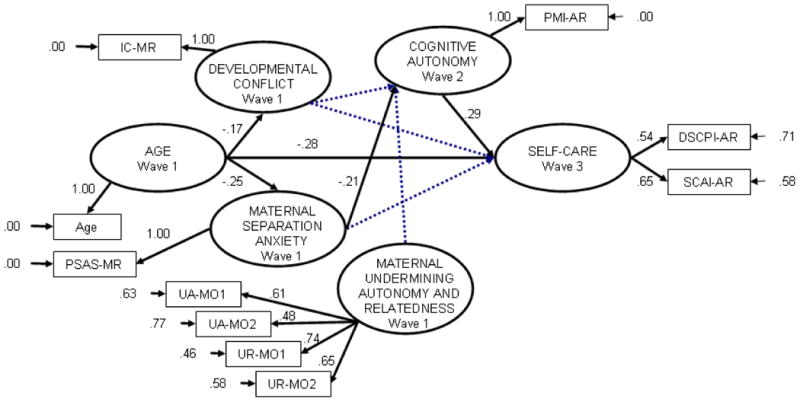
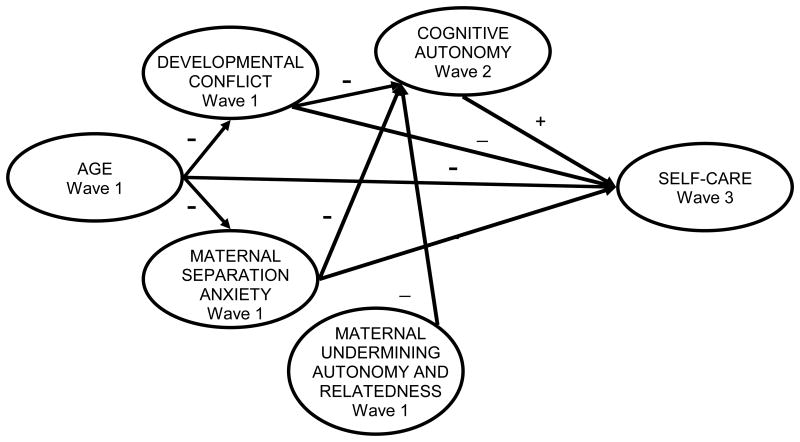
Based on attachment theory, the aim was to test a model of the influence of mother-adolescent developmental conflict, maternal separation anxiety and maternal inhibition of autonomy and relatedness on cognitive autonomy and self-care of adolescents with Type 1 diabetes.

METHOD

A total of 131 families with an adolescent, aged 11-15 years, contributed data annually across three waves. Mothers and adolescents completed paper-and-pencil measures and two interaction scenarios that were coded by trained staff from audio-tapes. The adolescent also completed a structured interview and questionnaire to assess self-care.

RESULTS

Maternal separation anxiety when adolescents were 11-15 years of age directly predicted cognitive autonomy at 1-year follow-up, and that cognitive autonomy was directly related to self-care 1 year later, but did not mediate between separation anxiety and self-care.

CONCLUSIONS

Future investigation of the influence of separation anxiety of parents on adolescent autonomy development is warranted, as well as the contribution of autonomy development to diabetes self-management behaviours of adolescents.

摘要

背景

在青少年时期,糖尿病使得疾病管理需求与发育需求处于一个非常复杂的交汇点,这些发育需求包括青少年对更大自主权的追求。在此期间,父母对青少年糖尿病自我管理能力的担忧和恐惧会加剧父母的依恋行为,并影响父母支持有效自我护理所需的自主发展的能力。对于患有1型糖尿病的青少年来说,母亲的养育过程可能尤为重要,因为母亲是主要的照顾者。

目的

基于依恋理论,旨在检验一个模型,该模型涉及母亲-青少年发育冲突、母亲的分离焦虑以及母亲对自主性和亲密关系的抑制对1型糖尿病青少年的认知自主性和自我护理的影响。

方法

共有131个家庭参与研究,这些家庭中的青少年年龄在11至15岁之间,研究分三个阶段每年收集数据。母亲和青少年完成纸笔测试以及两个互动场景,由训练有素的工作人员根据录音带进行编码。青少年还完成了一次结构化访谈和问卷调查,以评估自我护理情况。

结果

青少年11至15岁时母亲的分离焦虑直接预测了1年后的认知自主性,且认知自主性与1年后的自我护理直接相关,但在分离焦虑和自我护理之间没有起到中介作用。

结论

有必要进一步研究父母的分离焦虑对青少年自主发展的影响,以及自主发展对青少年糖尿病自我管理行为的作用。
相似文献

1
Parenting, autonomy and self-care of adolescents with Type 1 diabetes.
Child Care Health Dev. 2009 Jan;35(1):79-88. doi: 10.1111/j.1365-2214.2008.00892.x.
2
Parent-adolescent dyads: association of parental autonomy support and parent-adolescent shared diabetes care responsibility.
Child Care Health Dev. 2013 Sep;39(5):695-702. doi: 10.1111/j.1365-2214.2012.01373.x. Epub 2012 Mar 1.
3
Longitudinal Association between Maternal Autonomy Support and Controlling Parenting and Adolescents' Depressive Symptoms.
J Youth Adolesc. 2023 May;52(5):1058-1073. doi: 10.1007/s10964-022-01722-1. Epub 2023 Jan 19.
6
The management of autonomy in adolescent diabetes: a case study of triadic medical interaction.
Health (London). 2009 Mar;13(2):175-96. doi: 10.1177/1363459308099683.
8
The role of autonomy-supportive parenting in the competence, adherence and glycemic control of adolescents with type 1 diabetes.
Diabetes Res Clin Pract. 2021 Mar;173:108679. doi: 10.1016/j.diabres.2021.108679. Epub 2021 Jan 28.

引用本文的文献

6
Self-management in patients with inflammatory bowel disease: strategies, outcomes, and integration into clinical care.
Clin Exp Gastroenterol. 2016 Aug 23;9:259-67. doi: 10.2147/CEG.S106302. eCollection 2016.
7
Moving the Journey Towards Independence: Adolescents Transitioning to Successful Diabetes Self-Management.
J Pediatr Nurs. 2015 Sep-Oct;30(5):648-60. doi: 10.1016/j.pedn.2015.06.005. Epub 2015 Jul 17.
8
Patterns of self-management in pediatric type 1 diabetes predict level of glycemic control 2 years later.
J Dev Behav Pediatr. 2013 Apr;34(3):186-96. doi: 10.1097/DBP.0b013e318287cb48.
10
Diabetes management and glycemic control in youth with type 1 diabetes: test of a predictive model.
J Behav Med. 2013 Jun;36(3):234-45. doi: 10.1007/s10865-012-9426-0. Epub 2012 May 9.

本文引用的文献

1
The measurement and structure of psychosocial maturity.
J Youth Adolesc. 1975 Jun;4(2):127-43. doi: 10.1007/BF01537437.
2
Toward a concept of psychosocial maturity.
J Youth Adolesc. 1974 Dec;3(4):329-58. doi: 10.1007/BF02214746.
3
The extent and function of parental attachment among first-year college students.
J Youth Adolesc. 1987 Feb;16(1):17-29. doi: 10.1007/BF02141544.
4
Parental attachment and emotional distress in the transition to college.
J Youth Adolesc. 1991 Aug;20(4):427-40. doi: 10.1007/BF01537184.
5
Development and testing of a scale to measure separation anxiety of parents of adolescents.
J Nurs Meas. 2008;16(1):61-80. doi: 10.1891/1061-3749.16.1.61.
6
Parent-adolescent communication and diabetes: an integrative review.
J Adv Nurs. 2008 Apr;62(2):140-62. doi: 10.1111/j.1365-2648.2007.04549.x.
8
Maternal trait anxiety and diabetes control in adolescents with type 1 diabetes.
J Pediatr Psychol. 2007 Aug;32(7):733-44. doi: 10.1093/jpepsy/jsl053. Epub 2007 Jan 29.
9
Predictors of fear of hypoglycemia in adolescents with type 1 diabetes and their parents.
Pediatr Diabetes. 2006 Aug;7(4):215-22. doi: 10.1111/j.1399-5448.2006.00182.x.
10
Decision-making competence and adherence to treatment in adolescents with diabetes.
J Pediatr Psychol. 2007 Mar;32(2):178-88. doi: 10.1093/jpepsy/jsj122. Epub 2006 May 22.

文献AI研究员

20分钟写一篇综述,助力文献阅读效率提升50倍。

立即体验

用中文搜PubMed

大模型驱动的PubMed中文搜索引擎

马上搜索

文档翻译

学术文献翻译模型,支持多种主流文档格式。

立即体验