Tito Raúl Y, Macmil Simone, Wiley Graham, Najar Fares, Cleeland Lauren, Qu Chunmei, Wang Ping, Romagne Frederic, Leonard Sylvain, Ruiz Agustín Jiménez, Reinhard Karl, Roe Bruce A, Lewis Cecil M
Department of Anthropology, University of Oklahoma, Norman, OK, USA.
PLoS One. 2008;3(11):e3703. doi: 10.1371/journal.pone.0003703. Epub 2008 Nov 11.
The Human Microbiome Project (HMP) is one of the U.S. National Institutes of Health Roadmap for Medical Research. Primary interests of the HMP include the distinctiveness of different gut microbiomes, the factors influencing microbiome diversity, and the functional redundancies of the members of human microbiotas. In this present work, we contribute to these interests by characterizing two extinct human microbiotas.
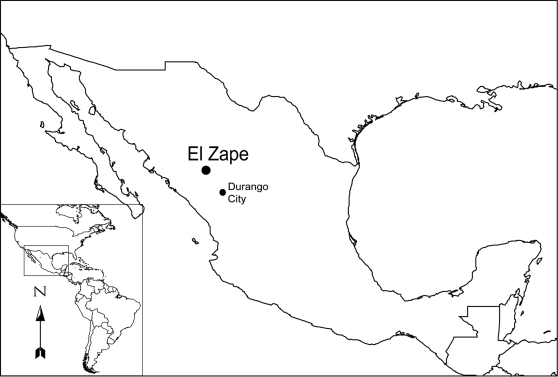
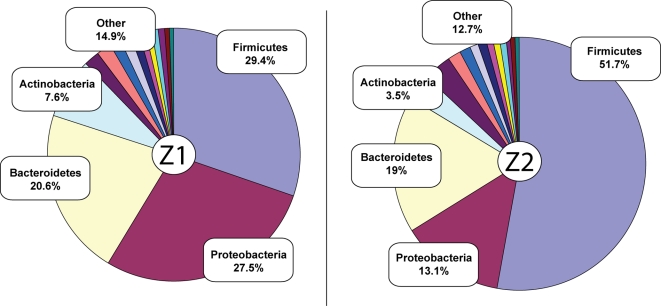
METHODOLOGY/PRINCIPAL FINDINGS: We examine two paleofecal samples originating from cave deposits in Durango Mexico and dating to approximately 1300 years ago. Contamination control is a serious issue in ancient DNA research; we use a novel approach to control contamination. After we determined that each sample originated from a different human, we generated 45 thousand shotgun DNA sequencing reads. The phylotyping and functional analysis of these reads reveals a signature consistent with the modern gut ecology. Interestingly, inter-individual variability for phenotypes but not functional pathways was observed. The two ancient samples have more similar functional profiles to each other than to a recently published profile for modern humans. This similarity could not be explained by a chance sampling of the databases.
CONCLUSIONS/SIGNIFICANCE: We conduct a phylotyping and functional analysis of ancient human microbiomes, while providing novel methods to control for DNA contamination and novel hypotheses about past microbiome biogeography. We postulate that natural selection has more of an influence on microbiome functional profiles than it does on the species represented in the microbial ecology. We propose that human microbiomes were more geographically structured during pre-Columbian times than today.
人类微生物组计划(HMP)是美国国立卫生研究院医学研究路线图的一部分。HMP的主要研究兴趣包括不同肠道微生物组的独特性、影响微生物组多样性的因素以及人类微生物群成员的功能冗余性。在本研究中,我们通过对两个已灭绝的人类微生物群进行特征分析,为这些研究兴趣做出了贡献。
方法/主要发现:我们检测了两份源自墨西哥杜兰戈洞穴沉积物、可追溯至约1300年前的古粪便样本。污染控制是古代DNA研究中的一个严重问题;我们采用了一种新颖的方法来控制污染。在确定每个样本都来自不同个体后,我们生成了4.5万个鸟枪法DNA测序读数。对这些读数的系统发育分型和功能分析揭示了与现代肠道生态一致的特征。有趣的是,观察到表型存在个体间差异,但功能途径没有。这两个古代样本彼此之间的功能谱比最近发表的现代人类功能谱更为相似。这种相似性无法用数据库的随机抽样来解释。
结论/意义:我们对古代人类微生物组进行了系统发育分型和功能分析,同时提供了控制DNA污染的新方法以及关于过去微生物组生物地理学的新假设。我们推测,自然选择对微生物组功能谱的影响比对微生物生态学中所代表物种的影响更大。我们提出,在哥伦布发现美洲大陆之前,人类微生物组在地理上的结构比现在更为明显。