Domenici Paolo, Booth David, Blagburn Jonathan M, Bacon Jonathan P
Istituto per l'Ambiente Marino Costiero, Consiglio Nazionale delle Ricerche, Localita Sa Mardini, 09072 Torregrande-Oristano, Italy.
Curr Biol. 2008 Nov 25;18(22):1792-6. doi: 10.1016/j.cub.2008.09.062. Epub 2008 Nov 13.
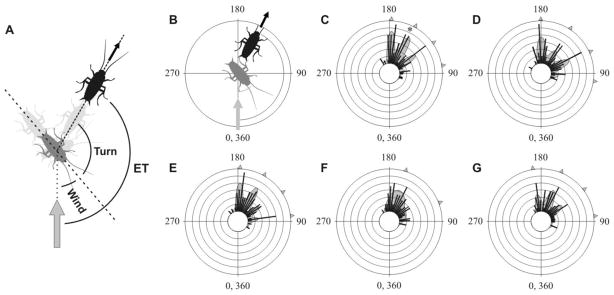
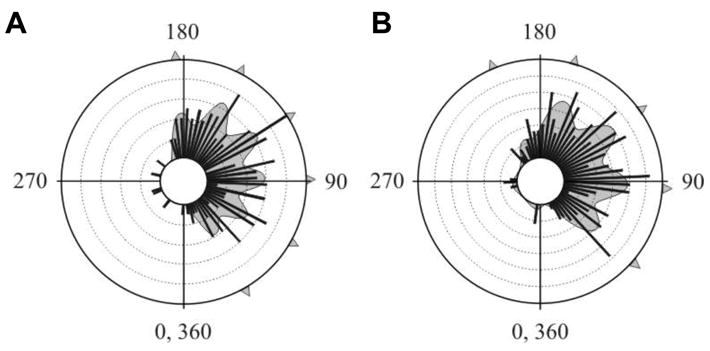
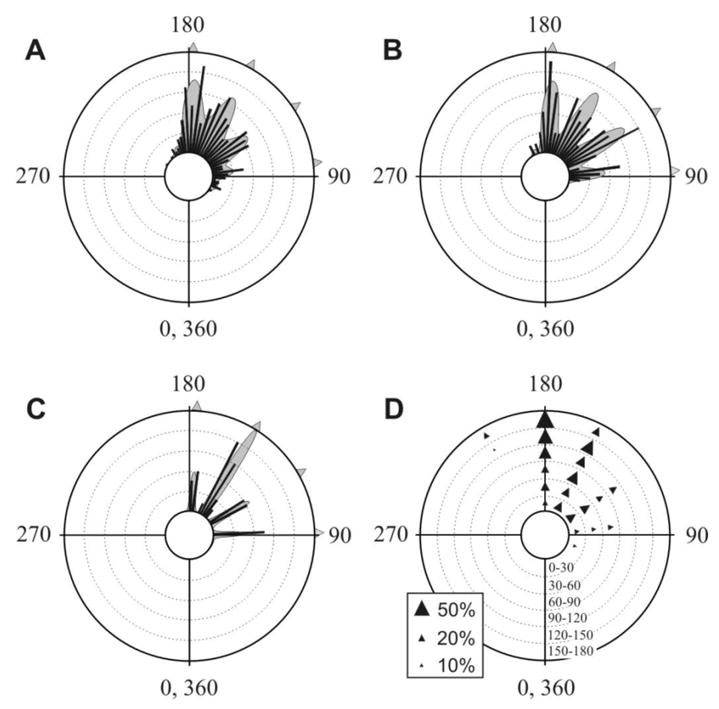
Antipredator behavior is vital for most animals and calls for accurate timing and swift motion. Whereas fast reaction times [1] and predictable, context-dependent escape-initiation distances [2] are common features of most escape systems, previous work has highlighted the need for unpredictability in escape directions, in order to prevent predators from learning a repeated, fixed pattern [3-5]. Ultimate unpredictability would result from random escape trajectories. Although this strategy would deny any predictive power to the predator, it would also result in some escape trajectories toward the threat. Previous work has shown that escape trajectories are in fact generally directed away from the threat, although with a high variability [5-8]. However, the rules governing this variability are largely unknown. Here, we demonstrate that individual cockroaches (Periplaneta americana, a much-studied model prey species [9-14]) keep each escape unpredictable by running along one of a set of preferred trajectories at fixed angles from the direction of the threatening stimulus. These results provide a new paradigm for understanding the behavioral strategies for escape responses, underscoring the need to revisit the neural mechanisms controlling escape directions in the cockroach and similar animal models, and the evolutionary forces driving unpredictable, or "protean"[3], antipredator behavior.
反捕食行为对大多数动物来说至关重要,需要精确的时机把握和迅速的行动。虽然快速反应时间[1]以及可预测的、依赖于环境的逃逸起始距离[2]是大多数逃逸系统的共同特征,但先前的研究强调了逃逸方向需要不可预测性,以防止捕食者学会重复的固定模式[3 - 5]。最终的不可预测性将源于随机的逃逸轨迹。尽管这种策略会剥夺捕食者的任何预测能力,但也会导致一些朝向威胁的逃逸轨迹。先前的研究表明,逃逸轨迹实际上通常是远离威胁的,尽管具有很大的变异性[5 - 8]。然而,控制这种变异性的规则在很大程度上尚不清楚。在这里,我们证明了个体蟑螂(美洲大蠊,一种经过大量研究的模式猎物物种[9 - 14])通过沿着一组与威胁刺激方向成固定角度的首选轨迹之一奔跑,使每次逃逸都具有不可预测性。这些结果为理解逃逸反应的行为策略提供了一个新的范例,强调了有必要重新审视控制蟑螂及类似动物模型中逃逸方向的神经机制,以及驱动不可预测的或“多变的”[3]反捕食行为的进化力量。