Ho Bosco K, Gruswitz Franz
Department of Biochemistry and Biophysics, Howard Hughes Medical Institute, University of California, San Francisco, San Francisco, CA 94158-2517, USA.
BMC Struct Biol. 2008 Nov 14;8:49. doi: 10.1186/1472-6807-8-49.
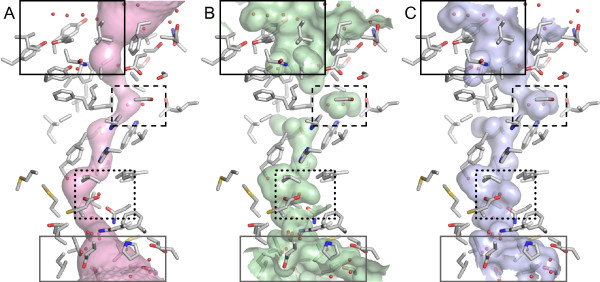
An accurate rendering of interior surfaces can facilitate the analysis of mechanisms at atomic-level detail, such as the transport of substrates in the ammonia channel. In molecular viewers, one must remove the exterior surface that obscures the channel surface by clipping the viewing plane or manually selecting the channel residues in order to display a partial surface. Neither method is entirely satisfactory, as unwanted additional pieces of surfaces are always generated.
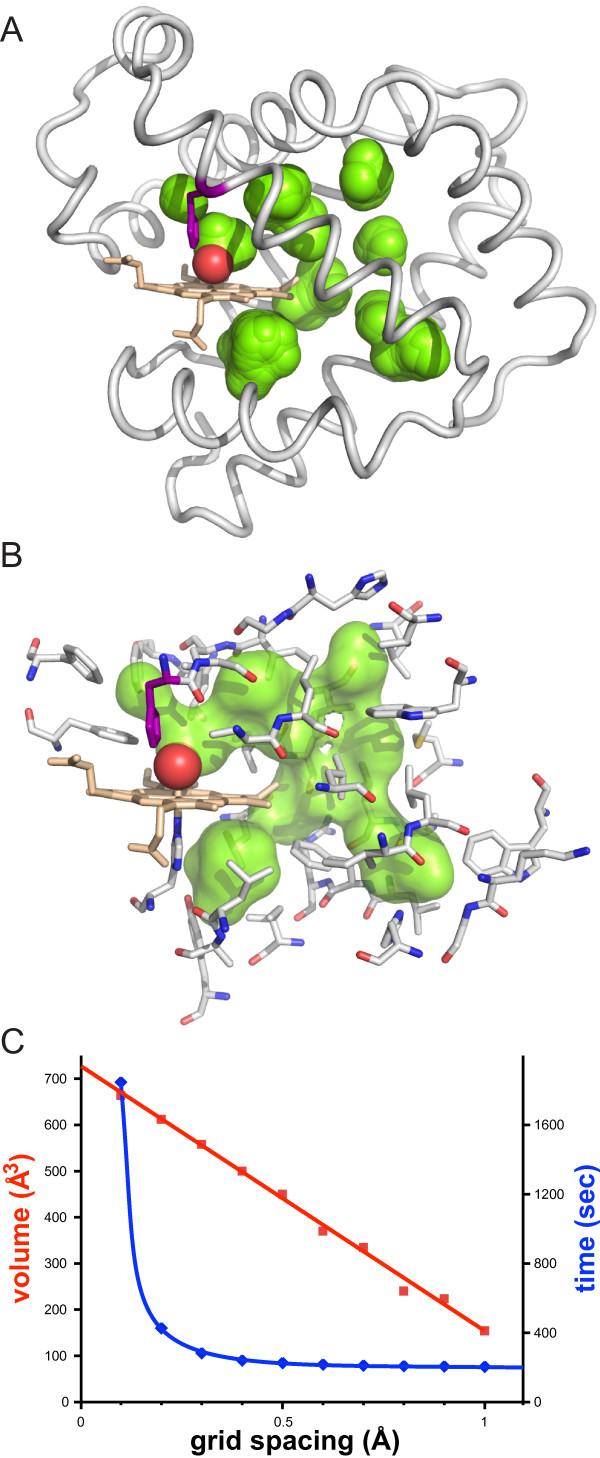
To cleanly visualize a channel surface, we present HOLLOW, a program that generates a "casting" of the interior volume of the protein as dummy atoms. We show that the molecular surface of the dummy atoms closely approximates the channel surface, where this complementary surface of the protein channel can be displayed without superfluous surfaces.
The use of HOLLOW significantly simplifies the generation of channel surfaces, and other interior surfaces of protein structures. HOLLOW is written in PYTHON and is available at http://hollow.sourceforge.net.
精确呈现内部表面有助于在原子级细节上分析机制,比如氨通道中底物的运输。在分子查看器中,为了显示部分表面,必须通过裁剪视平面或手动选择通道残基来去除遮挡通道表面的外部表面。这两种方法都不尽如人意,因为总会产生不需要的额外表面碎片。
为了清晰地可视化通道表面,我们展示了HOLLOW,这是一个将蛋白质内部体积“投射”为虚拟原子的程序。我们表明,虚拟原子的分子表面与通道表面非常接近,蛋白质通道的这种互补表面可以在没有多余表面的情况下显示。
HOLLOW的使用显著简化了通道表面以及蛋白质结构其他内部表面的生成。HOLLOW用PYTHON编写,可从http://hollow.sourceforge.net获取。