Richter Stefan, Anderson Valerie J, Garufi Gabriella, Lu Lianghua, Budzik Jonathan M, Joachimiak Andrzej, He Chuan, Schneewind Olaf, Missiakas Dominique
Department of Microbiology, University of Chicago, Chicago, IL 60637, USA.
Mol Microbiol. 2009 Jan;71(2):404-20. doi: 10.1111/j.1365-2958.2008.06533.x. Epub 2008 Nov 11.
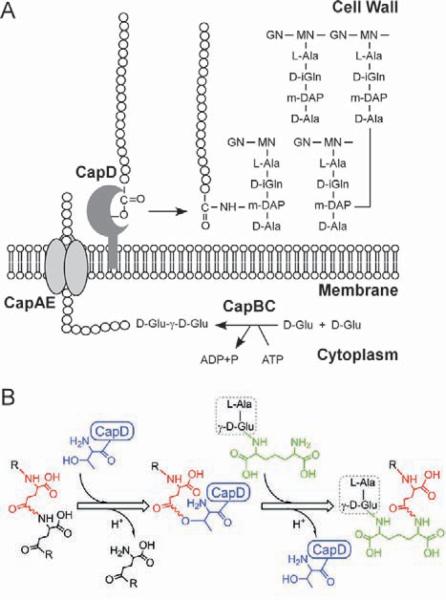
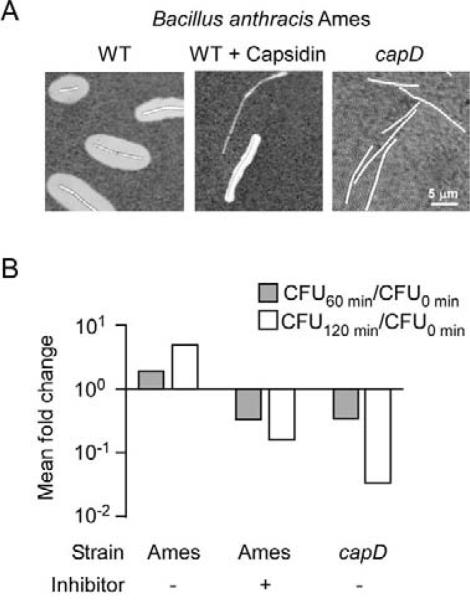
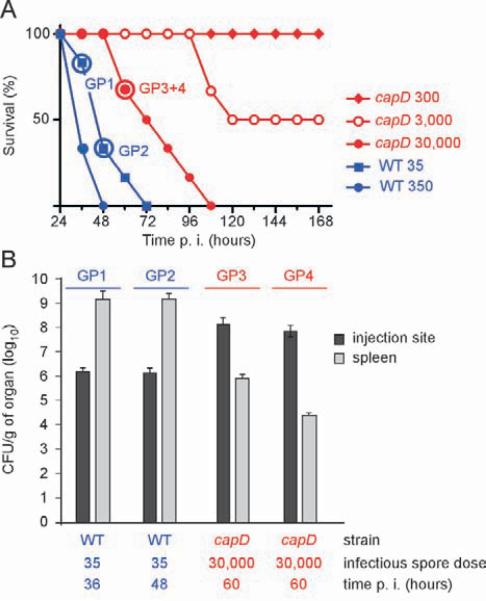
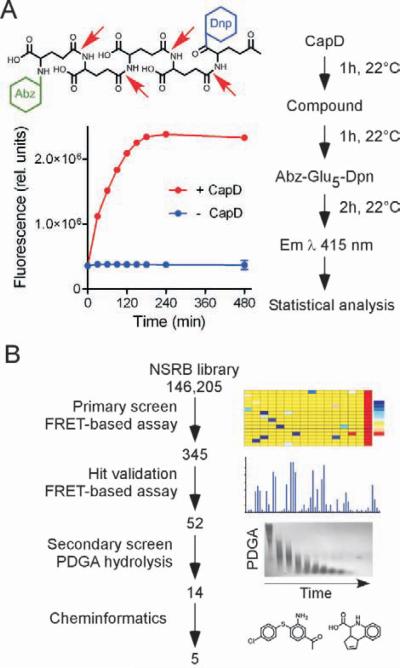
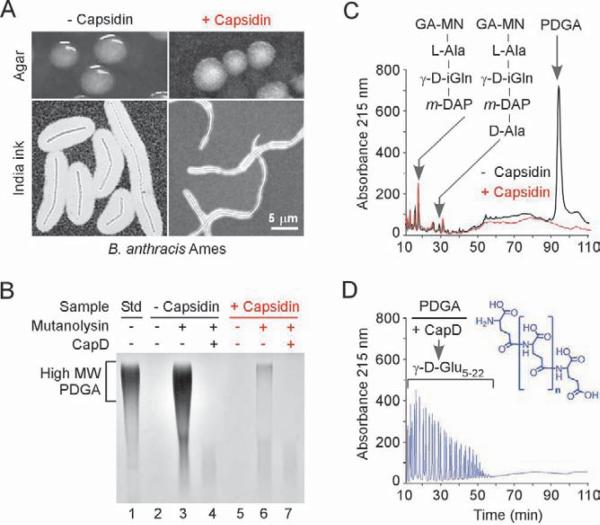
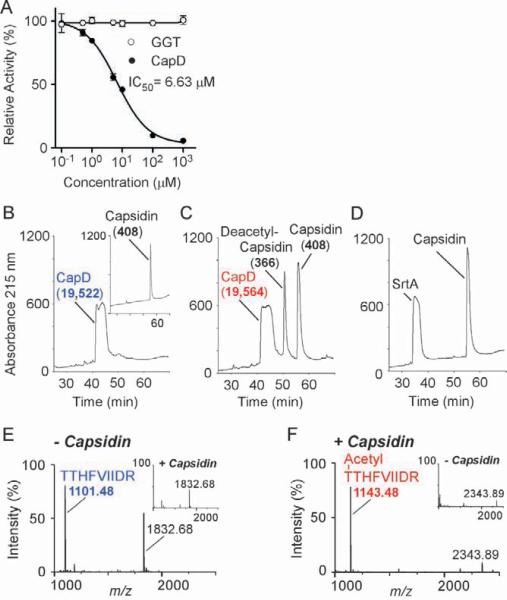
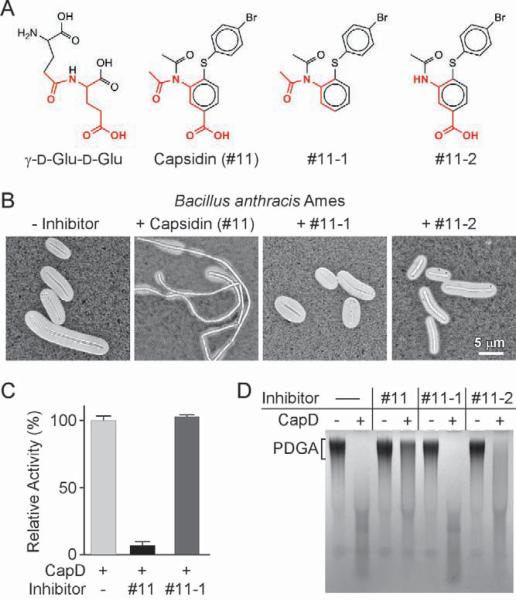
Bacillus anthracis, the causative agent of anthrax, is a dangerous biological weapon, as spores derived from drug-resistant strains cause infections for which antibiotic therapy is no longer effective. We sought to develop an anti-infective therapy for anthrax and targeted CapD, an enzyme that cleaves poly-gamma-D-glutamate capsule and generates amide bonds with peptidoglycan cross-bridges to deposit capsular material into the envelope of B. anthracis. In agreement with the model that capsule confers protection from phagocytic clearance, B. anthracis capD variants failed to deposit capsule into the envelope and displayed defects in anthrax pathogenesis. By screening chemical libraries, we identified the CapD inhibitor capsidin, 4-[(4-bromophenyl)thio]-3-(diacetylamino)benzoic acid), which covalently modifies the active-site threonine of the transpeptidase. Capsidin treatment blocked capsular assembly by B. anthracis and enabled phagocytic killing of non-encapsulated vegetative forms.
炭疽芽孢杆菌是炭疽病的病原体,是一种危险的生物武器,因为耐药菌株产生的孢子会引发感染,而抗生素疗法对这些感染已不再有效。我们试图开发一种针对炭疽病的抗感染疗法,并将目标锁定在CapD上,CapD是一种能切割聚γ-D-谷氨酸荚膜并与肽聚糖交联桥形成酰胺键,从而将荚膜物质沉积到炭疽芽孢杆菌包膜中的酶。与荚膜可保护细菌免受吞噬清除的模型一致,炭疽芽孢杆菌的CapD变体无法将荚膜沉积到包膜中,并且在炭疽病发病机制中表现出缺陷。通过筛选化学文库,我们鉴定出CapD抑制剂衣壳素(4-[(4-溴苯基)硫代]-3-(二乙酰氨基)苯甲酸),它可共价修饰转肽酶的活性位点苏氨酸。衣壳素处理可阻止炭疽芽孢杆菌的荚膜组装,并使吞噬细胞能够杀死无荚膜的营养体形式。