Lin Weihong, Ezekwe Ejiofor A D, Zhao Zhen, Liman Emily R, Restrepo Diego
Department of Biological Sciences, University of Maryland, Baltimore County, Baltimore, MD 21250, USA.
BMC Neurosci. 2008 Nov 24;9:114. doi: 10.1186/1471-2202-9-114.
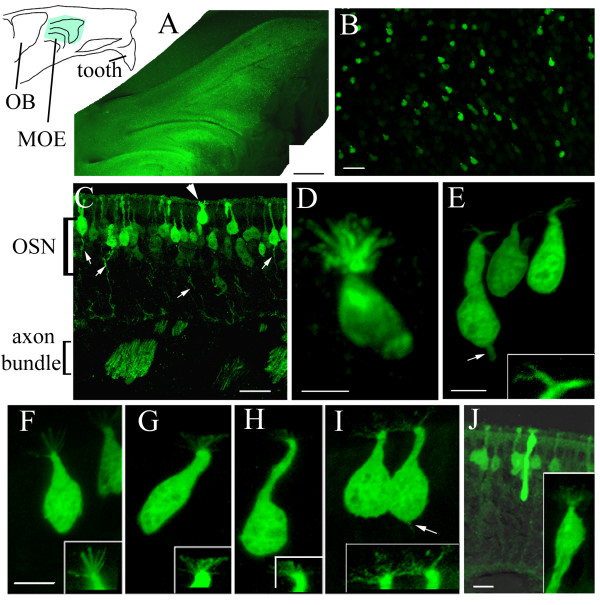
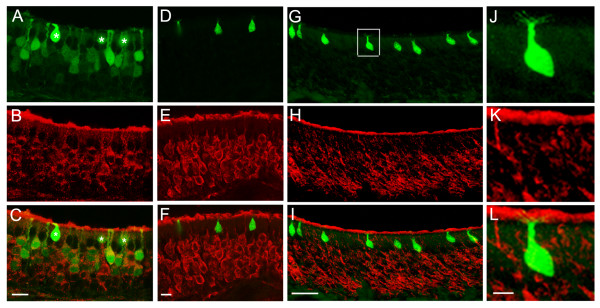
The main olfactory epithelium (MOE) in the nasal cavity detects a variety of air borne molecules that provide information regarding the presence of food, predators and other relevant social and environmental factors. Within the epithelium are ciliated sensory neurons, supporting cells, basal cells and microvillous cells, each of which is distinct in morphology and function. Arguably, the least understood, are the microvillous cells, a population of cells that are small in number and whose function is not known. We previously found that in a mouse strain in which the TRPM5 promoter drives expression of the green fluorescent protein (GFP), a population of ciliated olfactory sensory neurons (OSNs), as well as a population of cells displaying microvilli-like structures is labeled. Here we examined the morphology and immunocytochemical properties of these microvillous-like cells using immunocytochemical methods.
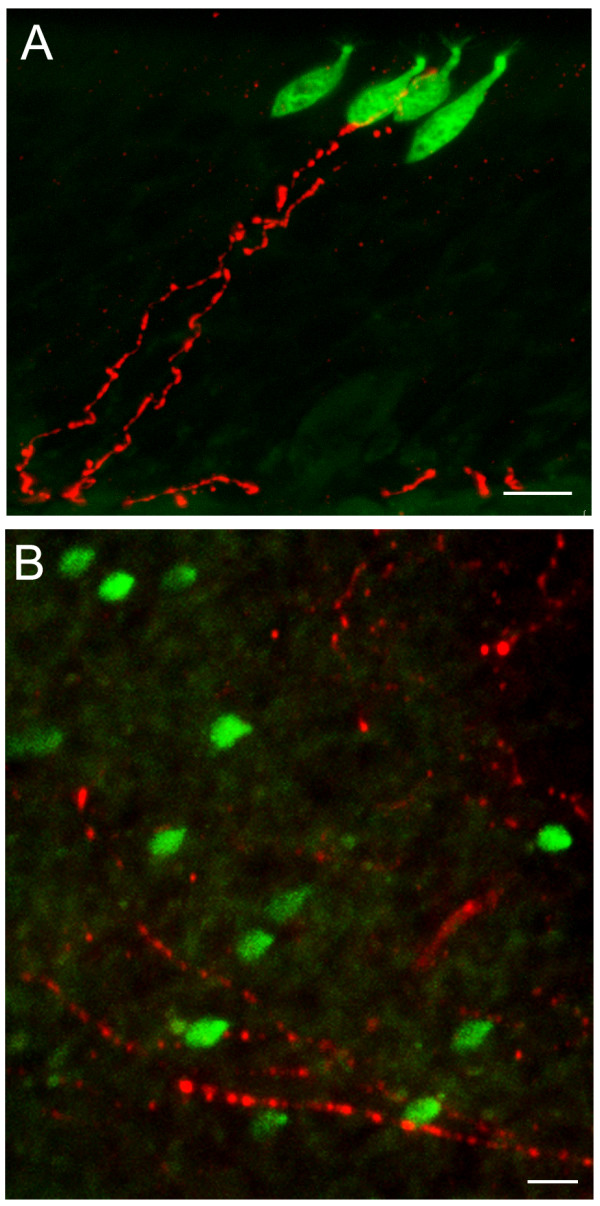
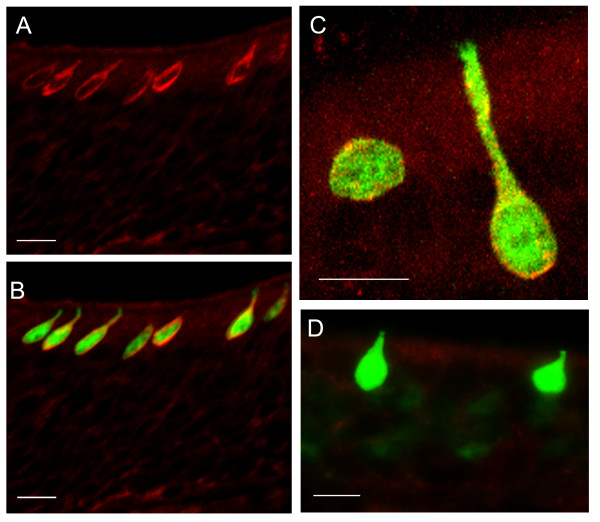
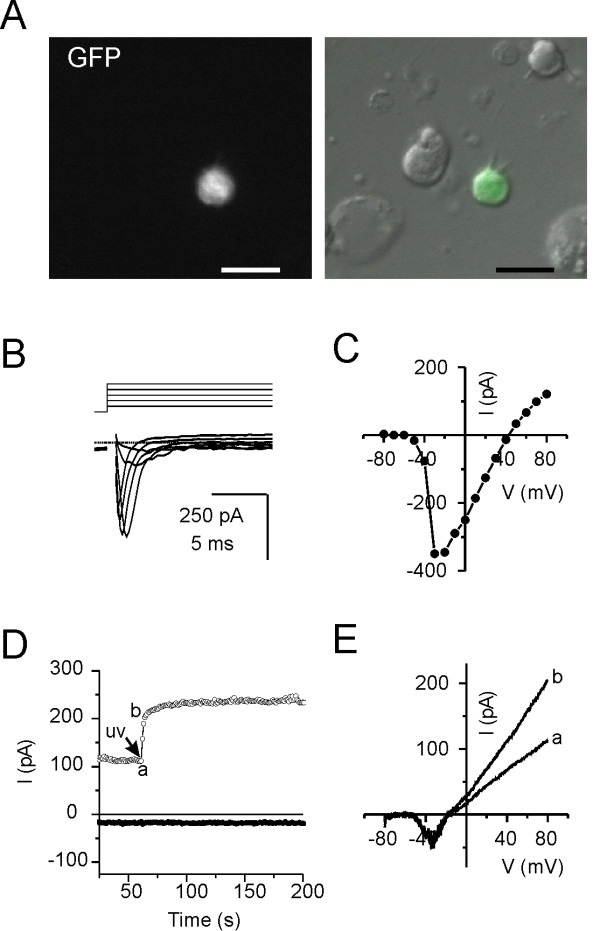
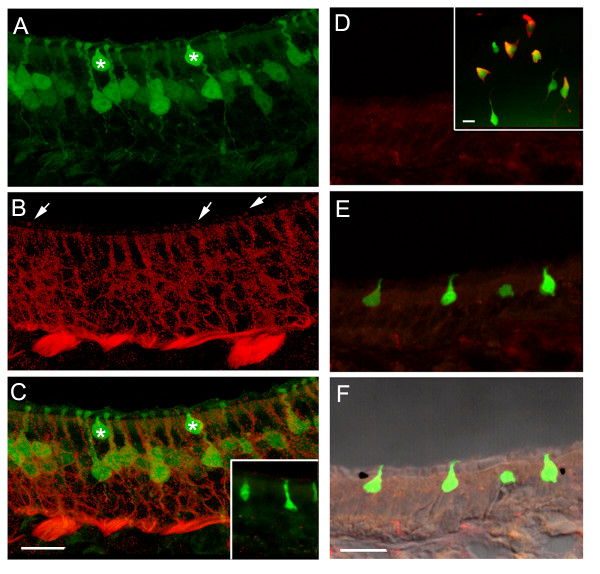
We show that the GFP-positive microvillous cells were morphologically diversified and scattered throughout the entire MOE. These cells immunoreacted to an antibody against TRPM5, confirming the expression of this ion channel in these cells. In addition, they showed a Ca2+-activated non-selective cation current in electrophysiological recordings. They did not immunoreact to antibodies that label cell markers and elements of the transduction pathways from olfactory sensory neurons and solitary chemosensory cells of the nasal cavity. Further, the TRPM5-expressing cells did not display axon-like processes and were not labeled with a neuronal marker nor did trigeminal peptidergic nerve fibers innervate these cells.
We provide morphological and immunocytochemical characterization of the TRPM5-expressing microvillous cells in the main olfactory epithelium. Our data demonstrate that these cells are non-neuronal and in terms of chemosensory transduction do not resemble the TRPM5-expressing olfactory sensory neurons and nasal solitary chemosensory cells.
鼻腔中的主嗅觉上皮(MOE)可检测多种空气中的分子,这些分子提供有关食物、捕食者以及其他相关社会和环境因素存在的信息。上皮内有纤毛感觉神经元、支持细胞、基底细胞和微绒毛细胞,它们在形态和功能上各不相同。可以说,了解最少的是微绒毛细胞,其数量较少且功能未知。我们之前发现,在一种小鼠品系中,TRPM5启动子驱动绿色荧光蛋白(GFP)的表达,一群纤毛嗅觉感觉神经元(OSN)以及一群显示微绒毛样结构的细胞被标记。在这里,我们使用免疫细胞化学方法研究了这些微绒毛样细胞的形态和免疫细胞化学特性。
我们发现GFP阳性的微绒毛细胞在形态上具有多样性,且分散在整个主嗅觉上皮中。这些细胞与抗TRPM5抗体发生免疫反应,证实了该离子通道在这些细胞中的表达。此外,在电生理记录中它们显示出钙激活的非选择性阳离子电流。它们不与标记鼻腔嗅觉感觉神经元和单个化学感受细胞的细胞标志物及转导途径元件的抗体发生免疫反应。此外,表达TRPM5的细胞未显示出轴突样突起,也未被神经元标志物标记,三叉神经肽能神经纤维也未支配这些细胞。
我们提供了主嗅觉上皮中表达TRPM5的微绒毛细胞的形态和免疫细胞化学特征。我们的数据表明,这些细胞是非神经元细胞,在化学感受转导方面与表达TRPM5的嗅觉感觉神经元和鼻腔单个化学感受细胞不同。