Moraru I I, Schaff J C, Slepchenko B M, Blinov M L, Morgan F, Lakshminarayana A, Gao F, Li Y, Loew L M
University of Connecticut Health Center, Center of Cell Analysis and Modeling, Connecticut, CA 06030, USA.
IET Syst Biol. 2008 Sep;2(5):352-62. doi: 10.1049/iet-syb:20080102.
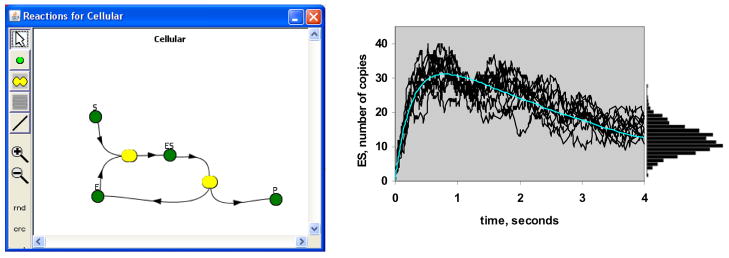
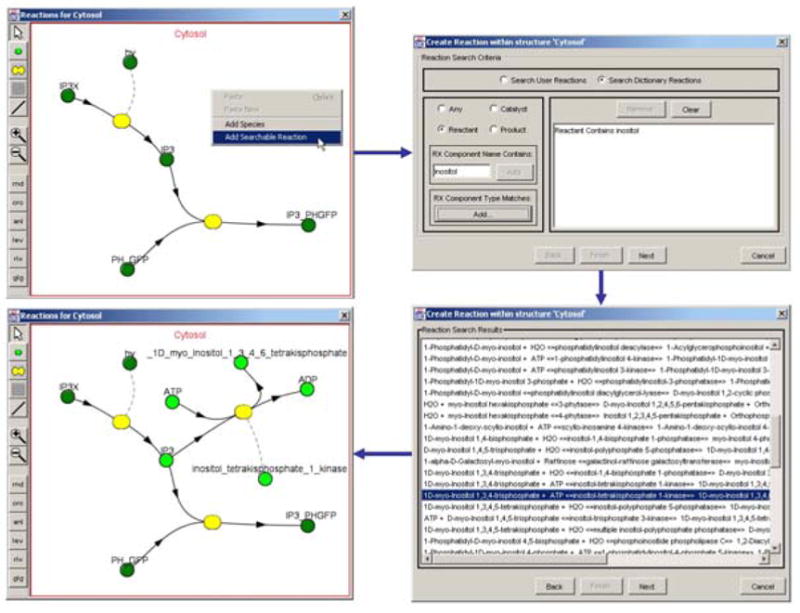
The Virtual Cell (VCell; http://vcell.org/) is a problem solving environment, built on a central database, for analysis, modelling and simulation of cell biological processes. VCell integrates a growing range of molecular mechanisms, including reaction kinetics, diffusion, flow, membrane transport, lateral membrane diffusion and electrophysiology, and can associate these with geometries derived from experimental microscope images. It has been developed and deployed as a web-based, distributed, client-server system, with more than a thousand world-wide users. VCell provides a separation of layers (core technologies and abstractions) representing biological models, physical mechanisms, geometry, mathematical models and numerical methods. This separation clarifies the impact of modelling decisions, assumptions and approximations. The result is a physically consistent, mathematically rigorous, spatial modelling and simulation framework. Users create biological models and VCell will automatically (i) generate the appropriate mathematical encoding for running a simulation and (ii) generate and compile the appropriate computer code. Both deterministic and stochastic algorithms are supported for describing and running non-spatial simulations; a full partial differential equation solver using the finite volume numerical algorithm is available for reaction-diffusion-advection simulations in complex cell geometries including 3D geometries derived from microscope images. Using the VCell database, models and model components can be reused and updated, as well as privately shared among collaborating groups, or published. Exchange of models with other tools is possible via import/export of SBML, CellML and MatLab formats. Furthermore, curation of models is facilitated by external database binding mechanisms for unique identification of components and by standardised annotations compliant with the MIRIAM standard. VCell is now open source, with its native model encoding language (VCML) being a public specification, which stands as the basis for a new generation of more customised, experiment-centric modelling tools using a new plug-in based platform.
虚拟细胞(VCell;http://vcell.org/)是一个基于中央数据库构建的问题解决环境,用于细胞生物学过程的分析、建模和模拟。VCell整合了越来越多的分子机制,包括反应动力学、扩散、流动、膜运输、膜侧向扩散和电生理学,并可将这些机制与从实验显微镜图像中获取的几何结构相关联。它已被开发并部署为基于网络的分布式客户端 - 服务器系统,全球有超过一千名用户。VCell提供了表示生物模型、物理机制、几何结构、数学模型和数值方法的分层(核心技术和抽象)。这种分层明确了建模决策、假设和近似的影响。其结果是一个物理上一致、数学上严谨的空间建模和模拟框架。用户创建生物模型,VCell将自动(i)生成用于运行模拟的适当数学编码,以及(ii)生成并编译适当的计算机代码。支持确定性和随机算法来描述和运行非空间模拟;对于复杂细胞几何结构(包括从显微镜图像导出的3D几何结构)中的反应 - 扩散 - 平流模拟,提供了使用有限体积数值算法的完整偏微分方程求解器。利用VCell数据库,模型和模型组件可以被重用、更新,也可以在合作团队之间私下共享或发布。通过导入/导出SBML、CellML和MatLab格式,可以与其他工具交换模型。此外,通过用于组件唯一标识的外部数据库绑定机制以及符合MIRIAM标准的标准化注释,促进了模型的管理。VCell现在是开源的,其原生模型编码语言(VCML)是一个公共规范,它是新一代更定制化、以实验为中心的建模工具的基础,这些工具使用新的基于插件的平台。