Demark-Wahnefried Wendy, Polascik Thomas J, George Stephen L, Switzer Boyd R, Madden John F, Ruffin Mack T, Snyder Denise C, Owzar Kouros, Hars Vera, Albala David M, Walther Philip J, Robertson Cary N, Moul Judd W, Dunn Barbara K, Brenner Dean, Minasian Lori, Stella Philip, Vollmer Robin T
Division of Cancer Prevention and Population Sciences, The University of Texas M. D. Anderson Cancer Center, P.O. Box 301439, Unit 1330, Houston, TX 77230-1439, USA.
Cancer Epidemiol Biomarkers Prev. 2008 Dec;17(12):3577-87. doi: 10.1158/1055-9965.EPI-08-0008.
Prostate cancer affects one of six men during their lifetime. Dietary factors are postulated to influence the development and progression of prostate cancer. Low-fat diets and flaxseed supplementation may offer potentially protective strategies.
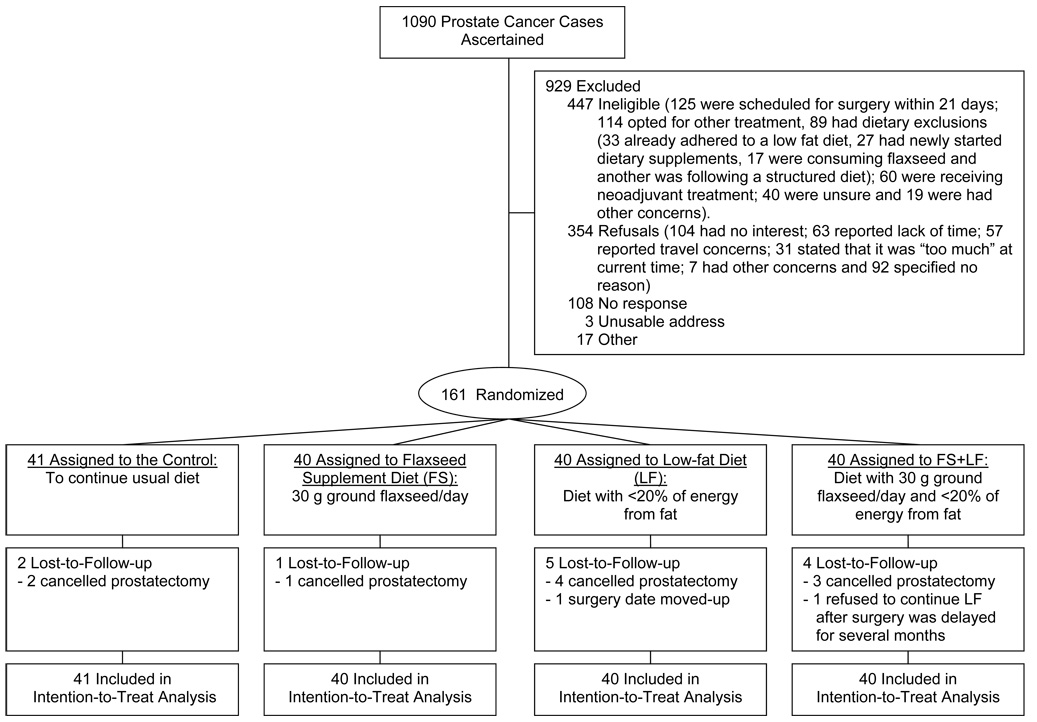
We undertook a multisite, randomized controlled trial to test the effects of low-fat and/or flaxseed-supplemented diets on the biology of the prostate and other biomarkers. Prostate cancer patients (n = 161) scheduled at least 21 days before prostatectomy were randomly assigned to one of the following arms: (a) control (usual diet), (b) flaxseed-supplemented diet (30 g/d), (c) low-fat diet (<20% total energy), or (d) flaxseed-supplemented, low-fat diet. Blood was drawn at baseline and before surgery and analyzed for prostate-specific antigen, sex hormone-binding globulin, testosterone, insulin-like growth factor-I and binding protein-3, C-reactive protein, and total and low-density lipoprotein cholesterol. Tumors were assessed for proliferation (Ki-67, the primary endpoint) and apoptosis.
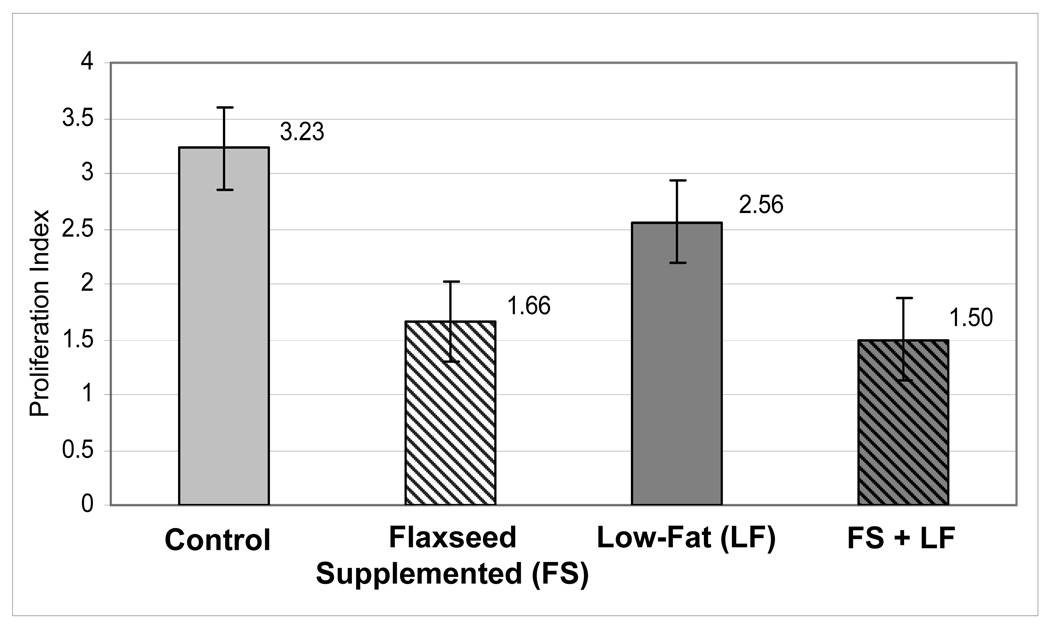
Men were on protocol an average of 30 days. Proliferation rates were significantly lower (P < 0.002) among men assigned to the flaxseed arms. Median Ki-67-positive cells/total nuclei ratios (x100) were 1.66 (flaxseed-supplemented diet) and 1.50 (flaxseed-supplemented, low-fat diet) versus 3.23 (control) and 2.56 (low-fat diet). No differences were observed between arms with regard to side effects, apoptosis, and most serologic endpoints; however, men on low-fat diets experienced significant decreases in serum cholesterol (P = 0.048).
Findings suggest that flaxseed is safe and associated with biological alterations that may be protective for prostate cancer. Data also further support low-fat diets to manage serum cholesterol.
前列腺癌在男性一生中的发病率为六分之一。据推测,饮食因素会影响前列腺癌的发生和发展。低脂饮食和补充亚麻籽可能提供潜在的预防策略。
我们进行了一项多中心随机对照试验,以测试低脂和/或补充亚麻籽的饮食对前列腺生物学和其他生物标志物的影响。计划在前列腺切除术前至少21天的前列腺癌患者(n = 161)被随机分配到以下组之一:(a)对照组(常规饮食),(b)补充亚麻籽的饮食(30克/天),(c)低脂饮食(总能量<20%),或(d)补充亚麻籽的低脂饮食。在基线和手术前采集血液,分析前列腺特异性抗原、性激素结合球蛋白、睾酮、胰岛素样生长因子-I及其结合蛋白-3、C反应蛋白以及总胆固醇和低密度脂蛋白胆固醇。评估肿瘤的增殖(Ki-67,主要终点)和凋亡情况。
男性平均遵循方案30天。分配到亚麻籽组的男性增殖率显著降低(P < 0.002)。Ki-67阳性细胞/总细胞核比率(×100)的中位数在补充亚麻籽饮食组为1.66,补充亚麻籽的低脂饮食组为1.50,而对照组为3.23,低脂饮食组为2.56。各组在副作用、凋亡和大多数血清学终点方面未观察到差异;然而,低脂饮食的男性血清胆固醇显著降低(P = 0.048)。
研究结果表明亚麻籽是安全的,并且与可能对前列腺癌有保护作用的生物学改变有关。数据还进一步支持低脂饮食对控制血清胆固醇的作用。