Froidevaux Pascal, Haldimann Max
University Institute of Radiation Physics, University Hospital Center, University of Lausanne, Grand Pré 1, Lausanne, Switzerland.
Environ Health Perspect. 2008 Dec;116(12):1731-4. doi: 10.1289/ehp.11358. Epub 2008 Sep 17.
Occupational risks, the present nuclear threat, and the potential danger associated with nuclear power have raised concerns regarding the metabolism of plutonium in pregnant women.
We measured plutonium levels in the milk teeth of children born between 1951 and 1995 to assess the potential risk that plutonium incorporated by pregnant women might pose to the radiosensitive tissues of the fetus through placenta transfer.
We used milk teeth, whose enamel is formed during pregnancy, to investigate the transfer of plutonium from the mother's blood plasma to the fetus. We measured plutonium using sensitive sector field inductively coupled plasma mass spectrometry techniques. We compared our results with those of a previous study on strontium-90 ((90)Sr) released into the atmosphere after nuclear bomb tests.
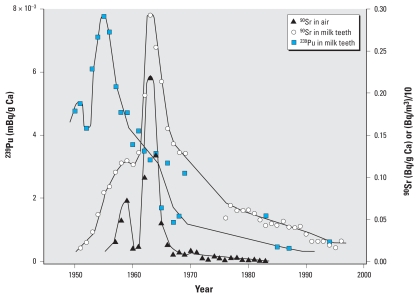
Results show that plutonium activity peaks in the milk teeth of children born about 10 years before the highest recorded levels of plutonium fallout. By contrast, (90)Sr, which is known to cross the placenta barrier, manifests differently in milk teeth, in accordance with (90)Sr fallout deposition as a function of time.
These findings demonstrate that plutonium found in milk teeth is caused by fallout that was inhaled around the time the milk teeth were shed and not from any accumulation during pregnancy through placenta transfer. Thus, plutonium may not represent a radiologic risk for the radiosensitive tissues of the fetus.
职业风险、当前的核威胁以及与核能相关的潜在危险引发了人们对孕妇体内钚代谢的担忧。
我们测量了1951年至1995年期间出生儿童的乳牙中的钚含量,以评估孕妇摄入的钚通过胎盘转移可能对胎儿放射敏感组织造成的潜在风险。
我们利用在孕期形成牙釉质的乳牙来研究钚从母亲血浆向胎儿的转移情况。我们使用灵敏的扇形磁场电感耦合等离子体质谱技术测量钚含量。我们将我们的结果与之前一项关于核弹试验后释放到大气中的锶-90(90Sr)的研究结果进行了比较。
结果显示,在钚沉降记录最高水平出现前约10年出生的儿童乳牙中,钚活度达到峰值。相比之下,已知能穿过胎盘屏障的90Sr在乳牙中的表现有所不同,这与90Sr沉降随时间的沉积情况一致。
这些发现表明,乳牙中发现的钚是由乳牙脱落时吸入的沉降物所致,而非孕期通过胎盘转移的任何积累。因此,钚可能不会对胎儿的放射敏感组织构成放射风险。