Nguyen Ngoc Khoi, Sartori Simone B, Herzog Herbert, Tasan Ramon, Sperk Günther, Singewald Nicolas
Department of Pharmacology and Toxicology, University of Innsbruck, Peter-Mayr-Strasse 1, Innsbruck, Austria.
Synapse. 2009 Mar;63(3):236-46. doi: 10.1002/syn.20597.
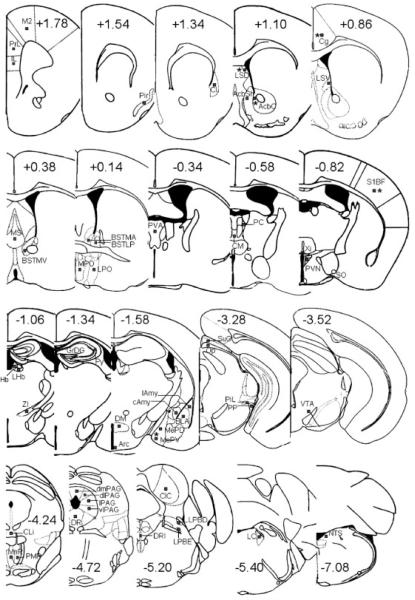
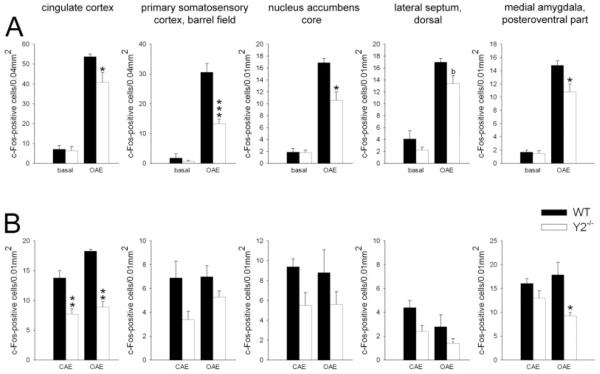
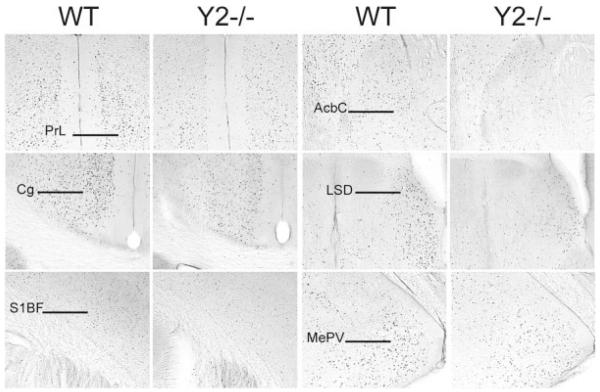
In different behavioral paradigms including the elevated plus maze (EPM), it was observed previously that deletion of the neuropeptide Y Y2 receptor subtype results in potent suppression of anxiety-related and stress-related behaviors. To identify neurobiological correlates underlying this behavioral reactivtiy, expression of c-Fos, an established early marker of neuronal activation, was examined in Y2 receptor knockout (Y2(-/-)) vs. wildtype (WT) mice. Mice were placed on the open arm (OA) or closed arm (CA) of the EPM for 10 min and the effect on regional c-Fos expression in the brain was investigated. The number of c-Fos positive neurons was significantly increased in both WT and Y2(-/-) lines after OA and CA exposure in 51 of 54 regions quantified. These regions included various cortical, limbic, thalamic, hypothalamic, and hindbrain regions. Genotype influenced c-Fos responses to arm exposures in 6 of the 51 activated regions: the cingulate cortex, barrel field of the primary somatosensory cortex, nucleus accumbens, dorsal lateral septum, amygdala and lateral periaqueductal gray. These differences in neuronal activity responses to the novel environments were more pronounced after OA than after CA exposure. Mice lacking Y2 receptors exhibited reduced neuronal activation when compared to WT animals in response to the emotional stressors. Reduced neuronal excitability in the identified brain areas relevant to the processing of motivated, explorative as well as anxiety-related behaviors is suggested to contribute to the reduced anxiety-related behavior observed in Y2(-/-) mice.
在包括高架十字迷宫(EPM)在内的不同行为范式中,先前观察到神经肽Y Y2受体亚型的缺失会有效抑制焦虑相关行为和应激相关行为。为了确定这种行为反应背后的神经生物学相关性,在Y2受体基因敲除(Y2(-/-))小鼠与野生型(WT)小鼠中检测了神经元激活的既定早期标志物c-Fos的表达。将小鼠置于EPM的开放臂(OA)或封闭臂(CA)上10分钟,并研究其对大脑区域c-Fos表达的影响。在定量的54个区域中的51个区域,OA和CA暴露后,WT和Y2(-/-)品系中c-Fos阳性神经元的数量均显著增加。这些区域包括各种皮质、边缘系统、丘脑、下丘脑和后脑区域。基因型在51个激活区域中的6个区域影响了c-Fos对臂暴露的反应:扣带回皮质、初级体感皮质的桶状区、伏隔核、背外侧隔核、杏仁核和导水管周围灰质外侧。与CA暴露后相比,OA暴露后对新环境的神经元活动反应差异更明显。与WT动物相比,缺乏Y2受体的小鼠在面对情绪应激源时神经元激活减少。在与动机、探索以及焦虑相关行为处理相关的特定脑区中,神经元兴奋性降低被认为是导致Y2(-/-)小鼠焦虑相关行为减少的原因。