Berger Sandrine Bittencourt, Coelho Alessandra Sanchez, Oliveira Valéria Aparecida Pessatti, Cavalli Vanessa, Giannini Marcelo
Department of Restorative Dentistry, Dental School of Piracicaba, Stare University of Campinas, Piracicaba, SP, Brazil.
J Appl Oral Sci. 2008 May-Jun;16(3):201-4. doi: 10.1590/s1678-77572008000300007.
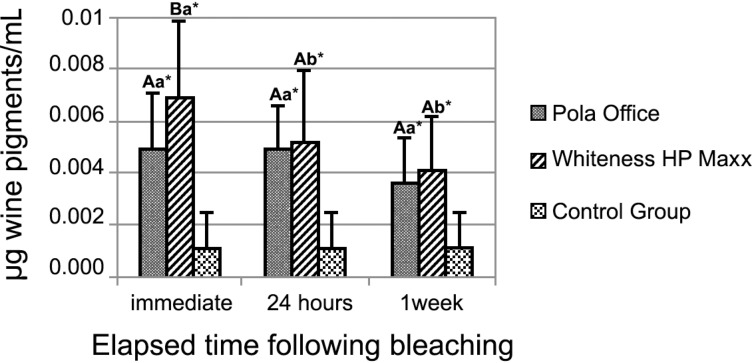
Concern has been expressed regarding the staining of enamel surface by different beverages after bleaching. This study investigated the influence of 35% hydrogen peroxide bleaching agents on enamel surface stained with wine after whitening treatments. Flat and polished bovine enamel surfaces were submitted to two commercially available 35% hydrogen peroxide bleaching agents or kept in 100% humidity, as a control group (n = 10). Specimens of all groups were immersed in red wine for 48 h at 37 degrees C, immediately, 24 h or 1 week after treatments. All specimens were ground into powder and prepared for the spectrophotometric analysis. Data were subjected to two-way analysis of variance and Fisher's PLSD test at 5% significance level. The amount of wine pigments uptake by enamel submitted to bleaching treatments was statistically higher than that of control group, independently of the evaluation time. Results suggested that wine staining susceptibility was increased by bleaching treatments.
人们对漂白后不同饮料对牙釉质表面的染色表示担忧。本研究调查了35%过氧化氢漂白剂在美白处理后对被葡萄酒染色的牙釉质表面的影响。将平坦且抛光的牛牙釉质表面分别用两种市售的35%过氧化氢漂白剂处理,或作为对照组置于100%湿度环境中(n = 10)。所有组的样本在处理后立即、24小时或1周后于37摄氏度下浸泡在红酒中48小时。将所有样本研磨成粉末并准备进行分光光度分析。数据进行双向方差分析,并在5%显著性水平下进行Fisher's PLSD检验。无论评估时间如何,经漂白处理的牙釉质吸收的葡萄酒色素量在统计学上均高于对照组。结果表明,漂白处理会增加葡萄酒染色的易感性。