Yukich Joshua O, Lengeler Christian, Tediosi Fabrizio, Brown Nick, Mulligan Jo-Ann, Chavasse Des, Stevens Warren, Justino John, Conteh Lesong, Maharaj Rajendra, Erskine Marcy, Mueller Dirk H, Wiseman Virginia, Ghebremeskel Tewolde, Zerom Mehari, Goodman Catherine, McGuire David, Urrutia Juan Manuel, Sakho Fana, Hanson Kara, Sharp Brian
Department of Public Health and Epidemiology, Swiss Tropical Institute, PO Box, 4002 Basel, Switzerland.
Malar J. 2008 Dec 17;7:258. doi: 10.1186/1475-2875-7-258.
Five large insecticide-treated net (ITN) programmes and two indoor residual spraying (IRS) programmes were compared using a standardized costing methodology.
Costs were measured locally or derived from existing studies and focused on the provider perspective, but included the direct costs of net purchases by users, and are reported in 2005 USD. Effectiveness was estimated by combining programme outputs with standard impact indicators.
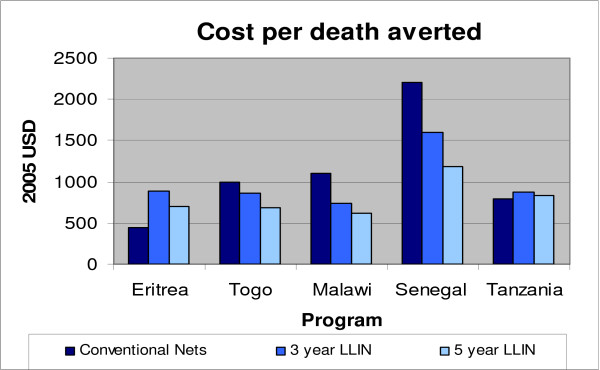
Conventional ITNs: The cost per treated net-year of protection ranged from USD 1.21 in Eritrea to USD 6.05 in Senegal. The cost per child death averted ranged from USD 438 to USD 2,199 when targeting to children was successful.Long-lasting insecticidal nets (LLIN) of five years duration: The cost per treated-net year of protection ranged from USD 1.38 in Eritrea to USD 1.90 in Togo. The cost per child death averted ranged from USD 502 to USD 692.IRS: The costs per person-year of protection for all ages were USD 3.27 in KwaZulu Natal and USD 3.90 in Mozambique. If only children under five years of age were included in the denominator the cost per person-year of protection was higher: USD 23.96 and USD 21.63. As a result, the cost per child death averted was higher than for ITNs: USD 3,933-4,357.
Both ITNs and IRS are highly cost-effective vector control strategies. Integrated ITN free distribution campaigns appeared to be the most efficient way to rapidly increase ITN coverage. Other approaches were as or more cost-effective, and appeared better suited to "keep-up" coverage levels. ITNs are more cost-effective than IRS for highly endemic settings, especially if high ITN coverage can be achieved with some demographic targeting.
采用标准化成本核算方法对五个大型经杀虫剂处理蚊帐(ITN)项目和两个室内滞留喷洒(IRS)项目进行了比较。
成本在当地进行衡量或源自现有研究,以提供者视角为重点,但包括使用者购买蚊帐的直接成本,并以2005年美元报告。通过将项目产出与标准影响指标相结合来估计有效性。
传统ITN:每处理蚊帐年的保护成本从厄立特里亚的1.21美元到塞内加尔的6.05美元不等。当针对儿童的目标成功时,避免每例儿童死亡的成本从438美元到2199美元不等。五年期长效杀虫剂蚊帐(LLIN):每处理蚊帐年的保护成本从厄立特里亚的1.38美元到多哥的1.90美元不等。避免每例儿童死亡的成本从502美元到692美元不等。IRS:夸祖鲁 - 纳塔尔省所有年龄段每人年的保护成本为3.27美元,莫桑比克为3.90美元。如果分母中仅包括五岁以下儿童,每人年的保护成本更高:分别为23.96美元和21.63美元。因此,避免每例儿童死亡的成本高于ITN:3933 - 4357美元。
ITN和IRS都是具有高成本效益的病媒控制策略。综合免费分发ITN运动似乎是迅速提高ITN覆盖率的最有效方式。其他方法同样或更具成本效益,并且似乎更适合维持覆盖率水平。在高度流行地区,ITN比IRS更具成本效益,特别是如果能够通过一些人口统计学目标实现高ITN覆盖率。