Ghosh Zhumur, Mallick Bibekanand, Chakrabarti Jayprokas
Computational Biology Group, Indian Association for the Cultivation of Science, Jadavpur, Calcutta 700 032, India.
Nucleic Acids Res. 2009 Mar;37(4):1035-48. doi: 10.1093/nar/gkn1004. Epub 2008 Dec 18.
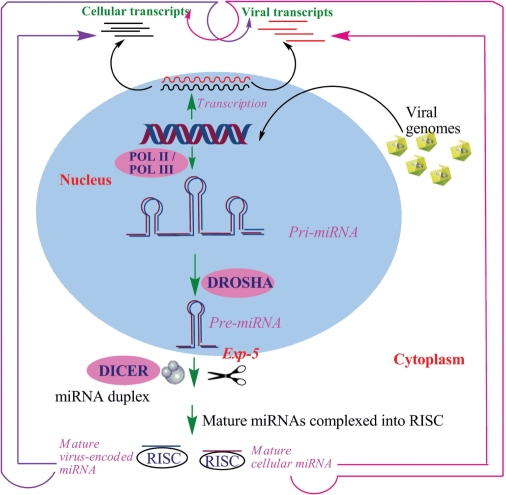
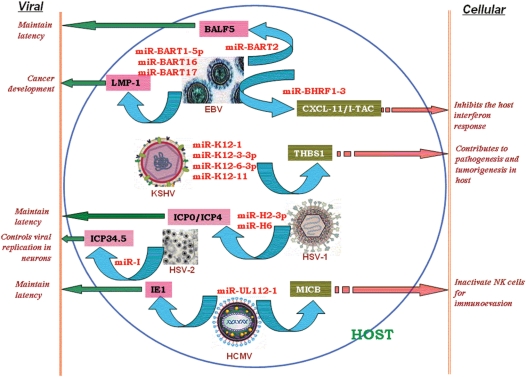
MicroRNAs (miRNAs) mark a new paradigm of RNA-directed gene expression regulation in a wide spectrum of biological systems. These small non-coding RNAs can contribute to the repertoire of host-pathogen interactions during viral infection. This interplay has important consequences, both for the virus and the host. There have been reported evidences of host-cellular miRNAs modulating the expression of various viral genes, thereby playing a pivotal role in the host-pathogen interaction network. In the hide-and-seek game between the pathogens and the infected host, viruses have evolved highly sophisticated gene-silencing mechanisms to evade host-immune response. Recent reports indicate that virus too encode miRNAs that protect them against cellular antiviral response. Furthermore, they may exploit the cellular miRNA pathway to their own advantage. Nevertheless, our increasing knowledge of the host-virus interaction at the molecular level should lead us toward possible explanations to viral tropism, latency and oncogenesis along with the development of an effective, durable and nontoxic antiviral therapy. Here, we summarize the recent updates on miRNA-induced gene-silencing mechanism, modulating host-virus interactions with a glimpse of the miRNA-based antiviral therapy for near future.
微小RNA(miRNA)标志着在广泛的生物系统中RNA指导基因表达调控的新范式。这些小的非编码RNA在病毒感染期间可促成宿主与病原体相互作用的全部内容。这种相互作用对病毒和宿主都有重要影响。已有报道表明宿主细胞miRNA可调节各种病毒基因的表达,从而在宿主与病原体相互作用网络中发挥关键作用。在病原体与受感染宿主之间的捉迷藏游戏中,病毒已经进化出高度复杂的基因沉默机制以逃避宿主免疫反应。最近的报道表明,病毒也编码miRNA来保护它们免受细胞抗病毒反应的影响。此外,它们可能利用细胞miRNA途径为自身谋利。然而,我们在分子水平上对宿主 - 病毒相互作用的了解不断增加,这应该使我们能够对病毒嗜性、潜伏和肿瘤发生作出可能的解释,并推动有效、持久且无毒的抗病毒疗法的发展。在此,我们总结了miRNA诱导基因沉默机制的最新进展,阐述了其对宿主 - 病毒相互作用的调节,并简要介绍了在不久的将来基于miRNA的抗病毒疗法。