Expósito-Rodríguez Marino, Borges Andrés A, Borges-Pérez Andrés, Pérez José A
Instituto de Productos Naturales y Agrobiología - CSIC, Avda, Astrofísico Francisco Sánchez 3, 38206 La Laguna, Tenerife, Canary Islands, Spain.
BMC Plant Biol. 2008 Dec 22;8:131. doi: 10.1186/1471-2229-8-131.
The elucidation of gene expression patterns leads to a better understanding of biological processes. Real-time quantitative RT-PCR has become the standard method for in-depth studies of gene expression. A biologically meaningful reporting of target mRNA quantities requires accurate and reliable normalization in order to identify real gene-specific variation. The purpose of normalization is to control several variables such as different amounts and quality of starting material, variable enzymatic efficiencies of retrotranscription from RNA to cDNA, or differences between tissues or cells in overall transcriptional activity. The validity of a housekeeping gene as endogenous control relies on the stability of its expression level across the sample panel being analysed. In the present report we describe the first systematic evaluation of potential internal controls during tomato development process to identify which are the most reliable for transcript quantification by real-time RT-PCR.
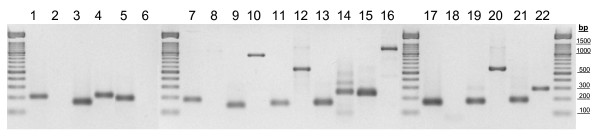
In this study, we assess the expression stability of 7 traditional and 4 novel housekeeping genes in a set of 27 samples representing different tissues and organs of tomato plants at different developmental stages. First, we designed, tested and optimized amplification primers for real-time RT-PCR. Then, expression data from each candidate gene were evaluated with three complementary approaches based on different statistical procedures. Our analysis suggests that SGN-U314153 (CAC), SGN-U321250 (TIP41), SGN-U346908 ("Expressed") and SGN-U316474 (SAND) genes provide superior transcript normalization in tomato development studies. We recommend different combinations of these exceptionally stable housekeeping genes for suited normalization of different developmental series, including the complete tomato development process.
This work constitutes the first effort for the selection of optimal endogenous controls for quantitative real-time RT-PCR studies of gene expression during tomato development process. From our study a tool-kit of control genes emerges that outperform the traditional genes in terms of expression stability.
对基因表达模式的阐释有助于更好地理解生物过程。实时定量逆转录聚合酶链反应(RT-PCR)已成为深入研究基因表达的标准方法。为了识别真正的基因特异性变异,对目标mRNA数量进行具有生物学意义的报告需要准确可靠的标准化。标准化的目的是控制几个变量,如起始材料的不同量和质量、从RNA到cDNA逆转录的可变酶效率,或组织或细胞在整体转录活性方面的差异。管家基因作为内参的有效性取决于其在被分析样本组中表达水平的稳定性。在本报告中,我们描述了对番茄发育过程中潜在内参的首次系统评估,以确定哪些是通过实时RT-PCR进行转录本定量最可靠的内参。
在本研究中,我们评估了7个传统管家基因和4个新管家基因在一组27个样本中的表达稳定性,这些样本代表了番茄植株在不同发育阶段的不同组织和器官。首先,我们设计、测试并优化了实时RT-PCR的扩增引物。然后,基于不同的统计程序,用三种互补方法评估了每个候选基因的表达数据。我们的分析表明,SGN-U314153(CAC)、SGN-U321250(TIP41)、SGN-U346908(“表达的”)和SGN-U316474(SAND)基因在番茄发育研究中提供了卓越的转录本标准化。我们推荐这些异常稳定的管家基因的不同组合,用于不同发育系列(包括整个番茄发育过程)的合适标准化。
这项工作是为番茄发育过程中基因表达的定量实时RT-PCR研究选择最佳内参的首次尝试。从我们的研究中出现了一套内参基因工具包,其在表达稳定性方面优于传统基因。