Guo Qiuping, Yang Xiaohai, Wang Kemin, Tan Weihong, Li Wei, Tang Hongxing, Li Huimin
State Key Laboratory of Chemo/Biosensing and Chemometrics, College of Chemistry and Chemical Engineering, Hunan University, Changsha 410082, PR China.
Nucleic Acids Res. 2009 Feb;37(3):e20. doi: 10.1093/nar/gkn1024. Epub 2009 Jan 7.
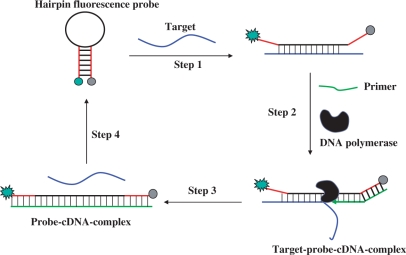
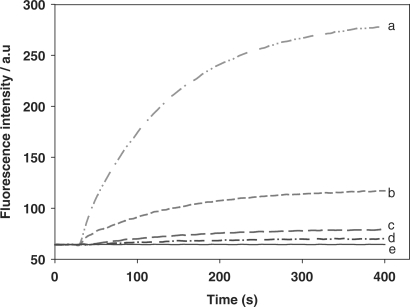
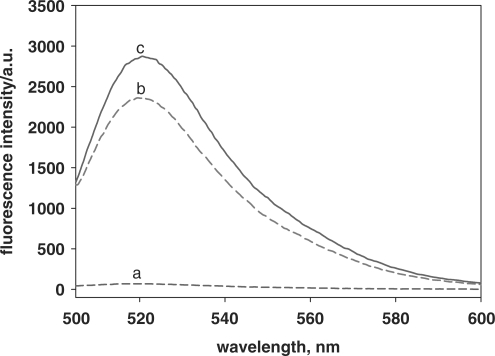
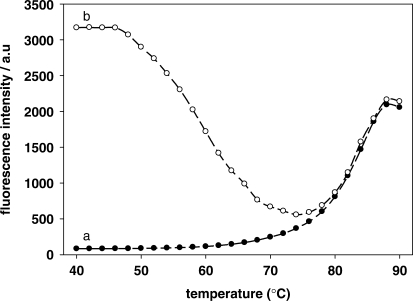
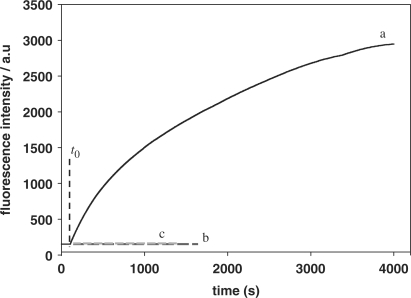
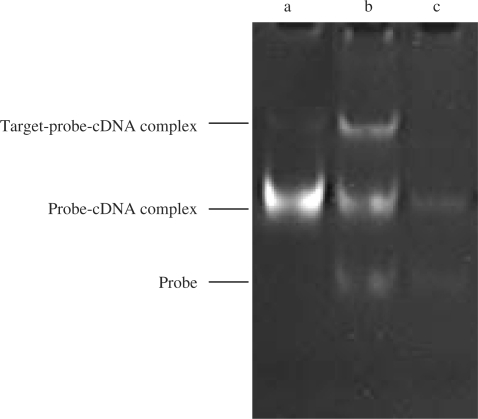
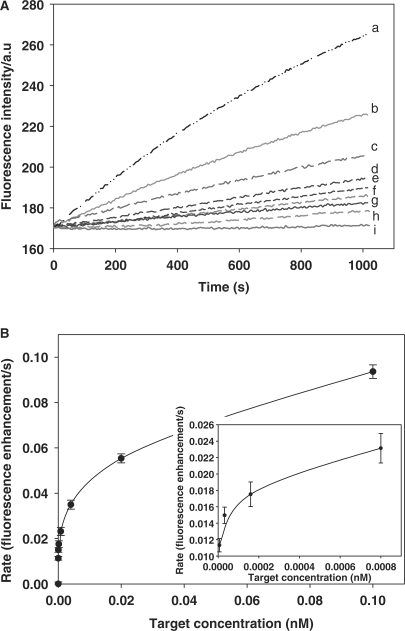
Here we have developed a sensitive DNA amplified detection method based on isothermal strand-displacement polymerization reaction. This method takes advantage of both the hybridization property of DNA and the strand-displacement property of polymerase. Importantly, we demonstrate that our method produces a circular polymerization reaction activated by the target, which essentially allows it to self-detect. Functionally, this DNA system consists of a hairpin fluorescence probe, a short primer and polymerase. Upon recognition and hybridization with the target ssDNA, the stem of the hairpin probe is opened, after which the opened probe anneals with the primer and triggers the polymerization reaction. During this process of the polymerization reaction, a complementary DNA is synthesized and the hybridized target is displaced. Finally, the displaced target recognizes and hybridizes with another probe, triggering the next round of polymerization reaction, reaching a target detection limit of 6.4 x 10(-15) M.
在此,我们基于等温链置换聚合反应开发了一种灵敏的DNA扩增检测方法。该方法利用了DNA的杂交特性和聚合酶的链置换特性。重要的是,我们证明了我们的方法会产生由靶标激活的环状聚合反应,这本质上使其能够进行自我检测。从功能上讲,这个DNA系统由一个发夹荧光探针、一个短引物和聚合酶组成。与靶标单链DNA识别并杂交后,发夹探针的茎部打开,之后打开的探针与引物退火并触发聚合反应。在聚合反应过程中,合成互补DNA并置换杂交的靶标。最后,被置换的靶标与另一个探针识别并杂交,触发下一轮聚合反应,达到6.4×10⁻¹⁵ M的靶标检测限。