Tanaka Toshiko, Shen Jian, Abecasis Gonçalo R, Kisialiou Aliaksei, Ordovas Jose M, Guralnik Jack M, Singleton Andrew, Bandinelli Stefania, Cherubini Antonio, Arnett Donna, Tsai Michael Y, Ferrucci Luigi
Medstar Research Institute, Baltimore, MD, USA.
PLoS Genet. 2009 Jan;5(1):e1000338. doi: 10.1371/journal.pgen.1000338. Epub 2009 Jan 16.
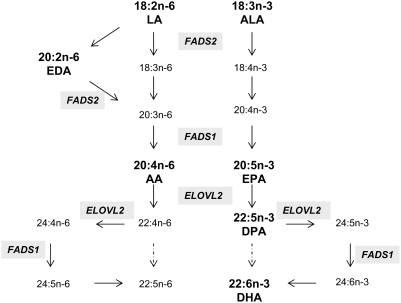
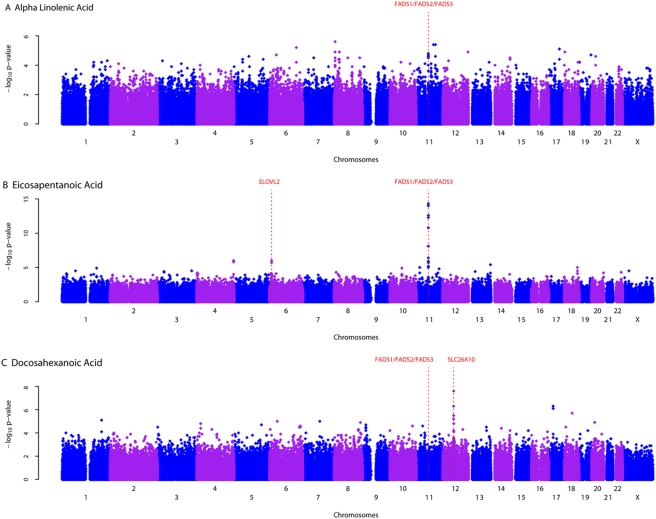
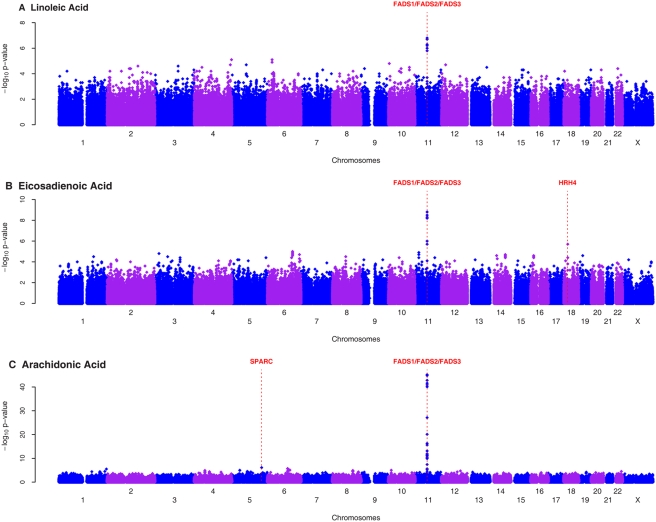
Polyunsaturated fatty acids (PUFA) have a role in many physiological processes, including energy production, modulation of inflammation, and maintenance of cell membrane integrity. High plasma PUFA concentrations have been shown to have beneficial effects on cardiovascular disease and mortality. To identify genetic contributors of plasma PUFA concentrations, we conducted a genome-wide association study of plasma levels of six omega-3 and omega-6 fatty acids in 1,075 participants in the InCHIANTI study on aging. The strongest evidence for association was observed in a region of chromosome 11 that encodes three fatty acid desaturases (FADS1, FADS2, FADS3). The SNP with the most significant association was rs174537 near FADS1 in the analysis of arachidonic acid (AA; p = 5.95 x 10(-46)). Minor allele homozygotes had lower AA compared to the major allele homozygotes and rs174537 accounted for 18.6% of the additive variance in AA concentrations. This SNP was also associated with levels of eicosadienoic acid (EDA; p = 6.78 x 10(-9)) and eicosapentanoic acid (EPA; p = 1.07 x 10(-14)). Participants carrying the allele associated with higher AA, EDA, and EPA also had higher low-density lipoprotein (LDL-C) and total cholesterol levels. Outside the FADS gene cluster, the strongest region of association mapped to chromosome 6 in the region encoding an elongase of very long fatty acids 2 (ELOVL2). In this region, association was observed with EPA (rs953413; p = 1.1 x 10(-6)). The effects of rs174537 were confirmed in an independent sample of 1,076 subjects participating in the GOLDN study. The ELOVL2 SNP was associated with docosapentanoic and DHA but not with EPA in GOLDN. These findings show that polymorphisms of genes encoding enzymes in the metabolism of PUFA contribute to plasma concentrations of fatty acids.
多不饱和脂肪酸(PUFA)在许多生理过程中发挥作用,包括能量产生、炎症调节和细胞膜完整性的维持。已表明高血浆PUFA浓度对心血管疾病和死亡率具有有益影响。为了确定血浆PUFA浓度的遗传影响因素,我们对1075名参与衰老相关的基安蒂(InCHIANTI)研究的参与者的六种ω-3和ω-6脂肪酸的血浆水平进行了全基因组关联研究。在11号染色体上一个编码三种脂肪酸去饱和酶(FADS1、FADS2、FADS3)的区域观察到最强的关联证据。在花生四烯酸(AA)分析中,与FADS1附近的rs174537关联最显著(p = 5.95×10⁻⁴⁶)。与主要等位基因纯合子相比,次要等位基因纯合子的AA水平较低,且rs174537占AA浓度加性方差的18.6%。该单核苷酸多态性(SNP)也与二十碳二烯酸(EDA;p = 6.78×10⁻⁹)和二十碳五烯酸(EPA;p = 1.07×10⁻¹⁴)水平相关。携带与较高AA、EDA和EPA相关等位基因的参与者的低密度脂蛋白(LDL-C)和总胆固醇水平也较高。在FADS基因簇之外,最强的关联区域定位于6号染色体上编码极长链脂肪酸延长酶2(ELOVL2)的区域。在该区域,观察到与EPA的关联(rs953413;p = 1.1×10⁻⁶)。在参与GOLDN研究的1076名受试者的独立样本中证实了rs174537的作用。在GOLDN研究中,ELOVL2 SNP与二十二碳五烯酸和DHA相关,但与EPA无关。这些发现表明,PUFA代谢中编码酶的基因多态性有助于脂肪酸的血浆浓度。