Center for Research in Environmental Epidemiology (CREAL), Barcelona, Catalonia, Spain.
PLoS One. 2011 Feb 23;6(2):e17181. doi: 10.1371/journal.pone.0017181.
Breastfeeding effects on cognition are attributed to long-chain polyunsaturated fatty acids (LC-PUFAs), but controversy persists. Genetic variation in fatty acid desaturase (FADS) and elongase (ELOVL) enzymes has been overlooked when studying the effects of LC-PUFAs supply on cognition. We aimed to: 1) to determine whether maternal genetic variants in the FADS cluster and ELOVL genes contribute to differences in LC-PUFA levels in colostrum; 2) to analyze whether these maternal variants are related to child cognition; and 3) to assess whether children's variants modify breastfeeding effects on cognition.
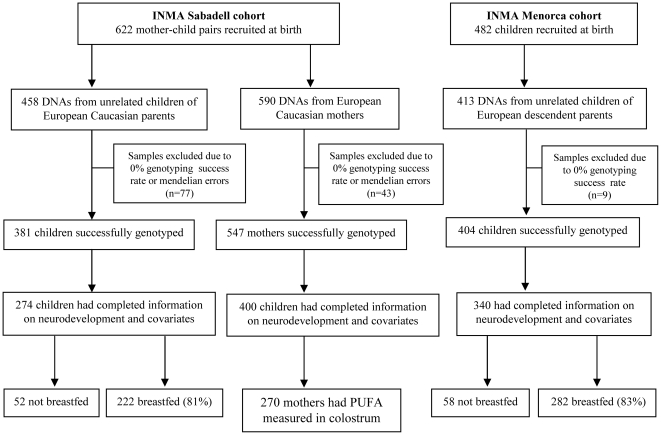
Data come from two population-based birth cohorts (n = 400 mother-child pairs from INMA-Sabadell; and n = 340 children from INMA-Menorca). LC-PUFAs were measured in 270 colostrum samples from INMA-Sabadell. Tag SNPs were genotyped both in mothers and children (13 in the FADS cluster, 6 in ELOVL2, and 7 in ELOVL5). Child cognition was assessed at 14 mo and 4 y using the Bayley Scales of Infant Development and the McCarthy Scales of Children's Abilities, respectively.
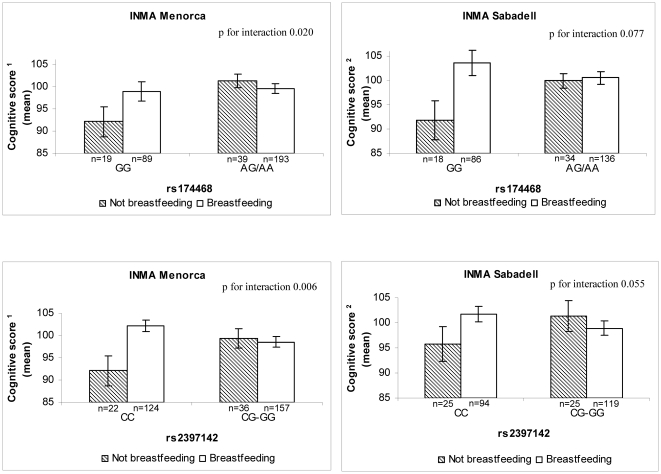
Children of mothers carrying genetic variants associated with lower FADS1 activity (regulating AA and EPA synthesis), higher FADS2 activity (regulating DHA synthesis), and with higher EPA/AA and DHA/AA ratios in colostrum showed a significant advantage in cognition at 14 mo (3.5 to 5.3 points). Not being breastfed conferred an 8- to 9-point disadvantage in cognition among children GG homozygote for rs174468 (low FADS1 activity) but not among those with the A allele. Moreover, not being breastfed resulted in a disadvantage in cognition (5 to 8 points) among children CC homozygote for rs2397142 (low ELOVL5 activity), but not among those carrying the G allele.
Genetically determined maternal supplies of LC-PUFAs during pregnancy and lactation appear to be crucial for child cognition. Breastfeeding effects on cognition are modified by child genetic variation in fatty acid desaturase and elongase enzymes.
母乳喂养对认知的影响归因于长链多不饱和脂肪酸(LC-PUFA),但争议仍然存在。在研究 LC-PUFA 供应对认知的影响时,人们忽视了脂肪酸去饱和酶(FADS)和延伸酶(ELOVL)基因的遗传变异。我们旨在:1)确定 FADS 簇和 ELOVL 基因中的母体遗传变异是否导致初乳中 LC-PUFA 水平的差异;2)分析这些母体变异是否与儿童认知有关;3)评估儿童的变异是否会改变母乳喂养对认知的影响。
数据来自两个基于人群的出生队列(INMA-Sabadell 的 400 对母婴和 INMA-Menorca 的 340 名儿童)。在 INMA-Sabadell 的 270 份初乳样本中测量 LC-PUFA。在母亲和儿童中均对标记 SNP 进行了基因分型(FADS 簇中 13 个,ELOVL2 中 6 个,ELOVL5 中 7 个)。分别在 14 个月和 4 岁时使用贝利婴幼儿发育量表和麦卡锡儿童能力量表评估儿童认知。
母亲携带与较低 FADS1 活性(调节 AA 和 EPA 合成)、较高 FADS2 活性(调节 DHA 合成)以及较高 EPA/AA 和 DHA/AA 比值相关的遗传变异的儿童在 14 个月时认知表现明显更优(3.5 至 5.3 分)。与母乳喂养相比,rs174468(低 FADS1 活性)GG 纯合子的儿童认知能力下降 8-9 分,但 AA 等位基因的儿童则不然。此外,rs2397142(低 ELOVL5 活性)CC 纯合子的儿童在母乳喂养方面认知能力下降(5-8 分),但携带 G 等位基因的儿童则不然。
怀孕期间和哺乳期内母体 LC-PUFA 的遗传决定供应似乎对儿童认知至关重要。母乳喂养对认知的影响受儿童脂肪酸去饱和酶和延伸酶基因遗传变异的影响。