Dumont Larry J, Yoshida Tatsuro, AuBuchon James P
Department of Pathology, Dartmouth-Hitchcock Medical Center, Lebanon, New Hampshire, USA.
Transfusion. 2009 Mar;49(3):458-64. doi: 10.1111/j.1537-2995.2008.02038.x. Epub 2009 Jan 2.
In preliminary studies, anaerobic red blood cell (RBC) storage reduced oxidative damage and phosphatidylserine exposure while maintaining adenosine triphosphate levels. The purpose of this study was to compare the 24-hour recovery and life span of autologous RBCs stored 6 and 9 weeks using OFAS3 additive solution in an anaerobic environment, compared to control RBCs aerobically stored in AS-3 for 6 weeks.
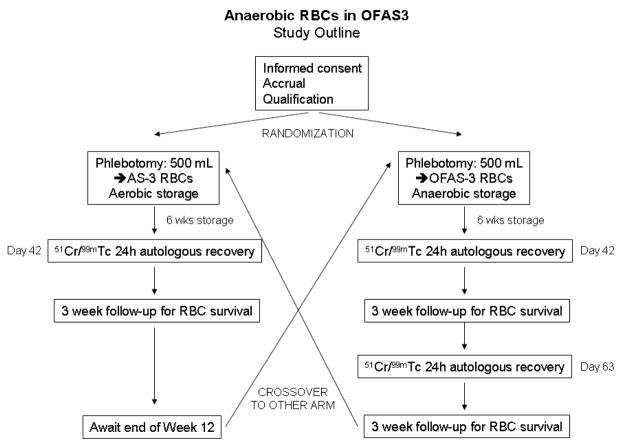
Eight subjects were entered into a randomized, crossover study. Whole blood was collected from each subject twice separated by 12 weeks or more into CP2D and leukoreduced. Controls were stored in AS-3. Test units in OFAS3 were oxygen depleted with argon then stored 9 weeks in an anaerobic chamber at 1 to 6 degrees C. At the end of each storage period, RBCs were labeled with (51)Cr and (99m)Tc and reinfused to the subject following standard methods to determine double-label recovery and life span. Hypotheses tests were conducted using paired, repeated-measures analysis of variance.
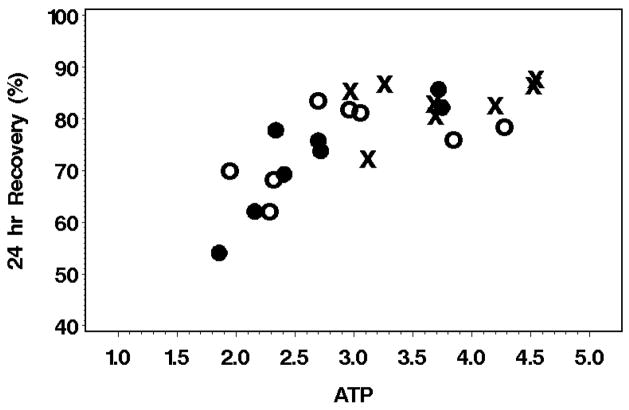
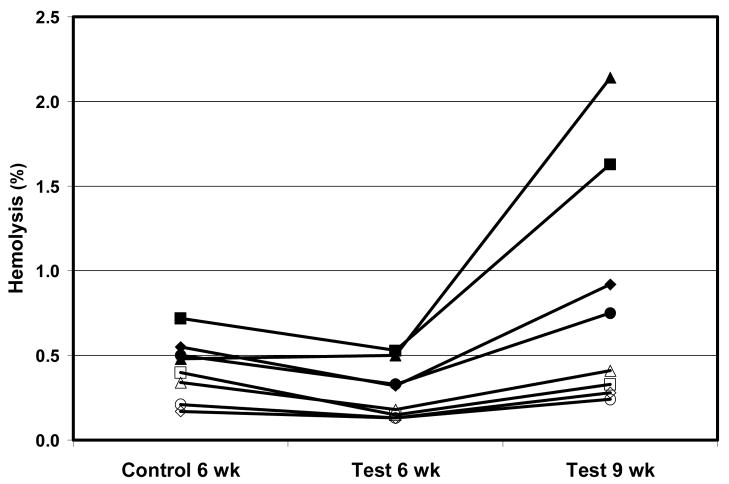
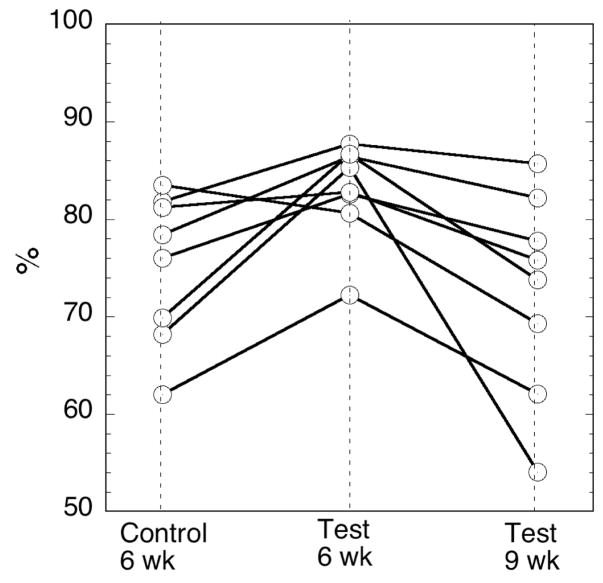
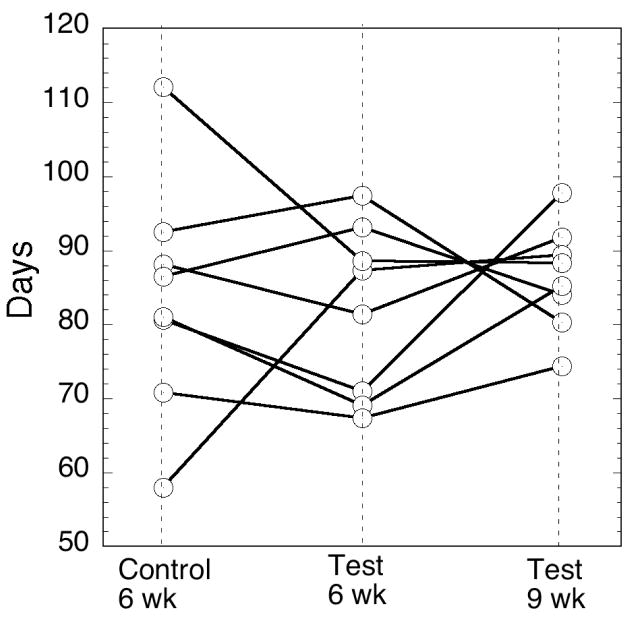
Recovery for the anaerobically stored test RBC was significantly better than control at 6 weeks (p = 0.023). Test units at 9 weeks were not different than the 6-week control units (p = 0.73). Other in vitro measures of RBC characteristics followed the same trend. Two test units at 9 weeks had hemolysis of greater than 1 percent.
Anaerobically stored RBCs in OFAS3 have superior recovery at 6 weeks compared to the controls and equivalent recovery at 9 weeks with no change in life span. Anaerobic storage of RBCs may provide improved RBCs for transfusion at 6 weeks of storage and may enable extending storage beyond the current 42-day limit.
在初步研究中,无氧条件下储存红细胞(RBC)可减少氧化损伤和磷脂酰丝氨酸暴露,同时维持三磷酸腺苷水平。本研究的目的是比较在无氧环境中使用OFAS3添加剂溶液储存6周和9周的自体红细胞与在有氧条件下于AS-3中储存6周的对照红细胞的24小时恢复情况和寿命。
8名受试者参与了一项随机交叉研究。从每位受试者采集全血两次,间隔12周或更长时间,分离成CP2D并进行白细胞滤除。对照组储存在AS-3中。OFAS3中的测试样本用氩气去除氧气,然后在1至6摄氏度的无氧箱中储存9周。在每个储存期结束时,用(51)铬和(99m)锝标记红细胞,并按照标准方法回输给受试者,以确定双标记恢复情况和寿命。采用配对重复测量方差分析进行假设检验。
在6周时,无氧储存的测试红细胞的恢复情况显著优于对照组(p = 0.023)。9周时的测试样本与6周的对照样本无差异(p = 0.73)。红细胞特征的其他体外测量结果也呈现相同趋势。9周时有两个测试样本的溶血率大于1%。
与对照组相比,在OFAS3中无氧储存的红细胞在6周时具有更好的恢复情况,在9周时恢复情况相当,且寿命无变化。红细胞的无氧储存可能在储存6周时为输血提供质量更好的红细胞,并可能使储存时间延长至超过目前的42天限制。