Wilson Martin, Davies Nigel P, Brundler Marie-Anne, McConville Carmel, Grundy Richard G, Peet Andrew C
Cancer Sciences, University of Birmingham, Birmingham, UK.
Mol Cancer. 2009 Feb 10;8:6. doi: 10.1186/1476-4598-8-6.
Brain and nervous system tumours are the most common solid cancers in children. Molecular characterisation of these tumours is important for providing novel biomarkers of disease and identifying molecular pathways which may provide putative targets for new therapies. 1H magic angle spinning NMR spectroscopy (1H HR-MAS) is a powerful tool for determining metabolite profiles from small pieces of intact tissue and could potentially provide important molecular information.
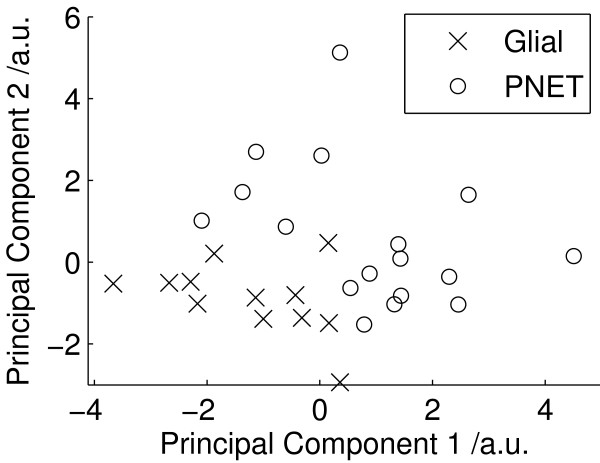
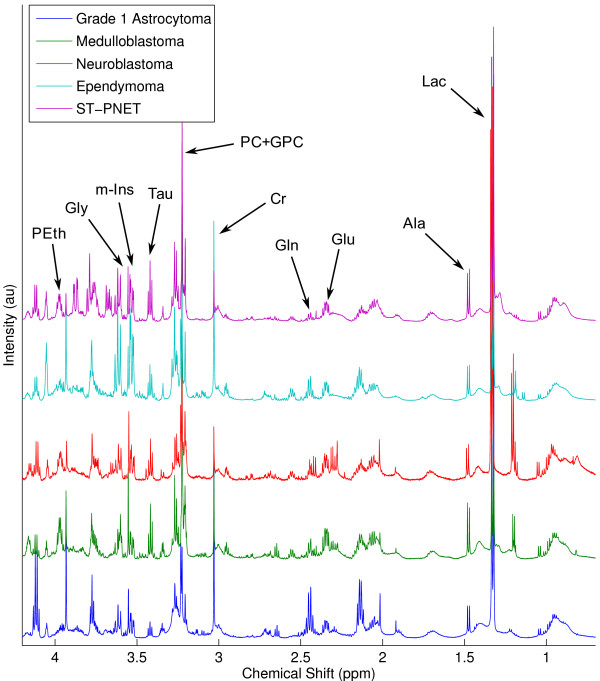
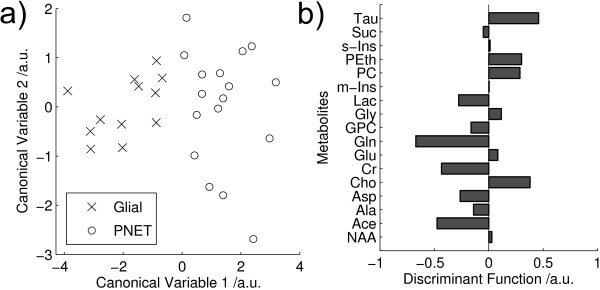
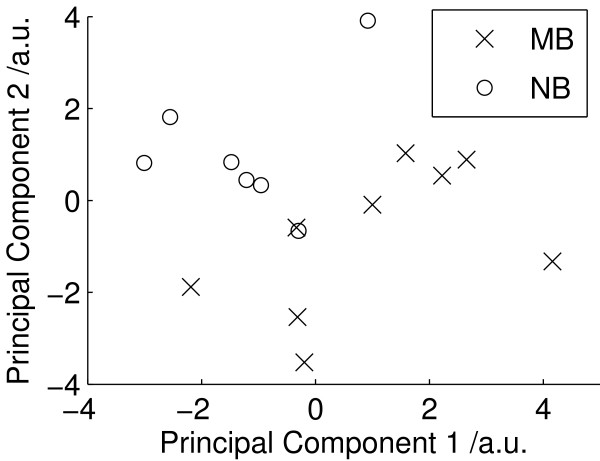
Forty tissue samples from 29 children with glial and primitive neuro-ectodermal tumours were analysed using HR-MAS (600 MHz Varian gHX nanoprobe). Tumour spectra were fitted to a library of individual metabolite spectra to provide metabolite values. These values were then used in a two tailed t-test and multi-variate analysis employing a principal component analysis and a linear discriminant analysis. Classification accuracy was estimated using a leave-one-out analysis and B632+ bootstrapping.
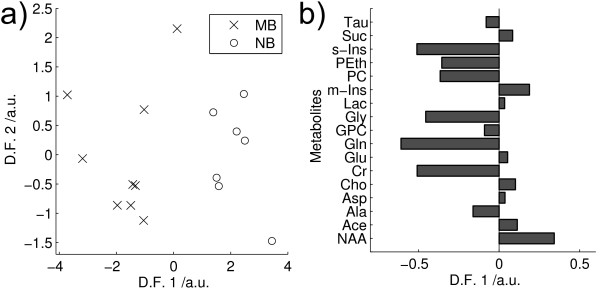
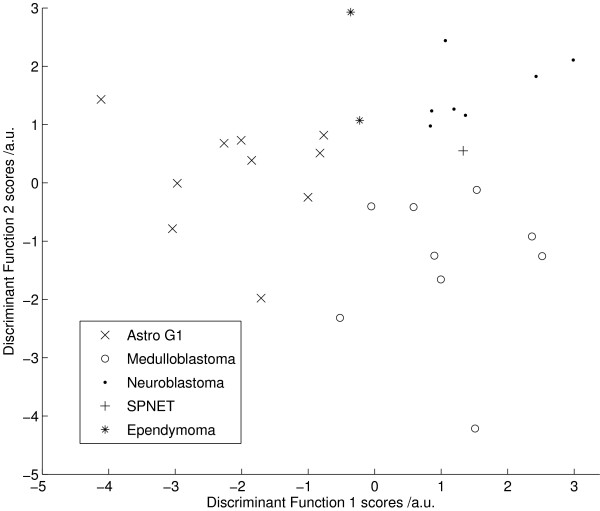
Glial tumours had significantly (two tailed t-test p < 0.05) higher creatine and glutamine and lower taurine, phosphoethanolamine, phosphorylcholine and choline compared with primitive neuro-ectodermal tumours. Classification accuracy was 90%. Medulloblastomas (n = 9) had significantly (two tailed t-test p < 0.05) higher creatine, glutamine, phosphorylcholine, glycine and scyllo-inositol than neuroblastomas (n = 7), classification accuracy was 94%. Supratentorial primitive neuro-ectodermal tumours had metabolite profiles in keeping with other primitive neuro-ectodermal tumours whilst ependymomas (n = 2) had metabolite profiles intermediate between pilocytic astrocytomas (n = 10) and primitive neuro-ectodermal tumours.
HR-MAS identified key differences in the metabolite profiles of childhood brain and nervous system improving the molecular characterisation of these tumours. Further investigation of the underlying molecular pathways is required to assess their potential as targets for new agents.
脑和神经系统肿瘤是儿童中最常见的实体癌。这些肿瘤的分子特征对于提供新的疾病生物标志物以及识别可能为新疗法提供假定靶点的分子途径至关重要。1H 魔角旋转核磁共振波谱(1H HR-MAS)是一种用于从小片完整组织中确定代谢物谱的强大工具,并且有可能提供重要的分子信息。
使用 HR-MAS(600 MHz 瓦里安 gHX 纳米探头)对 29 名患有胶质和原始神经外胚层肿瘤的儿童的 40 个组织样本进行分析。将肿瘤光谱与单个代谢物光谱库进行拟合以提供代谢物值。然后将这些值用于双尾 t 检验以及采用主成分分析和线性判别分析的多变量分析。使用留一法分析和 B632+ 自举法估计分类准确率。
与原始神经外胚层肿瘤相比,胶质肿瘤的肌酸和谷氨酰胺含量显著更高(双尾 t 检验 p < 0.05),而牛磺酸、磷酸乙醇胺、磷酸胆碱和胆碱含量更低。分类准确率为 90%。髓母细胞瘤(n = 9)的肌酸、谷氨酰胺、磷酸胆碱、甘氨酸和 scyllo-肌醇含量显著高于神经母细胞瘤(n = 7)(双尾 t 检验 p < 0.05),分类准确率为 94%。幕上原始神经外胚层肿瘤的代谢物谱与其他原始神经外胚层肿瘤一致,而室管膜瘤(n = 2)的代谢物谱介于毛细胞星形细胞瘤(n = 10)和原始神经外胚层肿瘤之间。
HR-MAS 确定了儿童脑和神经系统代谢物谱中的关键差异,改善了这些肿瘤的分子特征。需要进一步研究潜在的分子途径,以评估它们作为新药靶点的潜力。