Kirk Erik, Reeds Dominic N, Finck Brian N, Mayurranjan S Mitra, Patterson Bruce W, Klein Samuel
Center for Human Nutrition and Division of Geriatrics and Nutritional Science, Washington University School of Medicine, St Louis, Missouri 63110, USA.
Gastroenterology. 2009 May;136(5):1552-60. doi: 10.1053/j.gastro.2009.01.048. Epub 2009 Jan 25.
BACKGROUND & AIMS: We determined the effects of acute and chronic calorie restriction with either a low-fat, high-carbohydrate (HC) diet or a low-carbohydrate (LC) diet on hepatic and skeletal muscle insulin sensitivity.
Twenty-two obese subjects (body mass index, 36.5 +/- 0.8 kg/m2) were randomized to an HC (>180 g/day) or LC (<50 g/day) energy-deficit diet. A euglycemic-hyperinsulinemic clamp, muscle biopsy specimens, and magnetic resonance spectroscopy were used to determine insulin action, cellular insulin signaling, and intrahepatic triglyceride (IHTG) content before, after 48 hours, and after approximately 11 weeks (7% weight loss) of diet therapy.
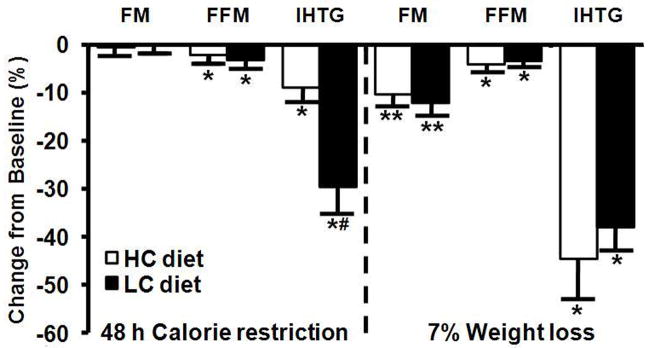
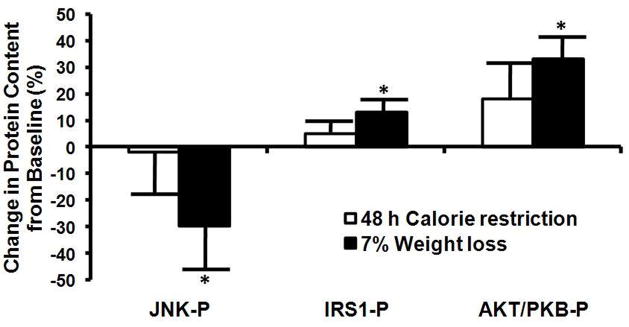
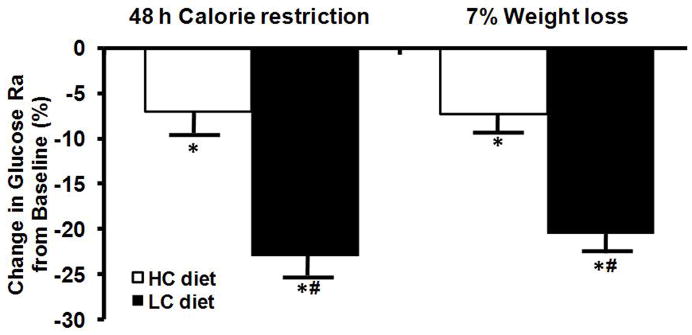
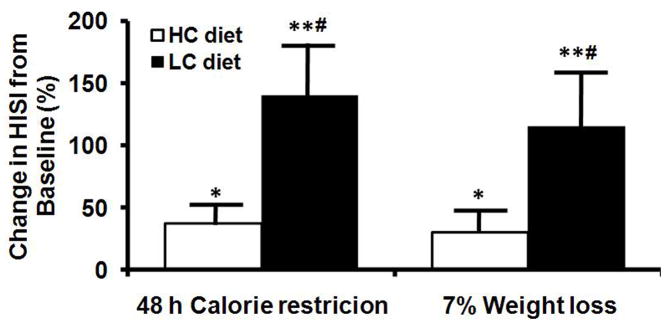
At 48 hours, IHTG content decreased more in the LC than the HC diet group (29.6% +/- 4.8% vs 8.9% +/- 1.4%; P < .05) but was similar in both groups after 7% weight loss (LC diet, 38.0% +/- 4.5%; HC diet, 44.5% +/- 13.5%). Basal glucose production rate decreased more in the LC than the HC diet group at 48 hours (23.4% +/- 2.2% vs 7.2% +/- 1.4%; P < .05) and after 7% weight loss (20.0% +/- 2.4% vs 7.9% +/- 1.2%; P < .05). Insulin-mediated glucose uptake did not change at 48 hours but increased similarly in both groups after 7% weight loss (48.4% +/- 14.3%; P < .05). In both groups, insulin-stimulated phosphorylation of c-Jun-N-terminal kinase decreased by 29% +/- 13% and phosphorylation of Akt and insulin receptor substrate 1 increased by 35% +/- 9% and 36% +/- 9%, respectively, after 7% weight loss (all P < .05).
Moderate calorie restriction causes temporal changes in liver and skeletal muscle metabolism; 48 hours of calorie restriction affects the liver (IHTG content, hepatic insulin sensitivity, and glucose production), whereas moderate weight loss affects muscle (insulin-mediated glucose uptake and insulin signaling).
我们确定了采用低脂高碳水化合物(HC)饮食或低碳水化合物(LC)饮食进行急性和慢性热量限制对肝脏和骨骼肌胰岛素敏感性的影响。
22名肥胖受试者(体重指数,36.5±0.8kg/m²)被随机分配至HC(>180g/天)或LC(<50g/天)能量亏空饮食组。在饮食治疗前、48小时后以及约11周(体重减轻7%)后,采用正常血糖-高胰岛素钳夹技术、肌肉活检标本以及磁共振波谱法来测定胰岛素作用、细胞胰岛素信号传导以及肝内甘油三酯(IHTG)含量。
48小时时,LC饮食组的IHTG含量下降幅度大于HC饮食组(29.6%±4.8%对8.9%±1.4%;P<.05),但体重减轻7%后两组相似(LC饮食组,38.0%±4.5%;HC饮食组44.5%±13.5%)。48小时时以及体重减轻7%后,LC饮食组基础葡萄糖生成率下降幅度大于HC饮食组(23.4%±2.2%对7.2%±1.4%;P<.05以及20.0%±2.4%对7.9%±1.2%;P<.05)。胰岛素介导的葡萄糖摄取在48小时时未发生变化,但体重减轻7%后两组均有相似程度增加(48.4%±14.3%;P<.05)。体重减轻7%后,两组胰岛素刺激的c-Jun氨基末端激酶磷酸化水平均下降29%±13%,Akt和胰岛素受体底物1的磷酸化水平分别增加35%±9%和36%±9%(均P<.05)。
适度热量限制会导致肝脏和骨骼肌代谢发生时间性变化;48小时的热量限制影响肝脏(IHTG含量、肝脏胰岛素敏感性和葡萄糖生成),而适度体重减轻影响肌肉(胰岛素介导的葡萄糖摄取和胰岛素信号传导)。