Yildirim Sibel, Tosun Gül, Koyutürk Alp Erdin, Sener Yagmur, Sengün Abdulkadir, Ozer Füsun, Imazato Satoshi
Associate professor, Selcuk University, Faculty of Dentistry, Department of Pediatric Dentistry, Konya, Turkey.
Eur J Dent. 2008 Jan;2(1):11-7.
The aim of this study was to test the hypothesis that the bonding ability of antibacterial bonding system to primary dentin was not different from the parental material which did not contain any antibacterial component.
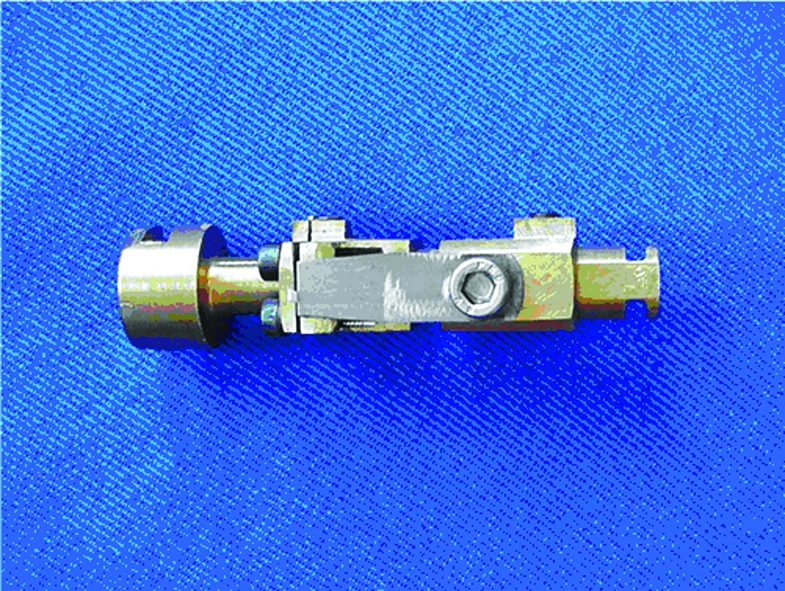
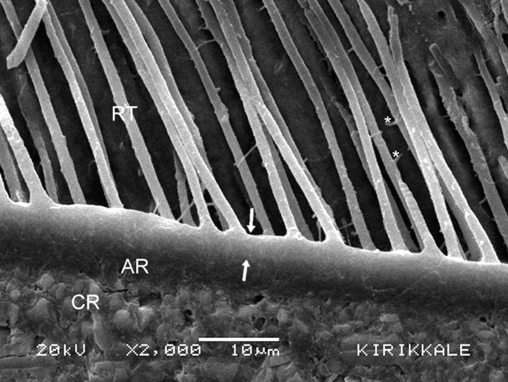
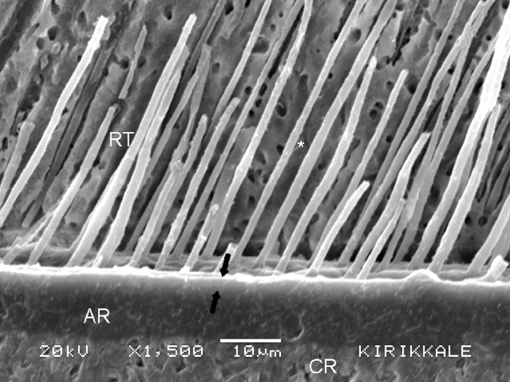
Extracted human non-carious primary molars were ground to expose the coronal dentin, and then randomly divided into two experimental groups: treatment with Clearfil Protect Bond or with Clearfil SE Bond (Kuraray Medical Inc.). Composite-dentin sticks with a cross-sectional area of approximately 0.90 mm(2) were prepared and subsequently subjected to microtensile bond strength (muTBS) and microshear bond strength (muSBS) tests. For the muTBS tests, specimens were attached to an Instron testing machine with a cyanoacrylate adhesive. For muSBS testing, the sticks were mechanically fixed to the muSBS testing apparatus. The bonds were stressed in shear or tension at a crosshead speed of 1mm/min until failure occurred. Resin-dentin interfaces produced by each system were examined using SEM. The data were analyzed with Mann-Whitney's U test.
The muTBS and muSBS of Clearfil Protect Bond were 30.69+/-9.71 and 9.94+/-3.78 MPa, respectively. Clearfil SE Bond showed significantly greater values of 37.31+/-9.57 and 12.83+/-3.15 MPa, respectively. SEM analysis demonstrated similar micro-morphological features including the thickness of the hybrid layer for both materials.
It was showed that antibacterial self-etching system Clearfil Protect Bond showed lower bond strength values compared to primary dentin than that of to Clearfil SE Bond on primary dentin. (Eur J Dent 2008;2:11-17).
本研究旨在验证以下假设,即抗菌粘结系统与不含任何抗菌成分的母体材料相比,其与乳牙本质的粘结能力并无差异。
将拔除的人类非龋性乳牙磨开以暴露冠部牙本质,然后随机分为两个实验组:分别用Clearfil Protect Bond或Clearfil SE Bond(可乐丽医疗株式会社)进行处理。制备横截面积约为0.90平方毫米的复合树脂-牙本质棒,随后进行微拉伸粘结强度(μTBS)和微剪切粘结强度(μSBS)测试。对于μTBS测试,使用氰基丙烯酸酯粘合剂将标本固定到Instron测试机上。对于μSBS测试,将棒机械固定到μSBS测试装置上。以1毫米/分钟的十字头速度在剪切或拉伸状态下对粘结进行加载直至破坏发生。使用扫描电子显微镜检查每个系统产生的树脂-牙本质界面。数据采用曼-惠特尼U检验进行分析。
Clearfil Protect Bond的μTBS和μSBS分别为30.69±9.71和9.94±3.78兆帕。Clearfil SE Bond的值明显更高,分别为37.31±9.57和12.83±3.15兆帕。扫描电子显微镜分析显示,两种材料的微观形态特征相似,包括混合层的厚度。
结果表明,与Clearfil SE Bond相比,抗菌自酸蚀系统Clearfil Protect Bond与乳牙本质的粘结强度较低。(《欧洲牙科杂志》2008年;2:11 - 17)