Shafiei Fereshteh, Alikhani Armaghan, Alavi Ali Asghar
Department of Operative Dentistry, School of Dentistry, Shiraz University of Medical Sciences, Shiraz, Iran.
Department of Operative Dentistry, School of Dentistry, Shiraz University of Medical Sciences, Shiraz, Iran ; Department of Operative Dentistry, Jundishapour University of Medical Sciences, Ahwaz, Iran.
Dent Res J (Isfahan). 2013 Nov;10(6):795-801.
Considering the possibility of remaining bacteria in the cavity or invading via microgaps, the use of antibacterial agents in adhesive restoration may be beneficial. This study evaluated the effect of chlorhexidine on immediate and long-term shear bond strength of adhesives with and without antibacterial agent to dentin.
In this in vitro study, the occlusal surfaces of 80 intact human premolars were removed to expose the flat midcoronal dentin. The teeth were assigned to four groups. Two adhesive systems, Clearfil SE Bond (SE) and Clearfil Protect Bond (PB) were used according to manufacturer's instructions as the control groups. In the experimental groups, 2% chlorhexidine was applied prior to acidic primer of two adhesives. Then, resin composite was applied. Half of the specimens in each group were submitted to shear bond test after 24 h without thermocycling, and the other half were submitted to water storage for 6 months and thermocycling before testing. The data was analyzed using three-way analysis of variance (ANOVA) and t-test (α = 0.05).
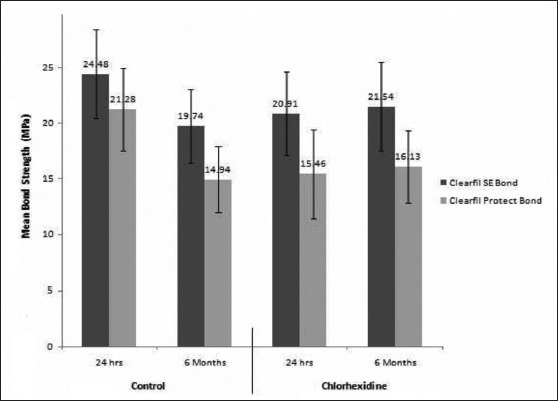
Chlorhexidine application significantly decreased the initial bond strength (BS) of the two self-etch adhesives to dentin (P < 0.05). There was a significant reduction in BS of SE and PB after aging compared to initial bonding (P < 0.05). However, there was no significant difference between BS of the control and chlorhexidine-treated groups for the tested adhesives after aging. PB showed a lower BS than SE in two time periods (P < 0.05).
Chlorhexidine was capable of diminishing the loss of BS of these adhesives over time. However, considering the negative effect of chlorhexidine on the initial BS, the benefits of chlorhexidine associated with these adhesives cannot possibly be used.
考虑到窝洞内可能残留细菌或细菌通过微间隙侵入的可能性,在粘结修复中使用抗菌剂可能有益。本研究评估了洗必泰对含和不含抗菌剂的粘结剂与牙本质的即刻和长期剪切粘结强度的影响。
在这项体外研究中,去除80颗完整人类前磨牙的咬合面,以暴露平坦的中冠部牙本质。将牙齿分为四组。按照制造商的说明,使用两种粘结系统,即Clearfil SE Bond(SE)和Clearfil Protect Bond(PB)作为对照组。在实验组中,在两种粘结剂的酸性底漆之前应用2%的洗必泰。然后,应用树脂复合材料。每组一半的标本在24小时后不进行热循环进行剪切粘结测试,另一半在测试前进行6个月的水储存和热循环。使用三因素方差分析(ANOVA)和t检验(α = 0.05)分析数据。
应用洗必泰显著降低了两种自酸蚀粘结剂与牙本质的初始粘结强度(BS)(P < 0.05)。与初始粘结相比,老化后SE和PB的BS显著降低(P < 0.05)。然而,老化后测试的粘结剂对照组和洗必泰处理组的BS之间没有显著差异。在两个时间段内,PB的BS均低于SE(P < 0.05)。
洗必泰能够随着时间的推移减少这些粘结剂的粘结强度损失。然而,考虑到洗必泰对初始BS的负面影响,与这些粘结剂相关的洗必泰的益处可能无法使用。