Shackman Alexander J, McMenamin Brenton W, Slagter Heleen A, Maxwell Jeffrey S, Greischar Lawrence L, Davidson Richard J
Laboratory for Affective Neuroscience and Waisman Laboratory for Brain Imaging and Behavior, University of Wisconsin, W.J. Brogden Hall, 1202 West Johnson Street, Madison, WI 53706, USA.
Brain Topogr. 2009 Jun;22(1):7-12. doi: 10.1007/s10548-009-0079-4. Epub 2009 Feb 12.
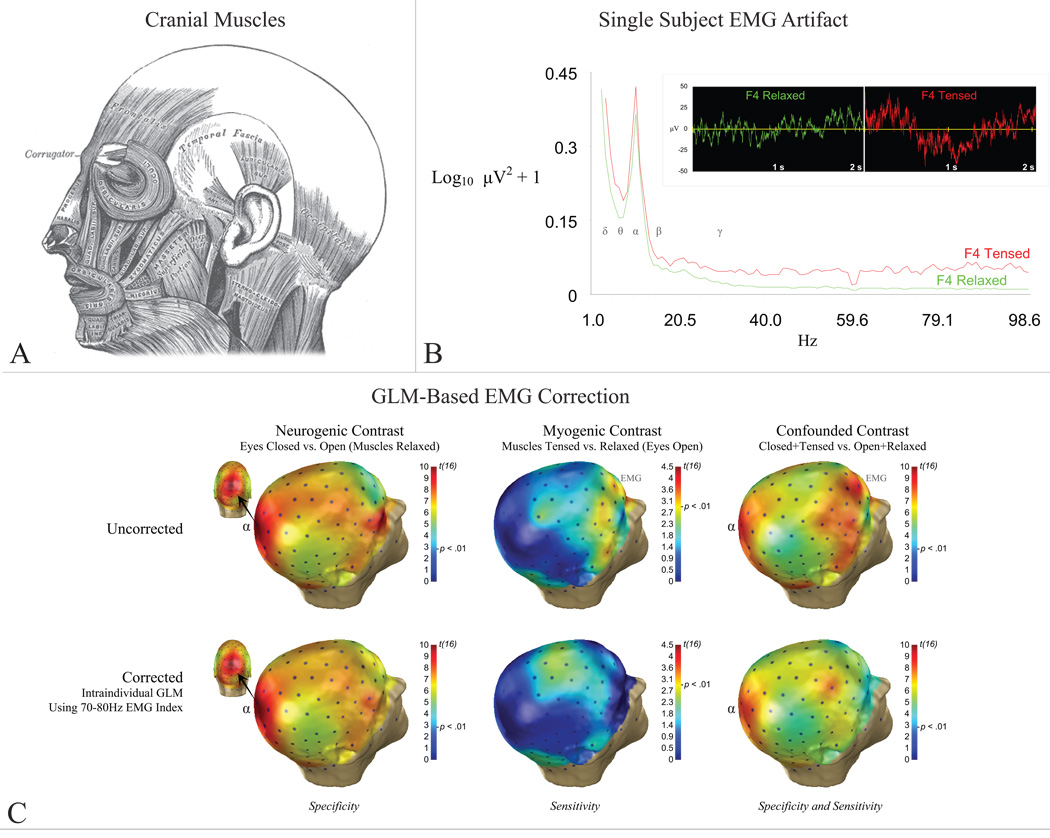
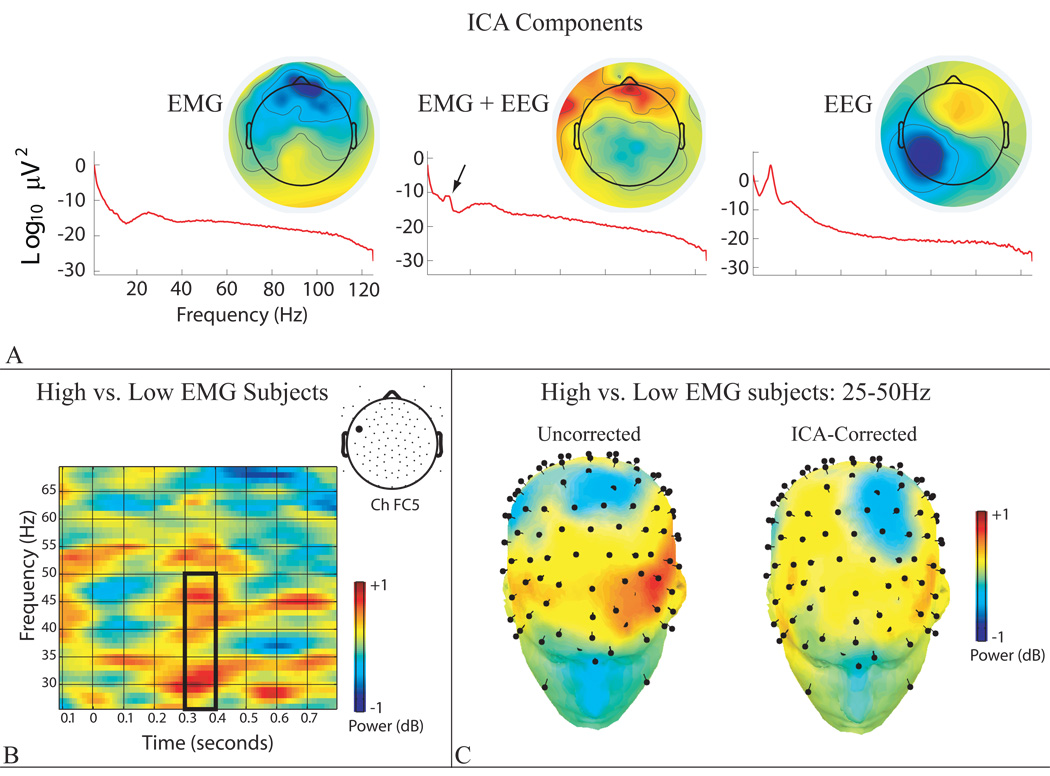
Muscle or electromyogenic (EMG) artifact poses a serious risk to inferential validity for any electroencephalography (EEG) investigation in the frequency-domain owing to its high amplitude, broad spectrum, and sensitivity to psychological processes of interest. Even weak EMG is detectable across the scalp in frequencies as low as the alpha band. Given these hazards, there is substantial interest in developing EMG correction tools. Unfortunately, most published techniques are subjected to only modest validation attempts, rendering their utility questionable. We review recent work by our laboratory quantitatively investigating the validity of two popular EMG correction techniques, one using the general linear model (GLM), the other using temporal independent component analysis (ICA). We show that intra-individual GLM-based methods represent a sensitive and specific tool for correcting on-going or induced, but not evoked (phase-locked) or source-localized, spectral changes. Preliminary work with ICA shows that it may not represent a panacea for EMG contamination, although further scrutiny is strongly warranted. We conclude by describing emerging methodological trends in this area that are likely to have substantial benefits for basic and applied EEG research.
肌肉或肌电(EMG)伪迹对任何频域脑电图(EEG)研究的推断效度都构成严重风险,这是因为其高幅度、宽频谱以及对相关心理过程的敏感性。即使是微弱的肌电,在低至阿尔法波段的频率下也能在头皮上被检测到。鉴于这些危害,人们对开发肌电校正工具有着浓厚兴趣。不幸的是,大多数已发表的技术仅经过适度的验证尝试,其效用令人质疑。我们回顾了我们实验室最近的工作,该工作定量研究了两种常用肌电校正技术的效度,一种使用通用线性模型(GLM),另一种使用时间独立成分分析(ICA)。我们表明,基于个体内通用线性模型的方法是一种敏感且特异的工具,可用于校正持续的或诱发的,但不是诱发(锁相)或源定位的频谱变化。ICA的初步工作表明,它可能并非解决肌电污染的万灵药,尽管强烈需要进一步审查。我们通过描述该领域新兴的方法学趋势来结束本文,这些趋势可能会给基础和应用脑电图研究带来巨大益处。