Zalesak Martin, Heckers Stephan
The Harvard-MIT Division of Health Sciences and Technology, Cambridge, MA, United States.
Psychiatry Res. 2009 Apr 30;172(1):24-30. doi: 10.1016/j.pscychresns.2008.09.008. Epub 2009 Feb 12.
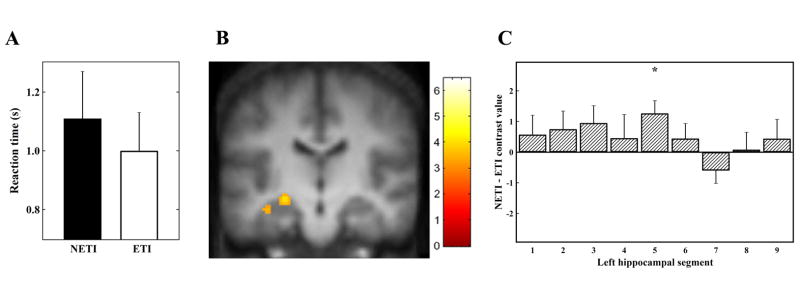
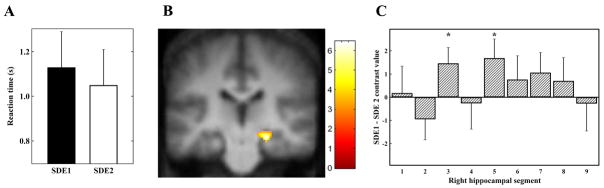
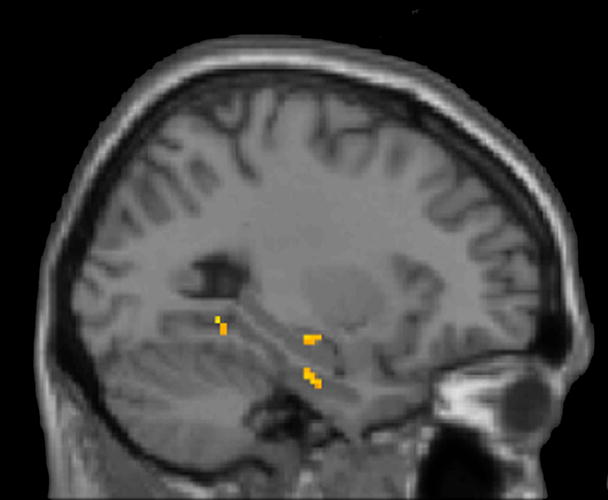
Transitive inference (TI) is the ability to infer the relationship between items (e.g., A>C) after having learned a set of premise pairs (e.g., A>B and B>C). Previous studies in humans have identified a distributed neural network, including cortex, hippocampus, and thalamus, during TI judgments. We studied two aspects of TI using functional magnetic resonance imaging of subjects who had acquired the six-item sequence (A>B>C>D>E>F) of visual stimuli. First, the identification of novel pairs not containing end items (i.e., B>D, C>E, B>E) was associated with greater left hippocampal activation compared with the identification of novel pairs containing end items A and F. This demonstrates that the identification of stimulus pairs requiring the flexible representation of a sequence is associated with hippocampal activation. Second, for the three novel pairs devoid of end items we found greater right hippocampal activation for pairs B>D and C>E compared with pair B>E. This indicates that TI decisions on pairs derived from more adjacent items in the sequence are associated with greater hippocampal activation. Hippocampal activation thus scales with the degree of relational processing necessary for TI judgments. Both findings confirm a role of the hippocampus in transitive inference in humans.
传递性推理(TI)是指在学习了一组前提对(例如,A>B和B>C)之后,推断项目之间关系(例如,A>C)的能力。先前针对人类的研究已经确定,在进行传递性推理判断时,会涉及一个包括皮质、海马体和丘脑的分布式神经网络。我们使用功能磁共振成像技术,对已经掌握了视觉刺激六项序列(A>B>C>D>E>F)的受试者进行研究,探讨传递性推理的两个方面。首先,与识别包含端点项A和F的新对相比,识别不包含端点项的新对(即B>D、C>E、B>E)时,左侧海马体激活程度更高。这表明,识别需要灵活表征序列的刺激对与海马体激活有关。其次,对于这三个不包含端点项的新对,我们发现,与B>E对相比,B>D和C>E对的右侧海马体激活程度更高。这表明,对序列中相邻程度更高的项目对进行传递性推理判断,与更强的海马体激活有关。因此,海马体激活程度与传递性推理判断所需的关系处理程度成正比。这两个发现均证实了海马体在人类传递性推理中的作用。