Mishra Kirti, Dash Aditya P, Swain Bijay K, Dey Nrisingha
Institute of Life Sciences, Nalco Square, Chandrasekhar Pur, Bhubaneswar, Orissa, India.
Malar J. 2009 Feb 12;8:26. doi: 10.1186/1475-2875-8-26.
Herbal extracts of Andrographis paniculata (AP) and Hedyotis corymbosa (HC) are known as hepato-protective and fever-reducing drugs since ancient time and they have been used regularly by the people in the south Asian sub-continent. Methanolic extracts of these two plants were tested in vitro on choloroquine sensitive (MRC-pf-20) and resistant (MRC-pf-303) strains of Plasmodium falciparum for their anti-malarial activity.
Growth inhibition was determined using different concentrations of these plant extracts on synchronized P. falciparum cultures at the ring stage. The interactions between these two plant extracts and individually with curcumin were studied in vitro. The performance of these two herbal extracts in isolation and combination were further evaluated in vivo on Balb/c mice infected with Plasmodium berghei ANKA and their efficacy was compared with that of curcumin. The in vivo toxicity of the plant derived compounds as well as their parasite stage-specificity was studied.
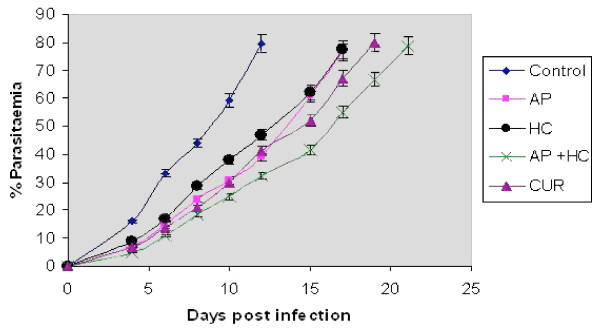
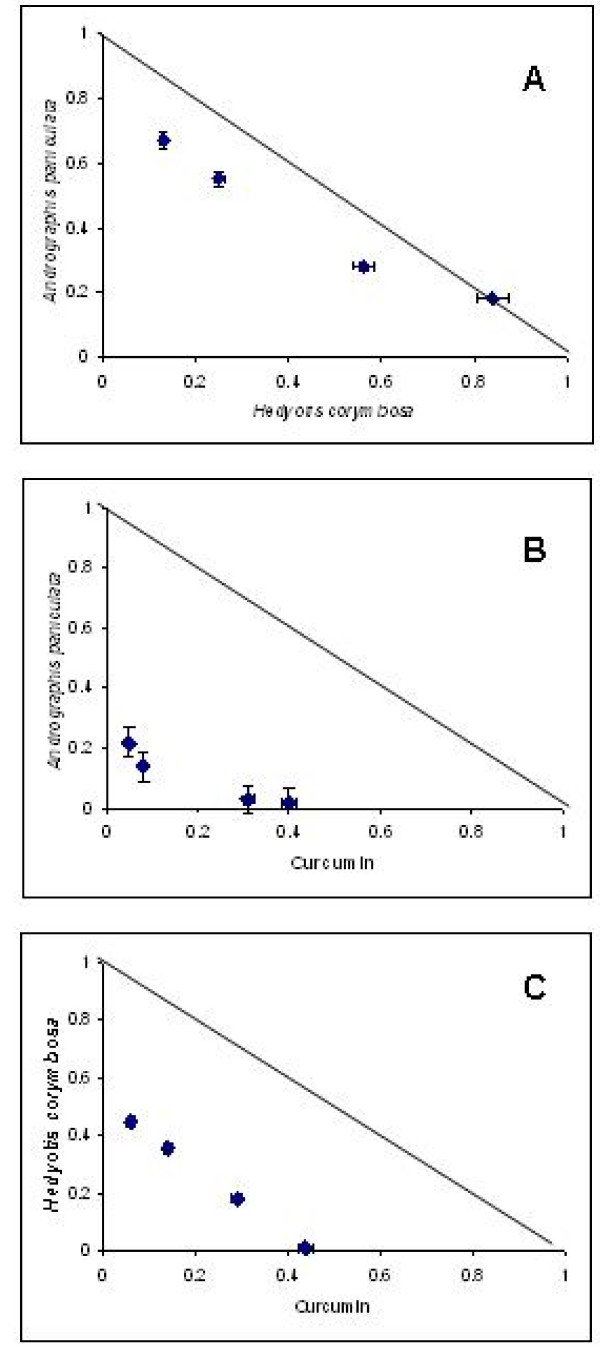
The 50% inhibitory concentration (IC50) of AP (7.2 microg/ml) was found better than HC (10.8 microg/ml). Combination of these two herbal drugs showed substantial enhancement in their anti-malarial activity. Combinatorial effect of each of these with curcumin also revealed anti-malarial effect. Additive interaction between the plant extracts (AP + HC) and their individual synergism with curcumin (AP+CUR, HC+CUR) were evident from this study. Increased in vivo potency was also observed with the combination of plant extracts over the individual extracts and curcumin. Both the plant extracts were found to inhibit the ring stage of the parasite and did not show any in vivo toxicity, whether used in isolation or in combination.
Both these two plant extracts in combination with curcumin could be an effective, alternative source of herbal anti-malarial drugs.
穿心莲(AP)和伞房花耳草(HC)的草药提取物自古以来就被认为是具有肝脏保护和退烧作用的药物,在南亚次大陆被人们经常使用。对这两种植物的甲醇提取物针对氯喹敏感(MRC-pf-20)和耐药(MRC-pf-303)的恶性疟原虫菌株进行了体外抗疟活性测试。
使用不同浓度的这些植物提取物对处于环状体阶段的同步化恶性疟原虫培养物测定生长抑制情况。在体外研究了这两种植物提取物之间以及它们分别与姜黄素之间的相互作用。在感染伯氏疟原虫ANKA的Balb/c小鼠体内进一步评估了这两种草药提取物单独使用和联合使用的效果,并将其疗效与姜黄素进行比较。研究了植物衍生化合物的体内毒性及其寄生虫阶段特异性。
发现穿心莲的50%抑制浓度(IC50)(7.2微克/毫升)优于伞房花耳草(10.8微克/毫升)。这两种草药药物联合使用显示出抗疟活性的显著增强。它们各自与姜黄素的联合作用也显示出抗疟效果。从本研究中可以明显看出植物提取物(AP + HC)之间的相加相互作用以及它们与姜黄素(AP+CUR,HC+CUR)各自的协同作用。与单独提取物和姜黄素相比,植物提取物联合使用时体内效力也有所提高。发现这两种植物提取物均能抑制寄生虫的环状体阶段,无论单独使用还是联合使用均未显示出任何体内毒性。
这两种植物提取物与姜黄素联合使用可能是一种有效的草药抗疟药物替代来源。