James Cook University School of Medicine and Dentistry, Townsville, Queensland, Australia.
Hum Resour Health. 2009 Feb 12;7:9. doi: 10.1186/1478-4491-7-9.
Specialist training was established in the late 1990s at the Fiji School of Medicine. Losses of graduates to overseas migration and to the local private sector prompted us to explore the reasons for these losses from the Fiji public workforce.
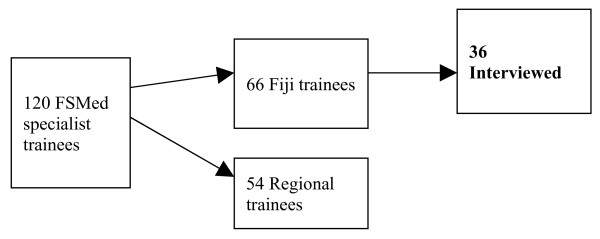
Data were collected on the whereabouts and highest educational attainments of the 66 Fiji doctors who had undertaken specialist training to at least the diploma level between 1997 and 2004. Semistructured interviews focusing on career decisions were carried out with 36 of these doctors, who were purposely sampled to include overseas migrants, temporary overseas trainees, local private practitioners and public sector doctors.
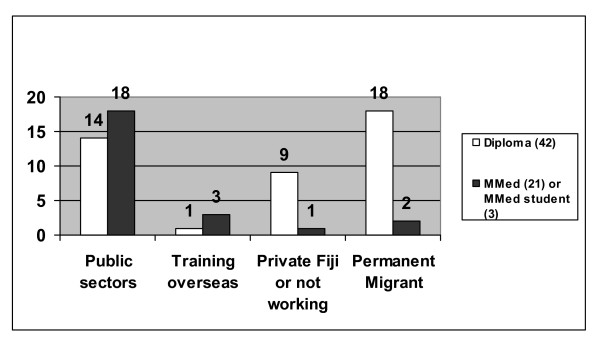
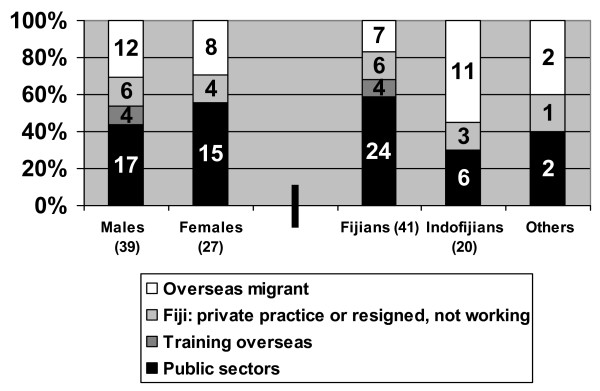
120 doctors undertook specialist training to at least the diploma level between 1997 and 2004; 66 of the graduates were Fiji citizens or permanent residents; 54 originated from other countries in the region. Among Fiji graduates, 42 completed a diploma and 24 had either completed (21) or were enrolled (3) in a master's programme. Thirty-two (48.5%) were working in the public sectors, four (6.0%) were temporarily training overseas, 30.3% had migrated overseas and the remainder were mostly in local private practice. Indo-Fijian ethnicity and non-completion of full specialist training were associated with lower retention in the public sectors, while gender had little impact. Decisions to leave the public sectors were complex, with concerns about political instability and family welfare predominating for overseas migrants, while working conditions not conducive to family life or frustrations with career progression predominated for local private practitioners. Doctors remaining in the public sectors reported many satisfying aspects to their work despite frustrations, though 40% had seriously considered resigning from the public service and 60% were unhappy with their career progression.
Overall, this study provides some support for the view that local or regional postgraduate training may increase retention of doctors. Attention to career pathways and other sources of frustration, in addition to encouragement to complete training, should increase the likelihood of such programmes' reaching their full potentials.
斐济医学院于 20 世纪 90 年代末开设专科培训课程。由于毕业生流失到海外移民和当地私营部门,我们开始从斐济公共劳动力中探索这些流失的原因。
收集了 1997 年至 2004 年间接受专科培训(至少达到文凭水平)的 66 名斐济医生的下落和最高教育程度的数据。对其中 36 名医生进行了重点关注职业决策的半结构化访谈,这些医生是经过有意选择的,包括海外移民、临时海外受训人员、当地私人开业医生和公共部门医生。
1997 年至 2004 年间,有 120 名医生接受了至少达到文凭水平的专科培训;66 名毕业生是斐济公民或永久居民;54 名来自该地区的其他国家。在斐济毕业生中,42 人完成了文凭课程,24 人要么已经完成(21 人),要么正在注册(3 人)攻读硕士课程。32 人(48.5%)在公共部门工作,4 人(6.0%)在海外临时培训,30.3%移民海外,其余大多在当地私人开业。印度裔斐济人和未完成完整专科培训与公共部门保留率较低有关,而性别影响不大。离开公共部门的决定很复杂,海外移民主要关注政治不稳定和家庭福利,而当地私人开业医生则主要关注不利于家庭生活或职业发展受挫的工作条件。留在公共部门的医生报告说,尽管有挫折,但他们的工作有许多令人满意的方面,尽管 40%的人曾认真考虑辞去公职,60%的人对自己的职业发展不满意。
总的来说,这项研究为以下观点提供了一些支持,即当地或区域研究生培训可能会增加医生的留用率。除了鼓励完成培训外,还应关注职业发展道路和其他挫折来源,以增加此类计划充分发挥潜力的可能性。