Velázquez-Muriel Javier A, Rueda Manuel, Cuesta Isabel, Pascual-Montano Alberto, Orozco Modesto, Carazo José-María
Centro Nacional de Biotecnología-CSIC, Campus Universidad Autónoma, 28049 Madrid, Spain.
BMC Struct Biol. 2009 Feb 17;9:6. doi: 10.1186/1472-6807-9-6.
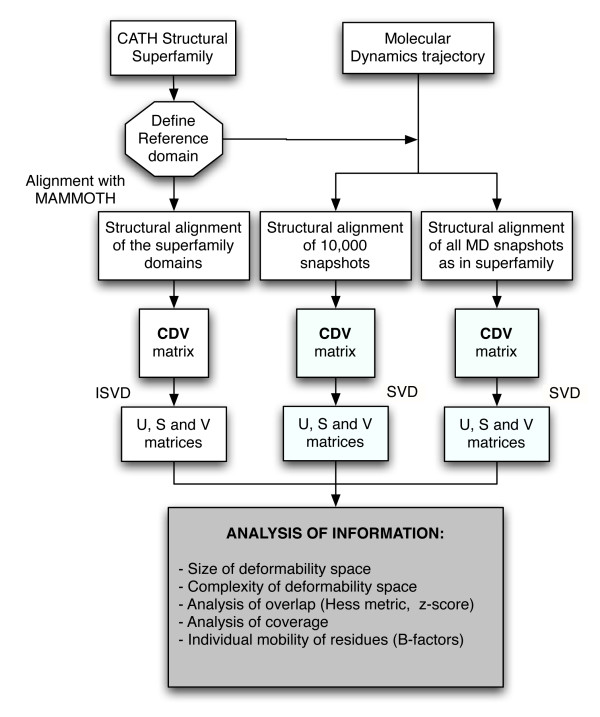
It is well known the strong relationship between protein structure and flexibility, on one hand, and biological protein function, on the other hand. Technically, protein flexibility exploration is an essential task in many applications, such as protein structure prediction and modeling. In this contribution we have compared two different approaches to explore the flexibility space of protein domains: i) molecular dynamics (MD-space), and ii) the study of the structural changes within superfamily (SF-space).
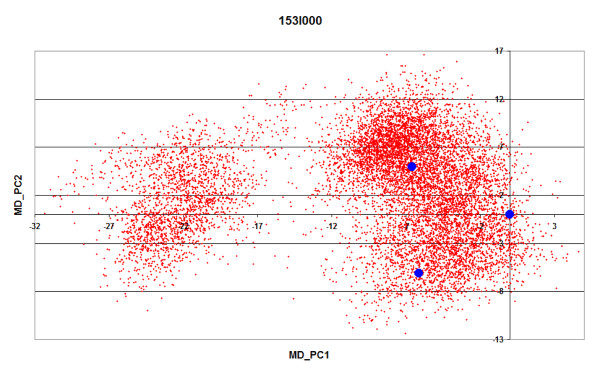
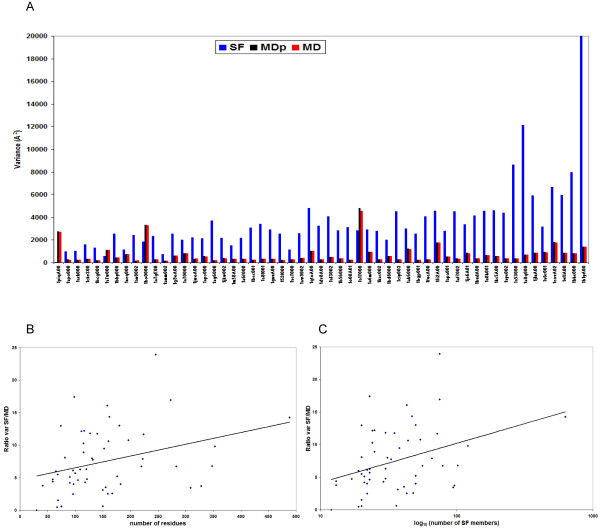
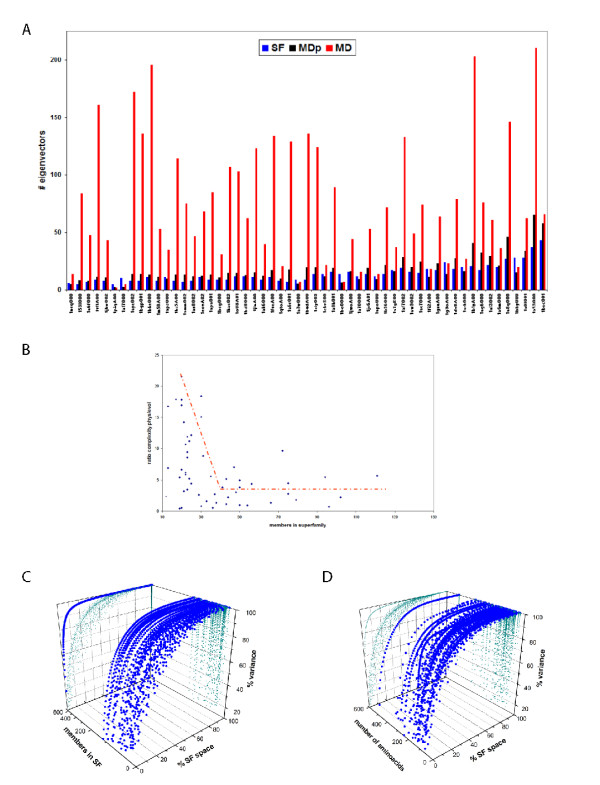
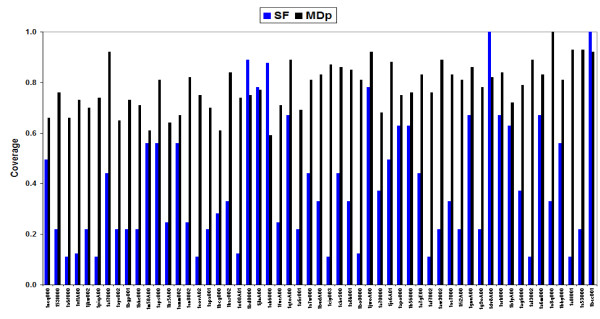
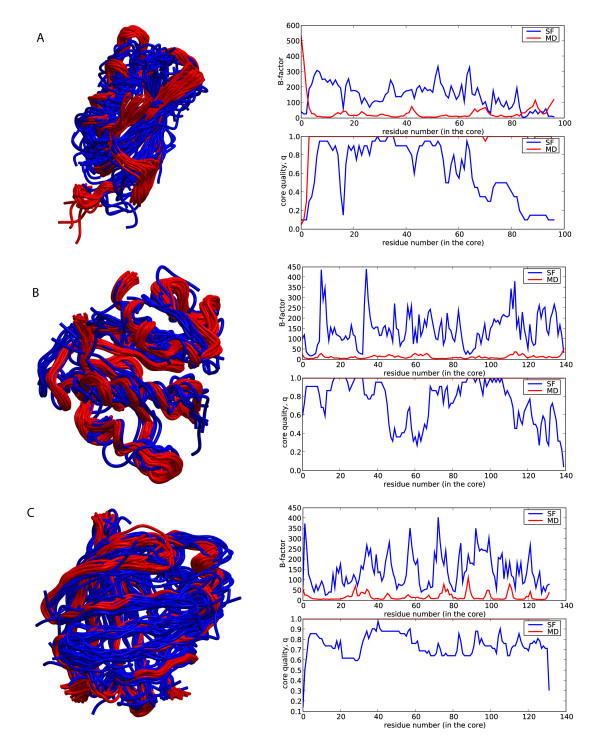
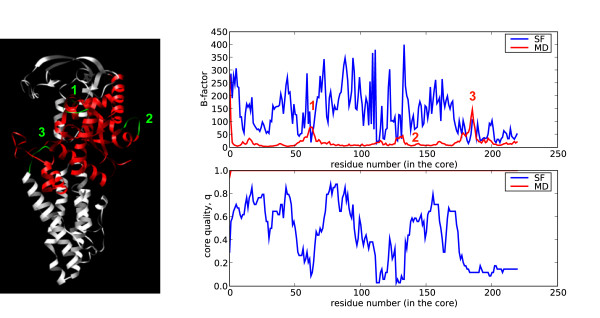
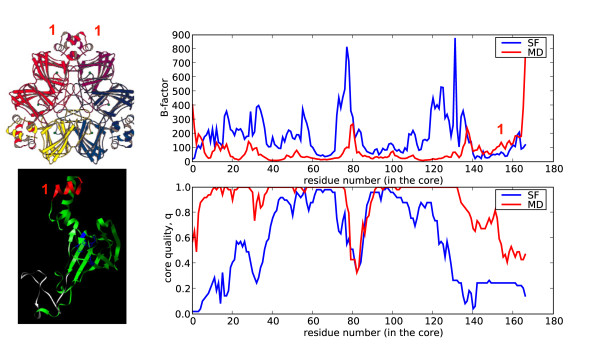
Our analysis indicates that the MD-space and the SF-space display a significant overlap, but are still different enough to be considered as complementary. The SF-space space is wider but less complex than the MD-space, irrespective of the number of members in the superfamily. Also, the SF-space does not sample all possibilities offered by the MD-space, but often introduces very large changes along just a few deformation modes, whose number tend to a plateau as the number of related folds in the superfamily increases.
Theoretically, we obtained two conclusions. First, that function restricts the access to some flexibility patterns to evolution, as we observe that when a superfamily member changes to become another, the path does not completely overlap with the physical deformability. Second, that conformational changes from variation in a superfamily are larger and much simpler than those allowed by physical deformability. Methodologically, the conclusion is that both spaces studied are complementary, and have different size and complexity. We expect this fact to have application in fields as 3D-EM/X-ray hybrid models or ab initio protein folding.
一方面,蛋白质结构与灵活性之间存在着紧密的关系,另一方面,与蛋白质生物学功能也紧密相关,这是众所周知的。从技术角度讲,蛋白质灵活性探索在许多应用中都是一项至关重要的任务,比如蛋白质结构预测和建模。在本研究中,我们比较了两种探索蛋白质结构域灵活性空间的不同方法:i)分子动力学(MD空间),以及ii)超家族内结构变化的研究(SF空间)。
我们的分析表明,MD空间和SF空间显示出显著的重叠,但仍存在足够差异,可被视为互补。无论超家族中的成员数量如何,SF空间都比MD空间更宽泛但复杂度更低。此外,SF空间并未对MD空间提供的所有可能性进行采样,但通常仅沿着少数几种变形模式引入非常大的变化,随着超家族中相关折叠数量的增加,这些变形模式的数量趋于平稳。
从理论上讲,我们得出了两个结论。第一,功能限制了进化对某些灵活性模式的获取,因为我们观察到当一个超家族成员转变为另一个成员时,其路径与物理可变形性并不完全重叠。第二,超家族中变异引起的构象变化比物理可变形性所允许的变化更大且简单得多。从方法学角度讲,结论是所研究的这两个空间是互补的,且具有不同的大小和复杂度。我们预计这一事实将在诸如3D-EM/X射线混合模型或从头算蛋白质折叠等领域得到应用。