Vanhoutte Kurt, de Asmundis Carlo, Francesconi Anna, Figysl Jurgen, Steurs Griet, Boussy Tim, Roos Markus, Mueller Andreas, Massimo Lucio, Paparella Gaetano, Van Caelenberg Kristien, Chierchia Gian Battista, Sarkozy Andrea, Terradellas Pedro Brugada Y, Zizi Martin
Faculty of Medicine and Pharmacy, Dept of Physiology, Vrije Universiteit Brussel.
Bioinformation. 2009;3(6):275-8. doi: 10.6026/97320630003275. Epub 2009 Jan 12.
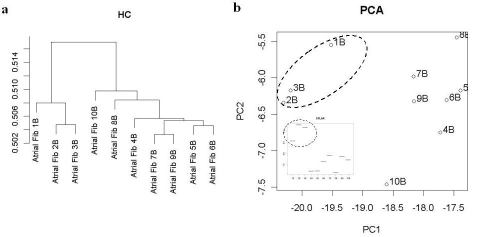
Atrial fibrillation (AF) is a frequent chronic dysrythmia with an incidence that increases with age (>40). Because of its medical and socio-economic impacts it is expected to become an increasing burden on most health care systems. AF is a multi-factorial disease for which the identification of subtypes is warranted. Novel approaches based on the broad concepts of systems biology may overcome the blurred notion of normal and pathological phenotype, which is inherent to high throughput molecular arrays analysis. Here we apply an internal contrast algorithm on AF patient data with an analytical focus on potential entry pathways into the disease. We used a RMA (Robust Multichip Average) normalized Affymetrix micro-array data set from 10 AF patients (geo_accession #GSE2240). Four series of probes were selected based on physiopathogenic links with AF entryways: apoptosis (remodeling), MAP kinase (cell remodeling), OXPHOS (ability to sustain hemodynamic workload) and glycolysis (ischemia). Annotated probe lists were polled with Bioconductor packages in R (version 2.7.1). Genetic profile contrasts were analysed with hierarchical clustering and principal component analysis. The analysis revealed distinct patient groups for all probe sets. A substantial part (54% till 67%) of the variance is explained in the first 2 principal components. Genes in PC1/2 with high discriminatory value were selected and analyzed in detail. We aim for reliable molecular stratification of AF. We show that stratification is possible based on physiologically relevant gene sets. Genes with high contrast value are likely to give pathophysiological insight into permanent AF subtypes.
心房颤动(AF)是一种常见的慢性心律失常,其发病率随年龄增长(>40岁)而增加。由于其对医学和社会经济的影响,预计它将给大多数医疗保健系统带来越来越大的负担。AF是一种多因素疾病,因此有必要识别其亚型。基于系统生物学广泛概念的新方法可能会克服高通量分子阵列分析中固有的正常和病理表型模糊概念。在此,我们对AF患者数据应用内部对比算法,重点分析该疾病可能的发病途径。我们使用了来自10名AF患者的RMA(稳健多芯片平均法)标准化Affymetrix微阵列数据集(geo登录号#GSE2240)。基于与AF发病途径的生理病理联系,选择了四组探针:凋亡(重塑)、MAP激酶(细胞重塑)、氧化磷酸化(维持血流动力学负荷的能力)和糖酵解(缺血)。使用R(版本2.7.1)中的Bioconductor软件包查询注释探针列表。通过层次聚类和主成分分析对基因谱对比进行分析。分析揭示了所有探针集的不同患者组。前两个主成分解释了大部分(54%至67%)的方差。选择并详细分析了PC1/2中具有高鉴别价值的基因。我们旨在对AF进行可靠的分子分层。我们表明,基于生理相关基因集进行分层是可能的。具有高对比值的基因可能会为永久性AF亚型提供病理生理学见解。