Johnson Laura, van Jaarsveld Cornelia H M, Emmett Pauline M, Rogers Imogen S, Ness Andy R, Hattersley Andrew T, Timpson Nicholas J, Smith George Davey, Jebb Susan A
Department of Epidemiology and Public Health, Cancer Research UK Health Behaviour Research Centre, University College London, London, United Kingdom.
PLoS One. 2009;4(3):e4594. doi: 10.1371/journal.pone.0004594. Epub 2009 Mar 4.
Dietary energy density (DED) does not have a simple linear relationship to fat mass in children, which suggests that some children are more susceptible than others to the effects of DED. Children with the FTO (rs9939609) variant that increases the risk of obesity may have a higher susceptibility to the effects of DED because their internal appetite control system is compromised. We tested the relationship between DED and fat mass in early adolescence and its interaction with FTO variants.
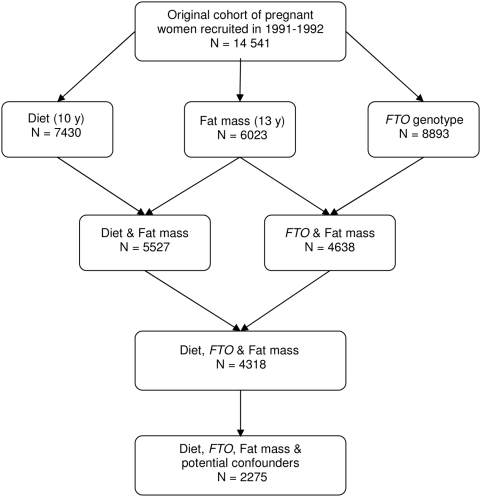
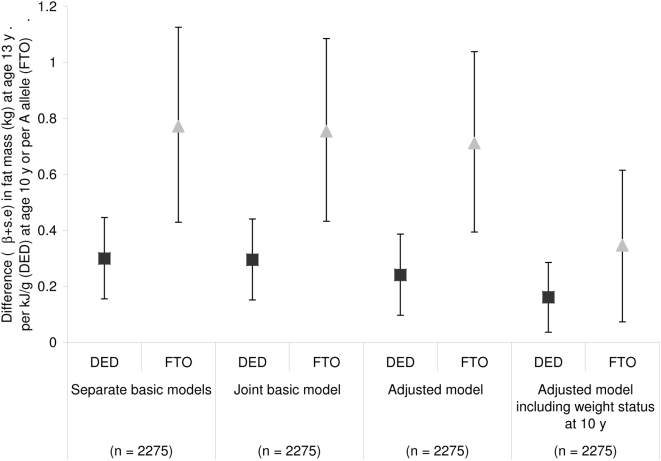
We carried out a prospective analysis on 2,275 children enrolled in the Avon Longitudinal Study of Parents and Children (ALSPAC). Diet was assessed at age 10 y using 3-day diet diaries. DED (kJ/g) was calculated excluding drinks. Children were genotyped for the FTO (rs9939609) variant. Fat mass was estimated at age 13 y using the Lunar Prodigy Dual-energy X-ray Absorptiometry scanner. There was no evidence of interaction between DED at age 10 y and the high risk A allele of the FTO gene in relation to fat mass at age 13 y (beta = 0.005, p = 0.51), suggesting that the FTO gene has no effect on the relation between DED at 10 y and fat mass at 13 y. When DED at 10 y and the A allele of FTO were in the same model they were independently related to fat mass at 13 y. Each A allele of FTO was associated with 0.35+/-0.13 kg more fat mass at 13 y and each 1 kJ/g DED at 10 y was associated with 0.16+/-0.06 kg more fat mass at age 13 y, after controlling for misreporting of energy intake, gender, puberty, overweight status at 10 y, maternal education, TV watching, and physical activity.
This study reveals the multi-factorial origin of obesity and indicates that although FTO may put some children at greater risk of obesity, encouraging a low dietary energy density may be an effective strategy to help all children avoid excessive fat gain.
饮食能量密度(DED)与儿童脂肪量之间不存在简单的线性关系,这表明一些儿童比其他儿童更容易受到DED的影响。携带增加肥胖风险的FTO(rs9939609)变异的儿童可能对DED的影响更敏感,因为他们的内部食欲控制系统受损。我们测试了青春期早期DED与脂肪量之间的关系及其与FTO变异的相互作用。
我们对参与阿冯父母与儿童纵向研究(ALSPAC)的2275名儿童进行了前瞻性分析。在10岁时使用3天饮食日记评估饮食情况。计算DED(千焦/克)时不包括饮料。对儿童进行FTO(rs9939609)变异的基因分型。在13岁时使用Lunar Prodigy双能X线吸收仪估计脂肪量。没有证据表明10岁时的DED与FTO基因的高风险A等位基因之间在13岁时的脂肪量方面存在相互作用(β = 0.005,p = 0.51),这表明FTO基因对10岁时的DED与13岁时的脂肪量之间的关系没有影响。当10岁时的DED和FTO的A等位基因在同一模型中时,它们与13岁时的脂肪量独立相关。在控制了能量摄入误报、性别、青春期、10岁时的超重状态、母亲教育程度、看电视时间和身体活动后,FTO的每个A等位基因与13岁时多0.35±0.13千克的脂肪量相关,10岁时每1千焦/克的DED与13岁时多0.16±0.06千克的脂肪量相关。
本研究揭示了肥胖的多因素起源,并表明尽管FTO可能使一些儿童患肥胖症的风险更高,但鼓励低饮食能量密度可能是帮助所有儿童避免过多脂肪增加的有效策略。