Rigola Diana, van Oeveren Jan, Janssen Antoine, Bonné Anita, Schneiders Harrie, van der Poel Hein J A, van Orsouw Nathalie J, Hogers René C J, de Both Michiel T J, van Eijk Michiel J T
Keygene NV, Wageningen, The Netherlands.
PLoS One. 2009;4(3):e4761. doi: 10.1371/journal.pone.0004761. Epub 2009 Mar 13.
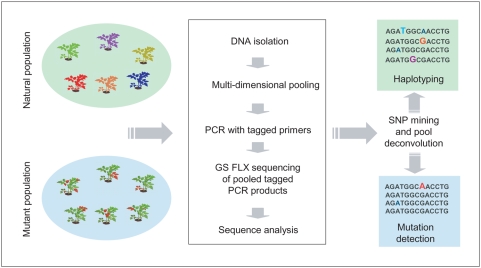
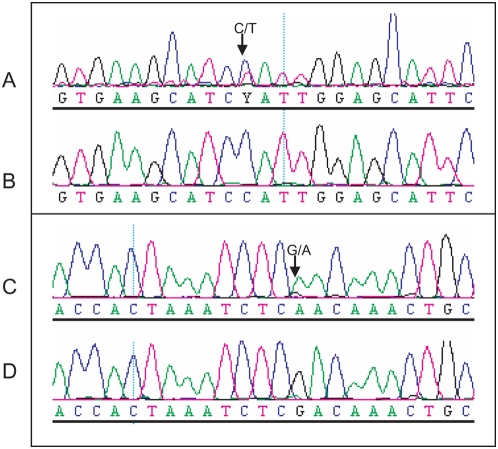
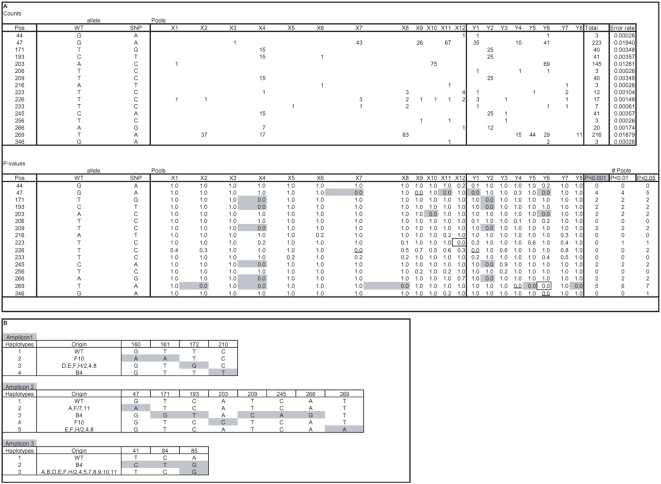
Reverse genetics approaches rely on the detection of sequence alterations in target genes to identify allelic variants among mutant or natural populations. Current (pre-) screening methods such as TILLING and EcoTILLING are based on the detection of single base mismatches in heteroduplexes using endonucleases such as CEL 1. However, there are drawbacks in the use of endonucleases due to their relatively poor cleavage efficiency and exonuclease activity. Moreover, pre-screening methods do not reveal information about the nature of sequence changes and their possible impact on gene function. We present KeyPoint technology, a high-throughput mutation/polymorphism discovery technique based on massive parallel sequencing of target genes amplified from mutant or natural populations. KeyPoint combines multi-dimensional pooling of large numbers of individual DNA samples and the use of sample identification tags ("sample barcoding") with next-generation sequencing technology. We show the power of KeyPoint by identifying two mutants in the tomato eIF4E gene based on screening more than 3000 M2 families in a single GS FLX sequencing run, and discovery of six haplotypes of tomato eIF4E gene by re-sequencing three amplicons in a subset of 92 tomato lines from the EU-SOL core collection. We propose KeyPoint technology as a broadly applicable amplicon sequencing approach to screen mutant populations or germplasm collections for identification of (novel) allelic variation in a high-throughput fashion.
反向遗传学方法依赖于检测目标基因中的序列改变,以在突变体或自然群体中鉴定等位基因变体。当前的(预)筛选方法,如定向诱导基因组局部突变(TILLING)和生态TILLING,是基于使用诸如CEL 1等核酸内切酶检测异源双链体中的单碱基错配。然而,由于核酸内切酶的切割效率相对较低和外切核酸酶活性,在使用核酸内切酶时存在缺点。此外,预筛选方法无法揭示有关序列变化的性质及其对基因功能可能影响的信息。我们提出了关键点技术,这是一种基于对从突变体或自然群体中扩增的目标基因进行大规模平行测序的高通量突变/多态性发现技术。关键点技术将大量个体DNA样本的多维汇集与样本识别标签(“样本条形码”)的使用与下一代测序技术相结合。我们通过在一次GS FLX测序运行中筛选超过3000个M2家系,在番茄eIF4E基因中鉴定出两个突变体,并通过对来自欧盟- SOL核心种质库的92个番茄品系的一个子集的三个扩增子进行重测序,发现了番茄eIF4E基因的六个单倍型,展示了关键点技术的强大功能。我们提出关键点技术作为一种广泛适用的扩增子测序方法,以高通量方式筛选突变群体或种质库,用于鉴定(新的)等位基因变异。