Johnsen Anna T, Tholstrup Dorte, Petersen Morten Aa, Pedersen Lise, Groenvold Mogens
Department of Palliative Medicine, Bispebjerg Hospital, Copenhagen NV, Denmark.
Eur J Haematol. 2009 Aug;83(2):139-48. doi: 10.1111/j.1600-0609.2009.01250.x. Epub 2009 Mar 5.
Knowledge of health related quality of life of haematological patients is limited. This study aimed at investigating the prevalence and predictors of symptoms and problems in a representative sample of haematological patients in Denmark.
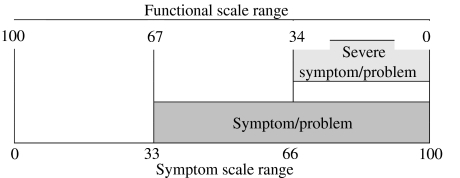
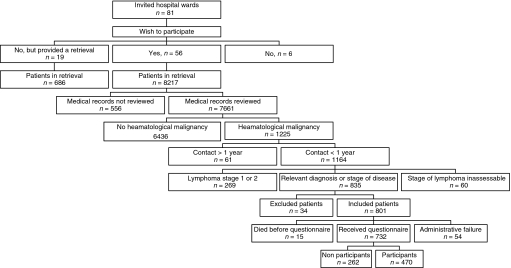
A random sample of patients with leukaemia, multiple myeloma and advanced lymphoma (n = 732) received the European Organisation for Research and Treatment of Cancer quality-of-life questionnaire (EORTC QLQ-C30). Mean scores were calculated. In addition, scores were dichotomised using two thresholds: patients reporting at least 'a little' of each EORTC QLQ-C30 symptom/problem were classified as having a 'symptom/problem', and patients reporting at least 'quite a bit' were classified as having a 'severe symptom/problem'. Multiple logistic regression was used to identify predictors.
In total, 470 (64%) patients participated. The most frequent symptoms/problems were fatigue (55%; severe 20%), reduced role function (49%; severe 23%), insomnia (46%; severe 15%), and pain (37%; severe 15%). Older patients and patients in active antineoplastic treatment had more symptoms and problems. There was only little evidence of social inequalities.
This is probably the first nationally representative study of symptoms and problems in haematological patients. These patients have symptoms/problems that deserve attention. Health related quality of life is an important issue in haematological malignancies.
关于血液学患者健康相关生活质量的了解有限。本研究旨在调查丹麦血液学患者代表性样本中症状和问题的患病率及预测因素。
对白血病、多发性骨髓瘤和晚期淋巴瘤患者的随机样本(n = 732)进行了欧洲癌症研究与治疗组织生活质量问卷(EORTC QLQ-C30)调查。计算了平均得分。此外,使用两个阈值将得分进行二分法划分:报告至少每个EORTC QLQ-C30症状/问题“有点”的患者被归类为有“症状/问题”,报告至少“相当多”的患者被归类为有“严重症状/问题”。采用多元逻辑回归来确定预测因素。
共有470名(64%)患者参与。最常见的症状/问题是疲劳(55%;严重2