Biswas Tithi, Okunieff Paul, Schell Michael C, Smudzin Therese, Pilcher Webster H, Bakos Robert S, Vates G Edward, Walter Kevin A, Wensel Andrew, Korones David N, Milano Michael T
Department of Radiation Oncology, University of Rochester Medical Center, Rochester, NY 14642, USA.
Radiat Oncol. 2009 Mar 17;4:11. doi: 10.1186/1748-717X-4-11.
This retrospective study was done to better understand the conditions for which stereotactic radiosurgery (SRS) for glioblastoma may be efficacious.
Between 2000 and 2007, 33 patients with a pathological diagnosis of glioblastoma received SRS with the Novalis Shaped Beam Radiosurgery system. Eighteen patients (54%) underwent salvage SRS for recurrence while 15 (45%) patients received upfront SRS following standard fractionated RT for newly diagnosed glioblastoma.
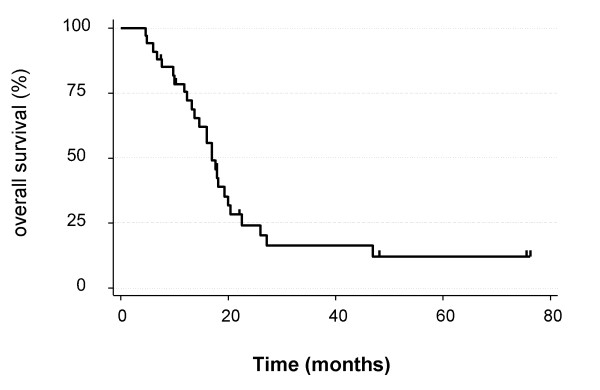
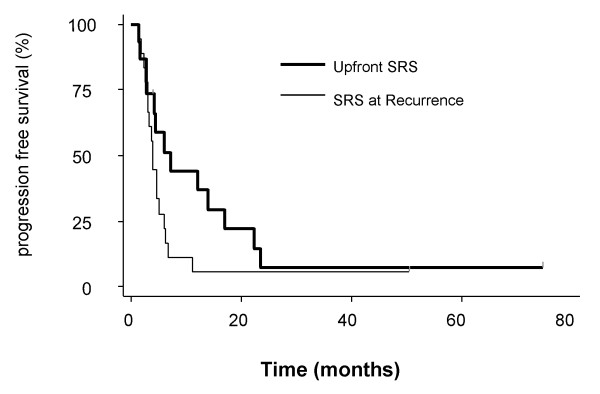
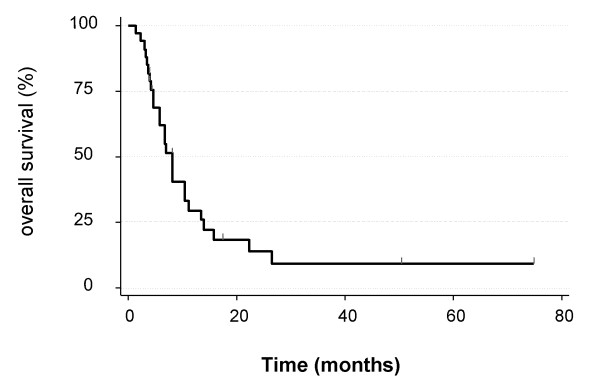
There were no RTOG grade >2 acute side effects. The median survival after SRS was 6.7 months (range 1.4 - 74.7). There was no significant difference in overall survival (from the time of initial diagnosis) with respect to the timing of SRS (p = 0.2). There was significantly better progression free survival in patients treated with SRS as consolidation versus at the time of recurrence (p = 0.04). The majority of patients failed within or at the margin of the SRS treatment volume (21/26 evaluable for recurrence).
SRS is well tolerated in the treatment of glioblastoma. As there was no difference in survival whether SRS is delivered upfront or at recurrence, the treatment for each patient should be individualized. Future studies are needed to identify patients most likely to respond to SRS.
进行这项回顾性研究以更好地了解胶质母细胞瘤立体定向放射外科治疗(SRS)可能有效的情况。
2000年至2007年间,33例经病理诊断为胶质母细胞瘤的患者接受了使用Novalis形束放射外科系统的SRS治疗。18例患者(54%)因复发接受挽救性SRS治疗,15例(45%)患者在新诊断的胶质母细胞瘤接受标准分割放疗后接受初始SRS治疗。
无RTOG 2级以上急性副作用。SRS治疗后的中位生存期为6.7个月(范围1.4 - 74.7个月)。SRS治疗时间对总生存期(从初始诊断时间起)无显著差异(p = 0.2)。与复发时接受SRS治疗的患者相比,巩固治疗时接受SRS治疗的患者无进展生存期显著更好(p = 0.04)。大多数患者在SRS治疗体积内或边缘处出现病情进展(26例可评估复发情况的患者中有21例)。
SRS治疗胶质母细胞瘤耐受性良好。由于SRS在初始治疗或复发时进行治疗,生存期无差异,因此每位患者的治疗应个体化。需要进一步研究以确定最可能对SRS有反应的患者。