Tokars Jerome I, Burkom Howard, Xing Jian, English Roseanne, Bloom Steven, Cox Kenneth, Pavlin Julie A
Centers for Disease Control and Prevention, Atlanta, Georgia, USA.
Emerg Infect Dis. 2009 Apr;15(4):533-9. doi: 10.3201/eid1504.080616.
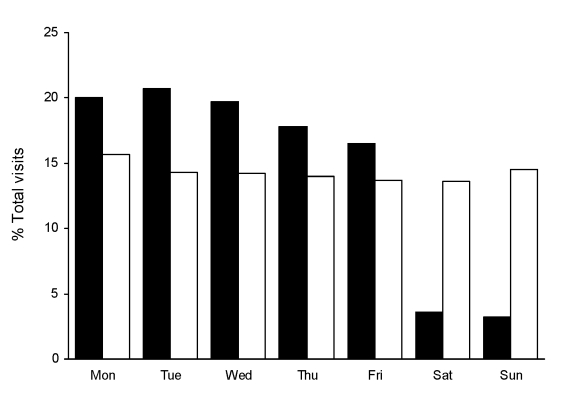
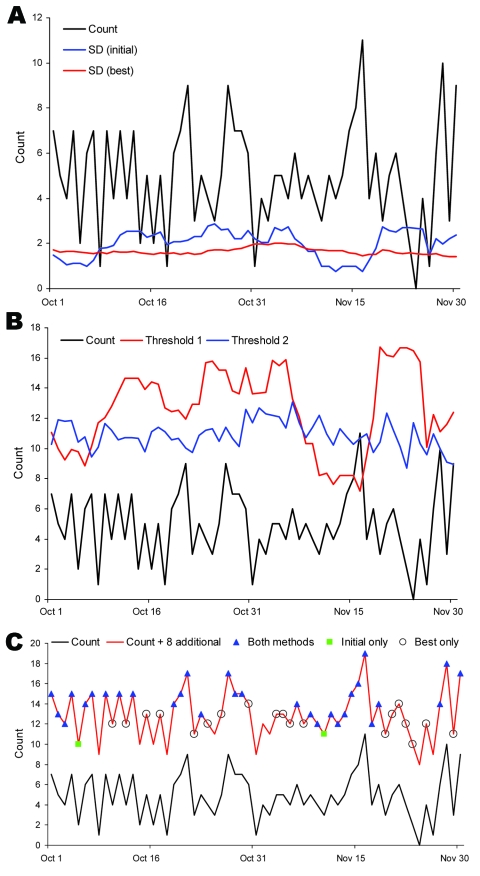
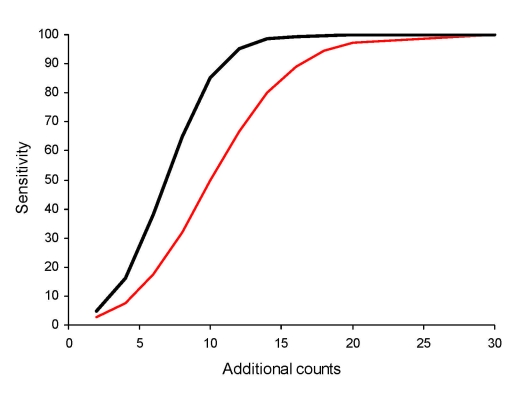
BioSense is a US national system that uses data from health information systems for automated disease surveillance. We studied 4 time-series algorithm modifications designed to improve sensitivity for detecting artificially added data. To test these modified algorithms, we used reports of daily syndrome visits from 308 Department of Defense (DoD) facilities and 340 hospital emergency departments (EDs). At a constant alert rate of 1%, sensitivity was improved for both datasets by using a minimum standard deviation (SD) of 1.0, a 14-28 day baseline duration for calculating mean and SD, and an adjustment for total clinic visits as a surrogate denominator. Stratifying baseline days into weekdays versus weekends to account for day-of-week effects increased sensitivity for the DoD data but not for the ED data. These enhanced methods may increase sensitivity without increasing the alert rate and may improve the ability to detect outbreaks by using automated surveillance system data.
BioSense是一个美国国家系统,它利用健康信息系统的数据进行自动疾病监测。我们研究了4种时间序列算法修改方法,旨在提高检测人为添加数据的敏感性。为了测试这些修改后的算法,我们使用了来自308个国防部设施和340个医院急诊科的每日综合征就诊报告。在恒定1%的警报率下,通过使用1.0的最小标准差(SD)、计算均值和标准差的14 - 28天基线持续时间以及将总门诊就诊次数作为替代分母进行调整,两个数据集的敏感性均得到了提高。将基线天数按工作日和周末分层以考虑一周中的日期效应,提高了国防部数据的敏感性,但对急诊科数据没有效果。这些改进方法可能在不提高警报率的情况下提高敏感性,并可能通过使用自动监测系统数据改善检测疫情的能力。