Centre for Public Health Nutrition, University of Westminster, London, UK.
PLoS Negl Trop Dis. 2009;3(3):e402. doi: 10.1371/journal.pntd.0000402. Epub 2009 Mar 31.
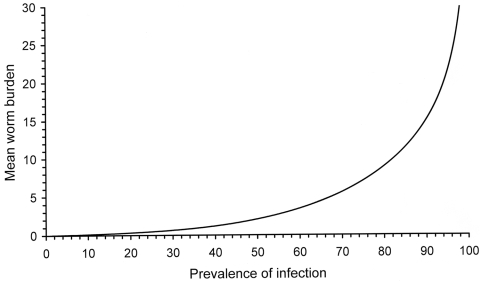
It is estimated that almost a half of all of people living in developing countries today are infected with roundworms, hookworms, or whipworms or combinations of these types of intestinal nematode worms. They can all be treated using safe, effective, and inexpensive single-dose generic drugs costing as little as USD 0.03 per person treated when bought in bulk. The disease caused by intestinal nematodes is strongly related to the number of worms in the gut, and it is typical to find that worms tend to be aggregated or clumped in their distribution so that <20% of people may harbour >80% of all worms. This clumping of worms is greatest when the prevalence is low. When the prevalence rises above 50%, the mean worm burden increases exponentially, worms are less clumped, and more people are likely to have moderate to heavy infections and may be diseased. Children are most at risk. For these reasons, the World Health Organization (WHO) currently recommends mass treatment of children > or =1 year old without prior diagnosis when the prevalence is > or =20% and treatment twice a year when the prevalence is > or =50%.
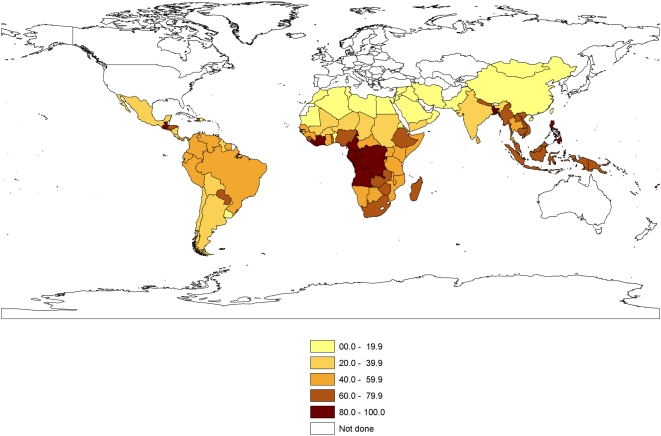
The risk of moderate to heavy infections with intestinal nematodes was estimated by applying the negative binomial probability distribution, then the drug cost of treating diseased individuals was calculated based on different threshold numbers of worms. Based on this cost analysis, a new three-tier treatment regime is proposed: if the combined prevalence is >40%, treat all children once a year; >60% treat twice a year; and >80% treat three times a year. Using average data on drug and delivery costs of USD 0.15 to treat a school-age child and USD 0.25 to treat a pre-school child (with provisos) the cost of treating children aged 2-14 years was calculated for 105 low- and low-middle-income countries and for constituent regions of India and China based on estimates of the combined prevalence of intestinal nematode worms therein. The annual cost of the three-tier threshold was estimated to be USD 224 million compared with USD 276 million when the current WHO recommendations for mass treatment were applied.
The three-tier treatment thresholds were less expensive and more effective as they allocated a greater proportion of expenditures to treating infected individuals when compared with the WHO thresholds (73% compared with 61%) and treated a larger proportion of individuals with moderate to heavy worm burdens, arbitrarily defined as more than 10 worms per person (31% compared with 21%).
据估计,当今生活在发展中国家的近一半人口感染了蛔虫、钩虫或鞭虫,或同时感染了这几种肠道线虫。这些寄生虫都可以用安全、有效且价格低廉的单一剂量通用药物治疗,以批发价购买时,每人的治疗费用低至 0.03 美元。肠道线虫引起的疾病与肠道内的寄生虫数量密切相关,当寄生虫的数量较多时,它们往往会聚集或成团分布,导致不到 20%的人可能携带了 80%以上的寄生虫。当流行率较低时,这种寄生虫的聚集现象最为严重。当流行率上升到 50%以上时,平均寄生虫负荷呈指数级增长,寄生虫的聚集程度降低,更多的人可能会受到中度至重度感染,并可能患病。儿童面临的风险最大。基于这些原因,世界卫生组织(WHO)目前建议在流行率大于或等于 20%时,对未经诊断的 1 岁以上儿童进行大规模治疗,而在流行率大于或等于 50%时,每年进行两次治疗。
采用负二项概率分布来估计中度至重度感染肠道线虫的风险,然后根据不同的寄生虫数量阈值计算治疗患病个体的药物成本。基于这项成本分析,提出了一种新的三层治疗方案:如果总流行率大于 40%,则每年对所有儿童进行一次治疗;如果流行率大于 60%,则每半年治疗一次;如果流行率大于 80%,则每年治疗三次。使用治疗学龄儿童的药物和交付成本的平均值 0.15 美元,以及治疗学龄前儿童的药物和交付成本的平均值 0.25 美元(有前提条件),根据肠道线虫总流行率的估计,计算了 105 个低收入和中低收入国家以及印度和中国的组成地区对 2-14 岁儿童的治疗成本。与目前 WHO 大规模治疗建议相比,新的三层阈值治疗每年的成本估计为 2.24 亿美元,而不是 2.76 亿美元。
与 WHO 阈值(73%对 61%)相比,新的三层治疗阈值将更大比例的支出用于治疗感染人群,并且治疗了更多患有中度至重度虫负荷的个体(任意定义为每人 10 条以上的寄生虫),因此更具成本效益。新的三层治疗阈值的比例为 31%,而不是 21%。