Frischer Josa M, Bramow Stephan, Dal-Bianco Assunta, Lucchinetti Claudia F, Rauschka Helmut, Schmidbauer Manfred, Laursen Henning, Sorensen Per Soelberg, Lassmann Hans
Department of Neuroimmunology, Center for Brain Research, Medical University of Vienna, Spitalgasse 4, A-1090 Wien, Austria.
Brain. 2009 May;132(Pt 5):1175-89. doi: 10.1093/brain/awp070. Epub 2009 Mar 31.
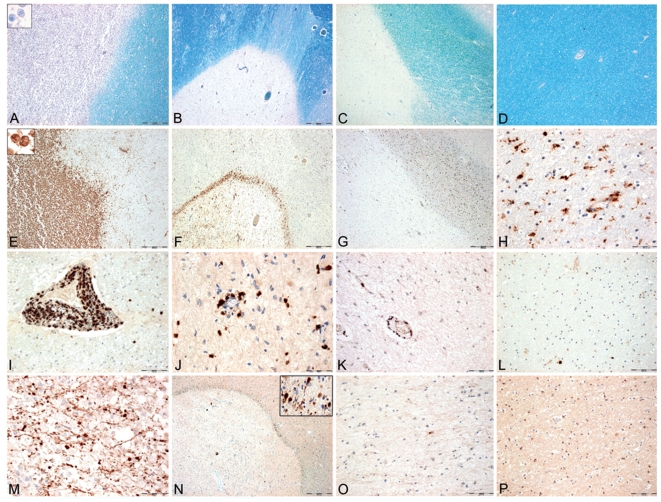
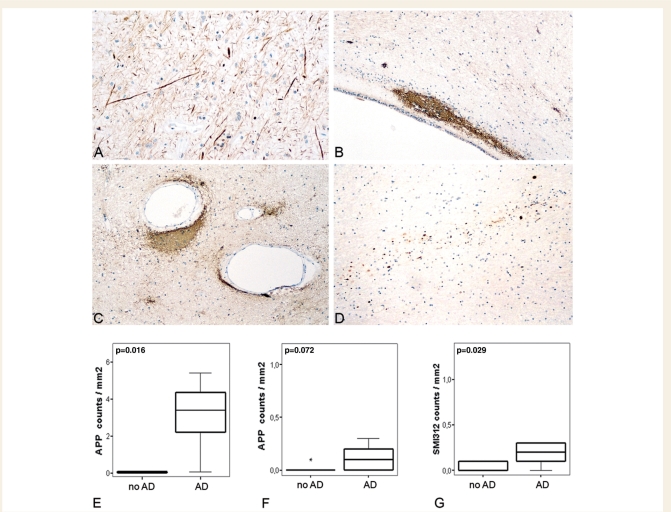
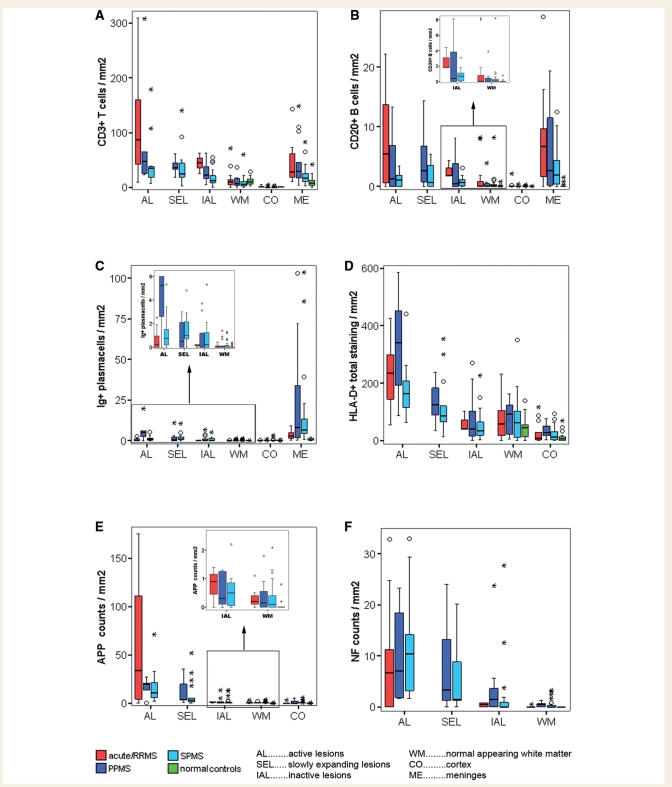
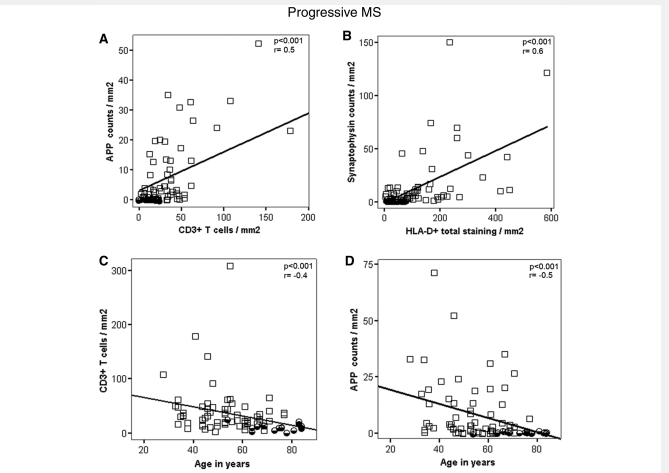
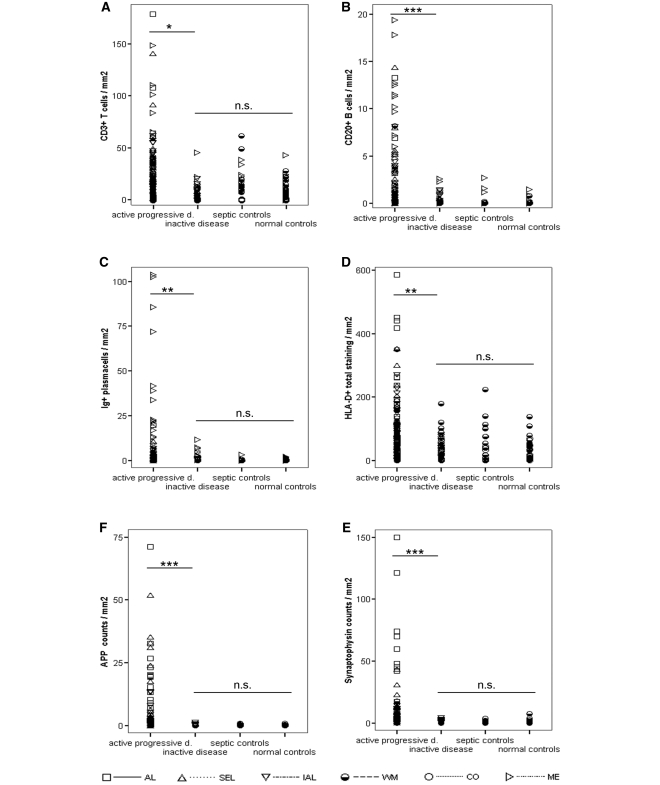
Some recent studies suggest that in progressive multiple sclerosis, neurodegeneration may occur independently from inflammation. The aim of our study was to analyse the interdependence of inflammation, neurodegeneration and disease progression in various multiple sclerosis stages in relation to lesional activity and clinical course, with a particular focus on progressive multiple sclerosis. The study is based on detailed quantification of different inflammatory cells in relation to axonal injury in 67 multiple sclerosis autopsies from different disease stages and 28 controls without neurological disease or brain lesions. We found that pronounced inflammation in the brain is not only present in acute and relapsing multiple sclerosis but also in the secondary and primary progressive disease. T- and B-cell infiltrates correlated with the activity of demyelinating lesions, while plasma cell infiltrates were most pronounced in patients with secondary progressive multiple sclerosis (SPMS) and primary progressive multiple sclerosis (PPMS) and even persisted, when T- and B-cell infiltrates declined to levels seen in age matched controls. A highly significant association between inflammation and axonal injury was seen in the global multiple sclerosis population as well as in progressive multiple sclerosis alone. In older patients (median 76 years) with long-disease duration (median 372 months), inflammatory infiltrates declined to levels similar to those found in age-matched controls and the extent of axonal injury, too, was comparable with that in age-matched controls. Ongoing neurodegeneration in these patients, which exceeded the extent found in normal controls, could be attributed to confounding pathologies such as Alzheimer's or vascular disease. Our study suggests a close association between inflammation and neurodegeneration in all lesions and disease stages of multiple sclerosis. It further indicates that the disease processes of multiple sclerosis may die out in aged patients with long-standing disease.
最近的一些研究表明,在进展性多发性硬化症中,神经退行性变可能独立于炎症而发生。我们研究的目的是分析炎症、神经退行性变和疾病进展在多发性硬化症不同阶段与病灶活动及临床病程之间的相互依存关系,尤其关注进展性多发性硬化症。该研究基于对67例来自不同疾病阶段的多发性硬化症尸检样本以及28例无神经疾病或脑部病变的对照样本中,不同炎症细胞与轴突损伤的详细定量分析。我们发现,脑部明显的炎症不仅存在于急性和复发型多发性硬化症中,也存在于继发进展型和原发进展型疾病中。T细胞和B细胞浸润与脱髓鞘病灶的活动相关,而浆细胞浸润在继发进展型多发性硬化症(SPMS)和原发进展型多发性硬化症(PPMS)患者中最为明显,甚至在T细胞和B细胞浸润降至年龄匹配对照组水平时仍持续存在。在整体多发性硬化症人群以及仅进展性多发性硬化症患者中,炎症与轴突损伤之间均存在高度显著的关联。在病程较长(中位数372个月)的老年患者(中位数76岁)中,炎症浸润降至与年龄匹配对照组相似的水平,轴突损伤程度也与年龄匹配对照组相当。这些患者持续存在的神经退行性变超过了正常对照组,可能归因于诸如阿尔茨海默病或血管疾病等混杂病理因素。我们的研究表明,在多发性硬化症的所有病灶和疾病阶段,炎症与神经退行性变之间存在密切关联。它还进一步表明,多发性硬化症的疾病进程在病程较长的老年患者中可能会逐渐消退。