Alford Spencer C, Pearson Joel D, Carette Amanda, Ingham Robert J, Howard Perry L
Centre for Biomedical Research, University of Victoria, PO Box 3020 Station CSC Victoria, British Columbia, V8W 3N5, Canada.
BMC Biochem. 2009 Apr 3;10:9. doi: 10.1186/1471-2091-10-9.
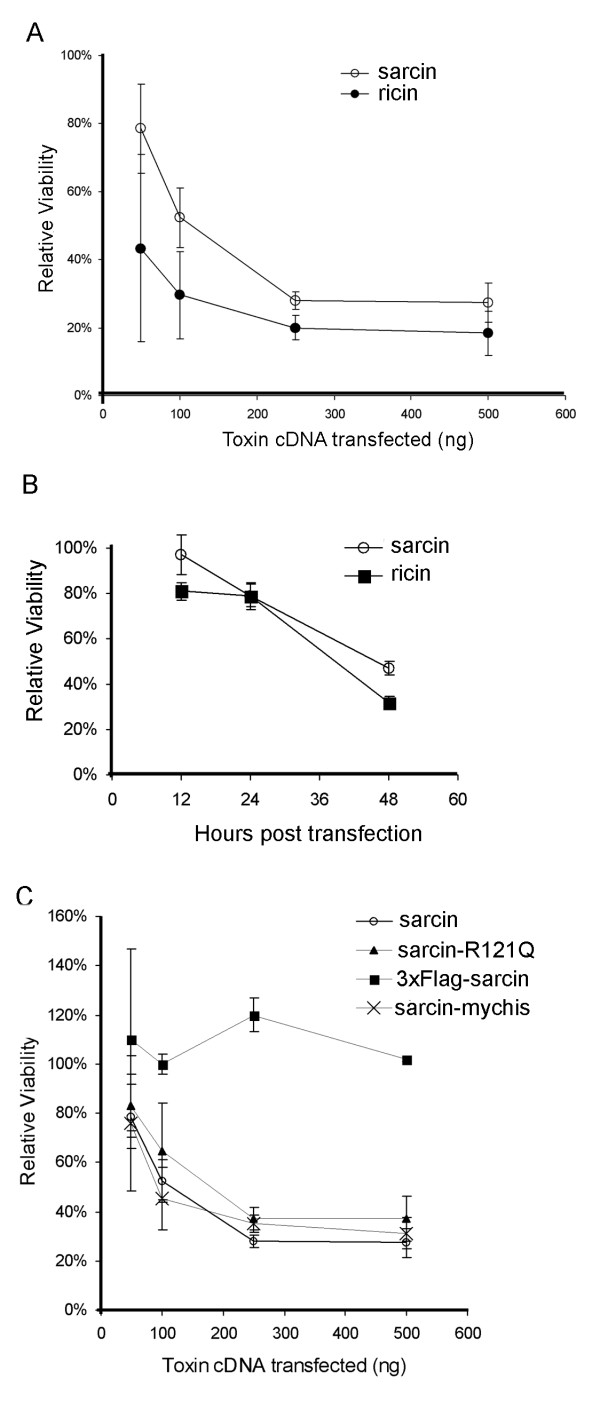
Alpha-sarcin is a protein toxin produced by Aspergillus giganteus. It belongs to a family of cytotoxic ribonucleases that inactivate the ribosome and inhibit protein synthesis. alpha-Sarcin cleaves a single phosphodiester bond within the RNA backbone of the large ribosomal subunit, which makes the ribosome unrecognizable to elongation factors and, in turn, blocks protein synthesis. Although it is widely held that the protein synthesis inhibition caused by the toxin leads to cell death, it has not been directly shown that catalytically inactive mutants of alpha-sarcin are non-toxic when expressed directly within the cytoplasm of cells. This is important since recent studies have cast doubt on whether protein synthesis inhibition is sufficient to initiate apoptosis.
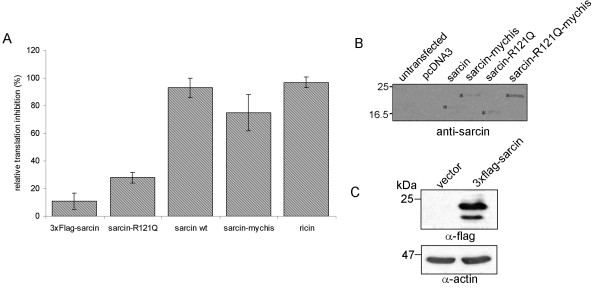
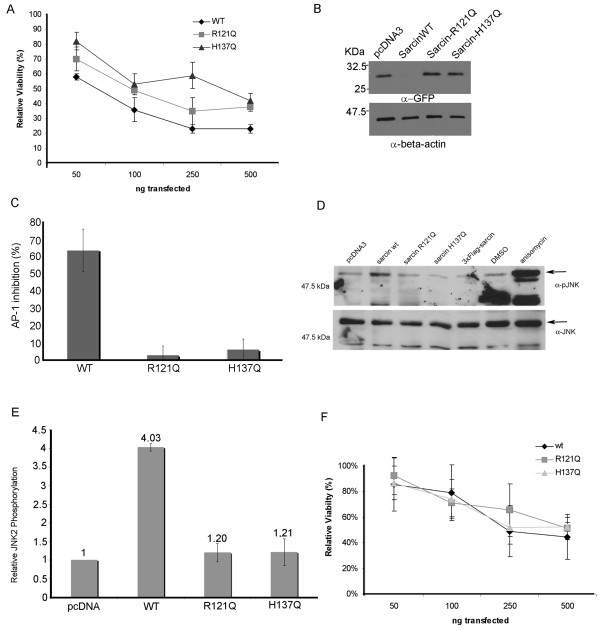
In this report, we assay alpha-sarcin cytotoxicity and ability to inhibit protein synthesis by direct cytoplasmic expression. We show that mutations in alpha-sarcin, which impair alpha-sarcin's ability to inhibit protein synthesis, do not affect its cytotoxicity. The mutants are unable to activate JNK, confirming that the sarcin-ricin loop remains intact and that the alpha-sarcin mutants are catalytically inactive. In addition, both mutant and wildtype variants of alpha-sarcin localize to the nucleus and cytoplasm, where they co-localize with ribosomal marker RPS6.
We conclude that although protein synthesis inhibition likely contributes to cell death, it is not required. Thus, our results suggest that alpha-sarcin can promote cell death through a previously unappreciated mechanism that is independent of rRNA cleavage and JNK activation.
α-肌动蛋白是巨大曲霉产生的一种蛋白质毒素。它属于细胞毒性核糖核酸酶家族,可使核糖体失活并抑制蛋白质合成。α-肌动蛋白在大核糖体亚基的RNA主链内切割一个磷酸二酯键,这使得核糖体无法被延伸因子识别,进而阻断蛋白质合成。尽管人们普遍认为毒素引起的蛋白质合成抑制会导致细胞死亡,但尚未直接证明α-肌动蛋白的催化失活突变体在细胞胞质内直接表达时无毒。这一点很重要,因为最近的研究对蛋白质合成抑制是否足以引发细胞凋亡提出了质疑。
在本报告中,我们通过直接胞质表达来检测α-肌动蛋白的细胞毒性和抑制蛋白质合成的能力。我们发现,α-肌动蛋白中损害其抑制蛋白质合成能力的突变并不影响其细胞毒性。这些突变体无法激活JNK,证实肌动蛋白-蓖麻毒素环保持完整,且α-肌动蛋白突变体催化失活。此外,α-肌动蛋白的突变体和野生型变体均定位于细胞核和细胞质,在那里它们与核糖体标记物RPS6共定位。
我们得出结论,虽然蛋白质合成抑制可能导致细胞死亡,但并非必需。因此,我们的结果表明,α-肌动蛋白可以通过一种以前未被认识的机制促进细胞死亡,该机制独立于rRNA切割和JNK激活。