Browne Eva P, Stapleton Heather M, Kelly Shannon M, Tilton Susan C, Gallagher Evan P
Department of Environmental and Occupational Health Sciences, University of Washington, 4225 Roosevelt Way Northeast, Suite 100, Seattle, WA 98105-6099, USA.
Aquat Toxicol. 2009 May 17;92(4):281-7. doi: 10.1016/j.aquatox.2009.02.017. Epub 2009 Mar 9.
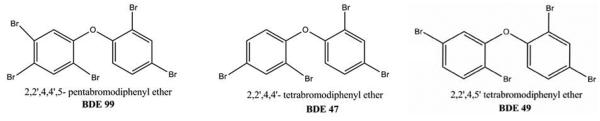
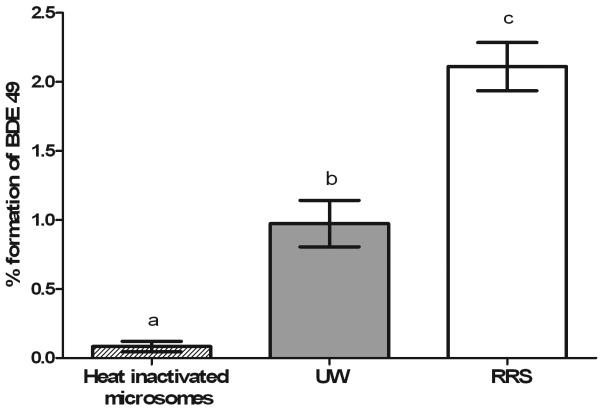
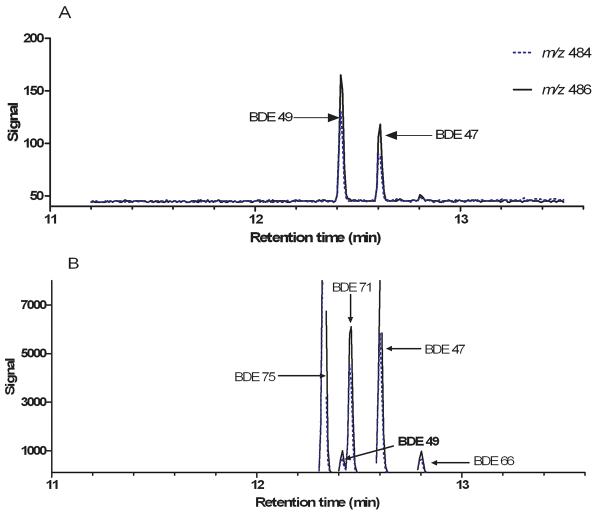
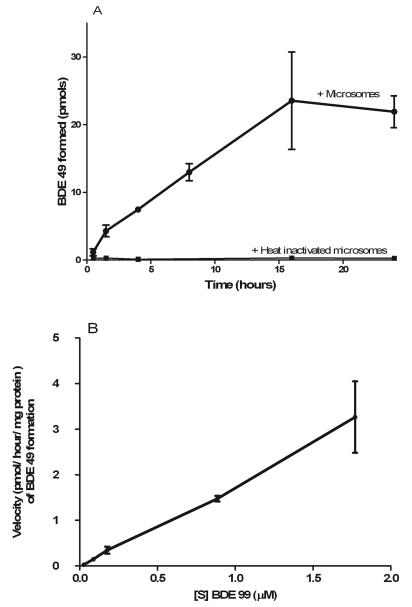
Polybrominated diphenyl ethers (PBDEs) are brominated flame retardants that persist in the environment and are present in geographically widespread fish species. PBDE concentrations can be particularly high in resident Chinook salmon (Onchorhynchus tshawytscha) in the Puget Sound, Washington. Although PBDE residues in salmon and other fish are often dominated by lower brominated congeners, these congeners are not produced commercially in the greatest quantity, suggesting bioaccumulation of the lower molecular weight PBDEs or debromination of more fully brominated congeners. We determined the capacity of Chinook liver fractions to debrominate 2,2',4,4',5-pentabromodiphenyl ether (BDE 99), a model PBDE congener readily debrominated by common carp (Cyprinus caprio). Liver subcellular fractions from two strains of Chinook were incubated with BDE 99 prior to liquid/liquid extraction followed by gas chromatography/mass spectrometry analysis (GC/MS analysis) to identify metabolites and debromination products. In contrast to common carp, debromination of BDE 99 to BDE 47 (2,2',4,4'-tetrabromodiphenyl ether) was not observed in microsomal fractions from either strain of Chinook salmon. However, Chinook salmon liver microsomes from both Chinook strains slowly debrominated BDE 99 to BDE 49 (2,2',4,5'-tetrabromodiphenyl ether), a unique debromination product whose formation has not been reported in other fish. Three-year-old males belonging to a Rapid River Spring Chinook salmon genetic strain showed a somewhat greater microsomal debromination capacity than older hatchery returning male Chinook, but were still inefficient in the debromination of BDE 99 relative to carp. Microsomal debromination of BDE 99 to BDE 49 was not NADPH-dependent, indicating a lack of cytochrome P450 involvement. By contrast, omission of the reductant dithiothreitol (DTT) from Chinook microsomal preparations resulted in a lack of BDE 99 debromination, suggesting the involvement of a microsomal reductase(s) or deiodinase (DI). Cytosolic fractions from Chinook salmon and Common carp debrominated BDE 99 to BDE 49 in vitro. However, carp cytosolic enzymes preferentially formed BDE 47. In summary, our data indicate significant differences among teleosts with respect to efficiency and metabolite profiles of BDE 99 debromination, and suggest that the high concentrations of BDE 47 in resident Chinook salmon from the Puget Sound are not a result of hepatic metabolism of BDE 99. The results of our study also suggest the involvement of an unidentified hepatic reductase or DI in PBDE debromination in fish.
多溴二苯醚(PBDEs)是一类溴化阻燃剂,它们在环境中持久存在,并且在分布于世界各地的鱼类中都有发现。华盛顿普吉特海湾的定居型奇努克鲑鱼(Onchorhynchus tshawytscha)体内的多溴二苯醚浓度可能特别高。尽管鲑鱼和其他鱼类体内的多溴二苯醚残留通常以低溴代同系物为主,但这些同系物并非商业生产中产量最大的,这表明低分子量多溴二苯醚存在生物累积现象,或者更完全溴代的同系物发生了脱溴反应。我们测定了奇努克鲑鱼肝部分对2,2',4,4',5-五溴二苯醚(BDE 99)进行脱溴的能力,BDE 99是一种典型的多溴二苯醚同系物,很容易被鲤鱼(Cyprinus caprio)脱溴。将来自两个品系奇努克鲑鱼的肝亚细胞部分与BDE 99一起孵育,然后进行液-液萃取,接着进行气相色谱/质谱分析(GC/MS分析),以鉴定代谢产物和脱溴产物。与鲤鱼不同,在任何一个品系的奇努克鲑鱼的微粒体部分都未观察到BDE 99脱溴生成BDE 47(2,2',4,4'-四溴二苯醚)。然而,两个奇努克鲑鱼品系的肝微粒体都能将BDE 99缓慢脱溴生成BDE 49(2,2',4,5'-四溴二苯醚),这是一种独特的脱溴产物,在其他鱼类中尚未有其形成的报道。属于急流河春季奇努克鲑鱼遗传品系的三岁雄性奇努克鲑鱼的微粒体脱溴能力比年龄较大的孵化场回游雄性奇努克鲑鱼略强,但相对于鲤鱼,它们对BDE 99的脱溴效率仍然较低。BDE 99微粒体脱溴生成BDE 49不依赖于NADPH,这表明细胞色素P450未参与其中。相比之下,在奇努克鲑鱼微粒体制备物中省略还原剂二硫苏糖醇(DTT)会导致BDE 99脱溴反应缺失,这表明微粒体还原酶或脱碘酶(DI)参与其中。奇努克鲑鱼和鲤鱼的胞质部分在体外可将BDE 99脱溴生成BDE 49。然而,鲤鱼的胞质酶优先生成BDE 47。总之,我们的数据表明硬骨鱼在BDE 99脱溴效率和代谢产物谱方面存在显著差异,并表明普吉特海湾定居型奇努克鲑鱼体内高浓度的BDE 47并非BDE 99肝脏代谢的结果。我们的研究结果还表明,一种未鉴定的肝脏还原酶或DI参与了鱼类体内多溴二苯醚的脱溴过程。