Abraham A D, Menzel W, Varrelmann M, Vetten H Josef
Julius Kuehn Institute, Federal Research Center for Cultivated Plants (JKI), Messeweg 11/12, 38104 Braunschweig, Germany.
Arch Virol. 2009;154(5):791-9. doi: 10.1007/s00705-009-0374-0. Epub 2009 Apr 5.
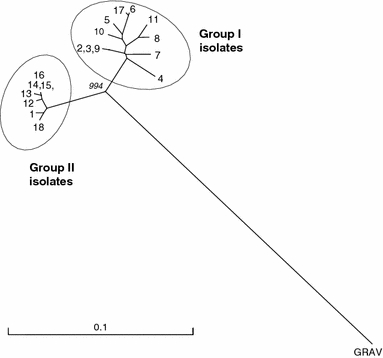
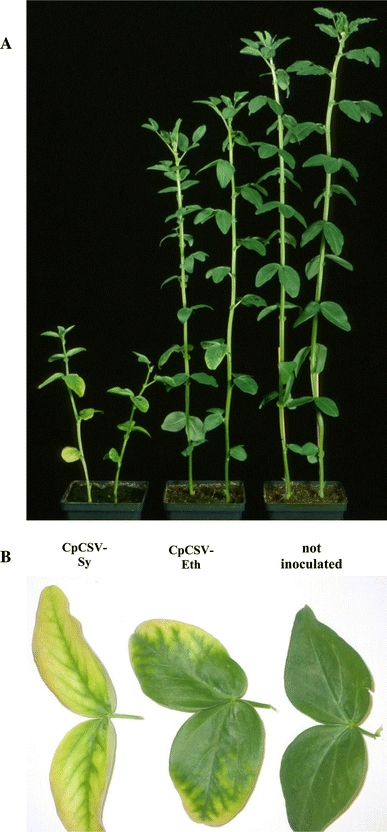
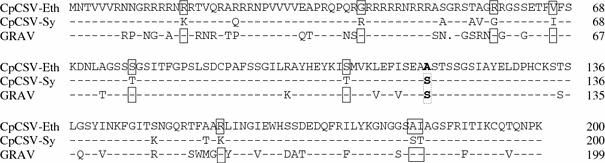
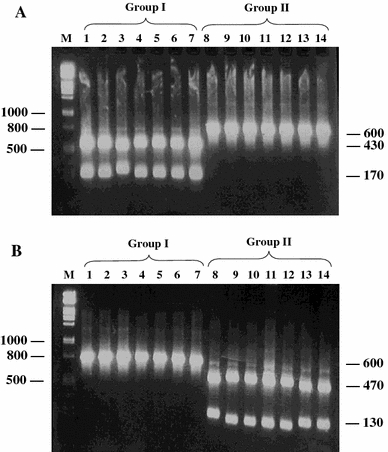
Chickpea chlorotic stunt virus (CpCSV), a proposed new member of the genus Polerovirus (family Luteoviridae), has been reported only from Ethiopia. In attempts to determine the geographical distribution and variability of CpCSV, a pair of degenerate primers derived from conserved domains of the luteovirus coat protein (CP) gene was used for RT-PCR analysis of various legume samples originating from five countries and containing unidentified luteoviruses. Sequencing of the amplicons provided evidence for the occurrence of CpCSV also in Egypt, Morocco, Sudan, and Syria. Phylogenetic analysis of the CP nucleotide sequences of 18 samples from the five countries revealed the existence of two geographic groups of CpCSV isolates differing in CP sequences by 8-10%. Group I included isolates from Ethiopia and Sudan, while group II comprised those from Egypt, Morocco and Syria. For distinguishing these two groups, a simple RFLP test using HindIII and/or PvuII for cleavage of CP-gene-derived PCR products was developed. In ELISA and immunoelectron microscopy, however, isolates from these two groups could not be distinguished with rabbit antisera raised against a group-I isolate from Ethiopia (CpCSV-Eth) and a group-II isolate from Syria (CpCSV-Sy). Since none of the ten monoclonal antibodies (MAbs) that had been produced earlier against CpCSV-Eth reacted with group-II isolates, further MAbs were produced. Of the seven MAbs raised against CpCSV-Sy, two reacted only with CpCSV-Sy and two others with both CpCSV-Sy and -Eth. This indicated that there are group I- and II-specific and common (species-specific) epitopes on the CpCSV CP and that the corresponding MAbs are suitable for specific detection and discrimination of CpCSV isolates. Moreover, CpCSV-Sy (group II) caused more severe stunting and yellowing in faba bean than CpCSV-Eth (group I). In conclusion, our data indicate the existence of a geographically associated variation in the molecular, serological and presumably biological properties of CpCSV.
鹰嘴豆褪绿矮化病毒(CpCSV)是黄症病毒属(黄症病毒科)中一个拟议的新成员,目前仅在埃塞俄比亚有报道。为了确定CpCSV的地理分布和变异性,一对源自黄症病毒外壳蛋白(CP)基因保守结构域的简并引物被用于对来自五个国家且含有未鉴定黄症病毒的各种豆科植物样本进行逆转录聚合酶链反应(RT-PCR)分析。扩增子测序结果证明埃及、摩洛哥、苏丹和叙利亚也存在CpCSV。对来自这五个国家的18个样本的CP核苷酸序列进行系统发育分析,结果显示存在两个地理组的CpCSV分离株,其CP序列相差8 - 10%。第一组包括来自埃塞俄比亚和苏丹的分离株,而第二组包括来自埃及、摩洛哥和叙利亚的分离株。为了区分这两组,开发了一种简单的限制性片段长度多态性(RFLP)检测方法,使用HindIII和/或PvuII切割CP基因衍生的PCR产物。然而,在酶联免疫吸附测定(ELISA)和免疫电子显微镜检测中,用针对来自埃塞俄比亚的第一组分离株(CpCSV-Eth)和来自叙利亚的第二组分离株(CpCSV-Sy)制备的兔抗血清无法区分这两组的分离株。由于之前制备的针对CpCSV-Eth的十种单克隆抗体(MAb)均未与第二组分离株发生反应,因此制备了更多的单克隆抗体。在针对CpCSV-Sy制备的七种单克隆抗体中,两种仅与CpCSV-Sy反应,另外两种与CpCSV-Sy和-Eth均反应。这表明在CpCSV CP上存在第一组和第二组特异性以及共同(种特异性)表位,相应的单克隆抗体适用于CpCSV分离株的特异性检测和鉴别。此外,CpCSV-Sy(第二组)在蚕豆中引起的矮化和黄化比CpCSV-Eth(第一组)更严重。总之,我们的数据表明CpCSV在分子、血清学以及可能的生物学特性方面存在与地理相关的变异。