Chen Jiejin, Callis Patrik R, King Jonathan
Department of Biology, Massachusetts Institute of Technology, Cambridge, Massachusetts 02139, USA.
Biochemistry. 2009 May 5;48(17):3708-16. doi: 10.1021/bi802177g.
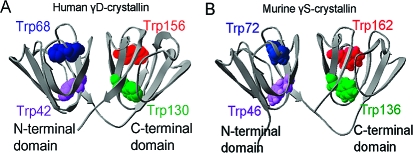
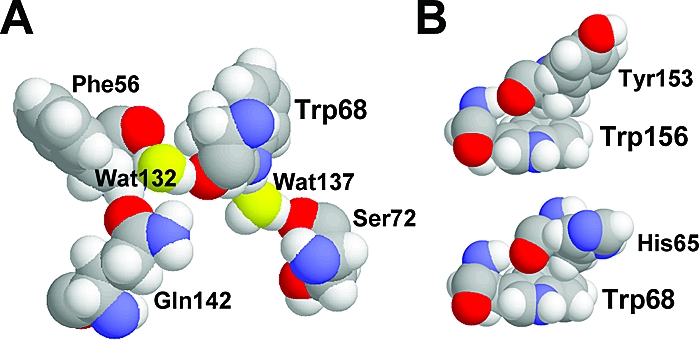
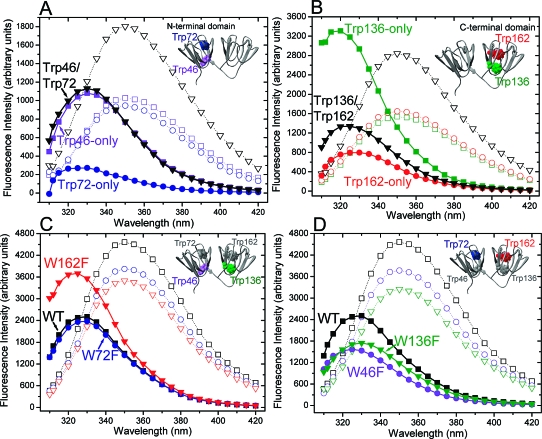
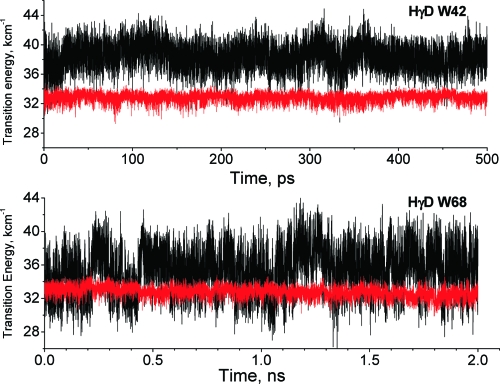
Proteins exposed to UV radiation are subject to irreversible photodamage through covalent modification of tryptophans (Trps) and other UV-absorbing amino acids. Crystallins, the major protein components of the vertebrate eye lens that maintain lens transparency, are exposed to ambient UV radiation throughout life. The duplicated beta-sheet Greek key domains of beta- and gamma-crystallins in humans and all other vertebrates each have two conserved buried Trps. Experiments and computation showed that the fluorescence of these Trps in human gammaD-crystallin is very efficiently quenched in the native state by electrostatically enabled electron transfer to a backbone amide [Chen et al. (2006) Biochemistry 45, 11552-11563]. This dispersal of the excited state energy would be expected to minimize protein damage from covalent scission of the excited Trp ring. We report here both experiments and computation showing that the same fast electron transfer mechanism is operating in a different crystallin, human gammaS-crystallin. Examination of solved structures of other crystallins reveals that the Trp conformation, as well as favorably oriented bound waters, and the proximity of the backbone carbonyl oxygen of the n - 3 residues before the quenched Trps (residue n), are conserved in most crystallins. These results indicate that fast charge transfer quenching is an evolved property of this protein fold, probably protecting it from UV-induced photodamage. This UV resistance may have contributed to the selection of the Greek key fold as the major lens protein in all vertebrates.
暴露于紫外线辐射下的蛋白质会通过色氨酸(Trp)和其他吸收紫外线的氨基酸的共价修饰而遭受不可逆的光损伤。晶状体蛋白是脊椎动物眼晶状体的主要蛋白质成分,可维持晶状体的透明度,其一生都暴露于环境紫外线辐射中。人类和所有其他脊椎动物的β-和γ-晶状体蛋白中重复的β-折叠希腊钥匙结构域各自都有两个保守的埋藏色氨酸。实验和计算表明,人γD-晶状体蛋白中这些色氨酸的荧光在天然状态下通过静电作用使电子转移至主链酰胺而被非常有效地淬灭[Chen等人(2006年)《生物化学》45, 11552 - 11563]。预计激发态能量的这种分散将使激发的色氨酸环共价断裂导致的蛋白质损伤最小化。我们在此报告的实验和计算均表明,相同的快速电子转移机制在另一种晶状体蛋白——人γS-晶状体蛋白中也起作用。对其他晶状体蛋白已解析结构的研究表明,在大多数晶状体蛋白中,色氨酸构象、取向有利的结合水以及淬灭色氨酸(残基n)之前n - 3残基的主链羰基氧的接近程度都是保守的。这些结果表明,快速电荷转移淬灭是这种蛋白质折叠的一种进化特性,可能保护其免受紫外线诱导的光损伤。这种抗紫外线能力可能有助于选择希腊钥匙折叠作为所有脊椎动物的主要晶状体蛋白。