• 文献检索
  • 文档翻译
  • 深度研究
  • 学术资讯
  • Suppr Zotero 插件Zotero 插件
  • 邀请有礼
  • 套餐&价格
  • 历史记录
应用&插件
Suppr Zotero 插件Zotero 插件浏览器插件Mac 客户端Windows 客户端微信小程序
定价
高级版会员购买积分包购买API积分包
服务
文献检索文档翻译深度研究API 文档MCP 服务
关于我们
关于 Suppr公司介绍联系我们用户协议隐私条款
关注我们

Suppr 超能文献

核心技术专利:CN118964589B侵权必究
粤ICP备2023148730 号-1Suppr @ 2026

文献检索

告别复杂PubMed语法,用中文像聊天一样搜索,搜遍4000万医学文献。AI智能推荐,让科研检索更轻松。

立即免费搜索

文件翻译

保留排版,准确专业,支持PDF/Word/PPT等文件格式,支持 12+语言互译。

免费翻译文档

深度研究

AI帮你快速写综述,25分钟生成高质量综述,智能提取关键信息,辅助科研写作。

立即免费体验

用N-乙酰半胱氨酸进行长期治疗会延迟对乙酰氨基酚肝毒性导致的肝脏恢复。

Prolonged treatment with N-acetylcystine delays liver recovery from acetaminophen hepatotoxicity.

作者信息

Yang Runkuan, Miki Keita, He Xin, Killeen Meaghan E, Fink Mitchell P

机构信息

Department of Critical Care Medicine, University of Pittsburgh Medical School, 3550 Terrace Street, Pittsburgh, PA 15261, USA.

出版信息

Crit Care. 2009;13(2):R55. doi: 10.1186/cc7782. Epub 2009 Apr 9.

DOI:10.1186/cc7782
PMID:19358737
原文链接:https://pmc.ncbi.nlm.nih.gov/articles/PMC2689502/
Abstract

INTRODUCTION

Acetaminophen (APAP) toxicity is the most common cause of acute liver failure in the US and Europe. Massive hepatocyte necrosis is the predominant feature of APAP-induced acute liver injury (ALI). Liver regeneration is a vital process for survival after a toxic insult, it occurs at a relative late time point after the injurious phase. Currently, N-acetylcysteine (NAC), a glutathione precursor, is the antidote for acetaminophen overdose. However, NAC is effective only for patients who present within hours of an acute overdose, and is less effective for late-presenting patients. It is possible that in delayed patients, previously reduced endogenous glutathione (GSH) level has restored and prolonged treatment with NAC might be toxic and impair liver regeneration. Therefore, we hypothesize that prolonged treatment with NAC impairs liver regeneration in ALI induced by APAP.

METHODS

ALI was induced in C57BL/6 male mice by a single dose of APAP (350 mg/kg) by intraperitoneal injection. After two hours of APAP challenge, the mice were given 100 mg/kg NAC dissolved in 0.6 mL saline, or saline treatment every 12 hours for a total of 72 hours.

RESULTS

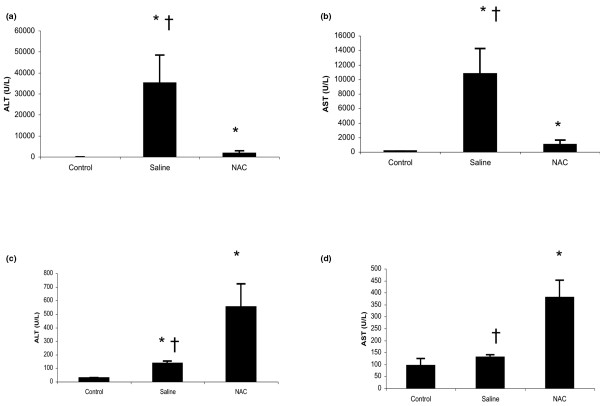
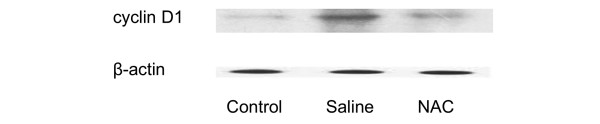
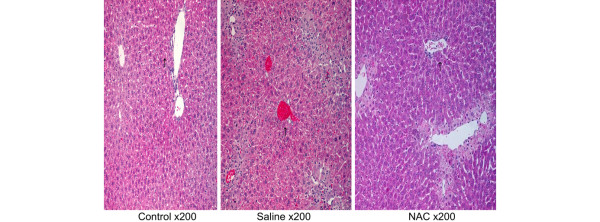
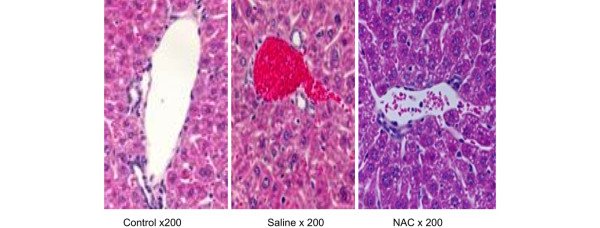
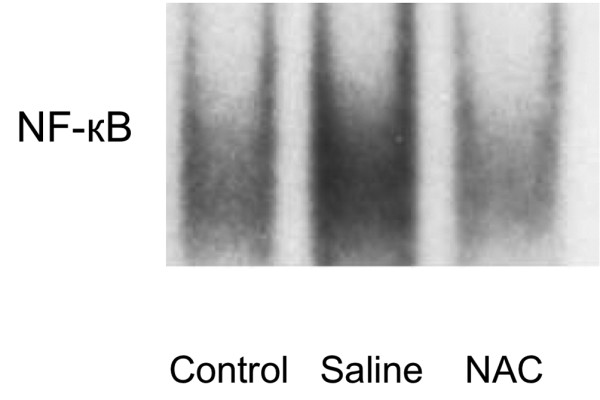
Seventy-two hours after APAP challenge, compared with saline treatment, NAC treatment significantly increased serum transaminases (alanine transaminase/aspartate aminotransferase), induced evident hepatocyte vacuolation in the periportal area and delayed liver regeneration seen in histopathology. This detrimental effect was associated with reduced hepatic nuclear factor (NF)-kappaB DNA binding and decreased expression of cell cycle protein cyclin D1, two important factors in liver regeneration.

CONCLUSIONS

Prolonged treatment with NAC impairs liver regeneration in ALI induced by APAP.

摘要

引言

对乙酰氨基酚(APAP)毒性是美国和欧洲急性肝衰竭最常见的病因。大量肝细胞坏死是APAP诱导的急性肝损伤(ALI)的主要特征。肝再生是毒性损伤后生存的关键过程,它发生在损伤期相对较晚的时间点。目前,谷胱甘肽前体N - 乙酰半胱氨酸(NAC)是对乙酰氨基酚过量的解毒剂。然而,NAC仅对急性过量服用后数小时内就诊的患者有效,对就诊较晚的患者效果较差。对于延迟就诊的患者,内源性谷胱甘肽(GSH)水平可能已经恢复,而NAC的长期治疗可能有毒性并损害肝再生。因此,我们推测NAC的长期治疗会损害APAP诱导的ALI中的肝再生。

方法

通过腹腔注射单剂量APAP(350 mg/kg)在C57BL/6雄性小鼠中诱导ALI。在APAP攻击两小时后,每12小时给小鼠注射溶解于0.6 mL盐水中的100 mg/kg NAC,或进行盐水处理,共72小时。

结果

APAP攻击72小时后,与盐水处理相比,NAC处理显著增加血清转氨酶(丙氨酸转氨酶/天冬氨酸转氨酶),在门周区域诱导明显的肝细胞空泡化,并在组织病理学上延迟肝再生。这种有害作用与肝细胞核因子(NF)-κB DNA结合减少和细胞周期蛋白cyclin D1表达降低有关,这两个是肝再生的重要因素。

结论

NAC的长期治疗会损害APAP诱导的ALI中的肝再生。

https://cdn.ncbi.nlm.nih.gov/pmc/blobs/f242/2689502/d6bfec642e95/cc7782-6.jpg
https://cdn.ncbi.nlm.nih.gov/pmc/blobs/f242/2689502/658968ff9b95/cc7782-1.jpg
https://cdn.ncbi.nlm.nih.gov/pmc/blobs/f242/2689502/4f88529538d7/cc7782-2.jpg
https://cdn.ncbi.nlm.nih.gov/pmc/blobs/f242/2689502/83dec4d001ff/cc7782-3.jpg
https://cdn.ncbi.nlm.nih.gov/pmc/blobs/f242/2689502/123e1cf87546/cc7782-4.jpg
https://cdn.ncbi.nlm.nih.gov/pmc/blobs/f242/2689502/d729f31ee9d9/cc7782-5.jpg
https://cdn.ncbi.nlm.nih.gov/pmc/blobs/f242/2689502/d6bfec642e95/cc7782-6.jpg
https://cdn.ncbi.nlm.nih.gov/pmc/blobs/f242/2689502/658968ff9b95/cc7782-1.jpg
https://cdn.ncbi.nlm.nih.gov/pmc/blobs/f242/2689502/4f88529538d7/cc7782-2.jpg
https://cdn.ncbi.nlm.nih.gov/pmc/blobs/f242/2689502/83dec4d001ff/cc7782-3.jpg
https://cdn.ncbi.nlm.nih.gov/pmc/blobs/f242/2689502/123e1cf87546/cc7782-4.jpg
https://cdn.ncbi.nlm.nih.gov/pmc/blobs/f242/2689502/d729f31ee9d9/cc7782-5.jpg
https://cdn.ncbi.nlm.nih.gov/pmc/blobs/f242/2689502/d6bfec642e95/cc7782-6.jpg

相似文献

1
Prolonged treatment with N-acetylcystine delays liver recovery from acetaminophen hepatotoxicity.用N-乙酰半胱氨酸进行长期治疗会延迟对乙酰氨基酚肝毒性导致的肝脏恢复。
Crit Care. 2009;13(2):R55. doi: 10.1186/cc7782. Epub 2009 Apr 9.
2
Ringer's lactate improves liver recovery in a murine model of acetaminophen toxicity.林格氏乳酸盐可改善对乙酰氨基酚毒性的小鼠模型中的肝恢复。
BMC Gastroenterol. 2011 Nov 15;11:125. doi: 10.1186/1471-230X-11-125.
3
Hepatotoxicity despite early administration of intravenous N-acetylcysteine for acute acetaminophen overdose.尽管早期静脉注射N-乙酰半胱氨酸治疗急性对乙酰氨基酚过量,但仍出现肝毒性。
Acad Emerg Med. 2009 Jan;16(1):34-9. doi: 10.1111/j.1553-2712.2008.00296.x. Epub 2008 Nov 8.
4
Delayed administration of N-acetylcysteine blunts recovery after an acetaminophen overdose unlike 4-methylpyrazole.与 4-甲基吡唑不同,乙酰半胱氨酸延迟给药会削弱对乙酰氨基酚过量后的恢复。
Arch Toxicol. 2021 Oct;95(10):3377-3391. doi: 10.1007/s00204-021-03142-9. Epub 2021 Aug 22.
5
Predicting acute acetaminophen hepatotoxicity with acetaminophen-aminotransferase multiplication product and the Psi parameter.用对乙酰氨基酚-氨基转移酶乘积和 Psi 参数预测急性对乙酰氨基酚肝毒性。
Clin Toxicol (Phila). 2014 Jun;52(5):506-11. doi: 10.3109/15563650.2014.917180. Epub 2014 May 20.
6
High mobility group B1 impairs hepatocyte regeneration in acetaminophen hepatotoxicity.高迁移率族蛋白 B1 可损害对乙酰氨基酚肝毒性中的肝细胞再生。
BMC Gastroenterol. 2012 May 8;12:45. doi: 10.1186/1471-230X-12-45.
7
N-acetylcysteine amide, a promising antidote for acetaminophen toxicity.N-乙酰半胱氨酸酰胺,一种有前景的对乙酰氨基酚中毒解毒剂。
Toxicol Lett. 2016 Jan 22;241:133-42. doi: 10.1016/j.toxlet.2015.11.008. Epub 2015 Nov 19.
8
Can AST/ALT ratio indicate recovery after acute paracetamol poisoning?谷草转氨酶/谷丙转氨酶比值能否提示对乙酰氨基酚急性中毒后的恢复情况?
Clin Toxicol (Phila). 2015 Mar;53(3):164-7. doi: 10.3109/15563650.2015.1006399. Epub 2015 Feb 5.
9
Comparing N-acetylcysteine and 4-methylpyrazole as antidotes for acetaminophen overdose.比较 N-乙酰半胱氨酸和 4-甲基吡唑作为对乙酰氨基酚过量的解毒剂。
Arch Toxicol. 2022 Feb;96(2):453-465. doi: 10.1007/s00204-021-03211-z. Epub 2022 Jan 3.
10
Clinical outcome of massive acetaminophen overdose treated with standard-dose N-acetylcysteine.标准剂量 N-乙酰半胱氨酸治疗大剂量对乙酰氨基酚中毒的临床转归。
Clin Toxicol (Phila). 2021 Oct;59(10):932-936. doi: 10.1080/15563650.2021.1887493. Epub 2021 Feb 23.

引用本文的文献

1
Amelioration of Acetaminophen-Induced Hepatic Oxidative Stress and Inflammation by RNAi Targeting In Vivo.体内RNA干扰靶向改善对乙酰氨基酚诱导的肝脏氧化应激和炎症
Curr Issues Mol Biol. 2025 May 19;47(5):372. doi: 10.3390/cimb47050372.
2
Sulfhydrylated albumin mitigates Acetaminophen-induced liver injury by restoring the integrated HS-albumin thiol antioxidant network.巯基化白蛋白通过恢复完整的HS-白蛋白硫醇抗氧化网络减轻对乙酰氨基酚诱导的肝损伤。
Redox Biol. 2025 Jul 17;85:103774. doi: 10.1016/j.redox.2025.103774.
3
Hepatoprotective action of Sonchus oleraceus against paracetamol-induced toxicity via Nrf2/KEAP-1/HO-1 pathway in relation to its metabolite fingerprint and in silico studies.

本文引用的文献

1
Safety and efficacy of N-acetylcysteine in children with non-acetaminophen-induced acute liver failure.N-乙酰半胱氨酸在非对乙酰氨基酚所致儿童急性肝衰竭中的安全性和有效性。
Liver Transpl. 2008 Jan;14(1):25-30. doi: 10.1002/lt.21246.
2
Safety and efficacy of intravenous N-acetylcysteine for acetaminophen overdose: analysis of the Hunter Area Toxicology Service (HATS) database.静脉注射N-乙酰半胱氨酸治疗对乙酰氨基酚过量的安全性和有效性:亨特地区毒理学服务(HATS)数据库分析
Curr Med Res Opin. 2007 Oct;23(10):2359-68. doi: 10.1185/030079907X219715.
3
Comparative treatment of alpha-amanitin poisoning with N-acetylcysteine, benzylpenicillin, cimetidine, thioctic acid, and silybin in a murine model.
通过Nrf2/KEAP-1/HO-1途径,苦苣菜对扑热息痛诱导的毒性的肝保护作用与其代谢物指纹图谱及计算机模拟研究的关系
PLoS One. 2025 Jun 26;20(6):e0325782. doi: 10.1371/journal.pone.0325782. eCollection 2025.
4
Nimbolide Targeting SIRT1 Protects Against Acetaminophen-Induced Acute Liver Injury by Regulating Oxidative Stress and Endoplasmic Reticulum Stress.靶向沉默调节蛋白1的印楝素通过调节氧化应激和内质网应激来预防对乙酰氨基酚诱导的急性肝损伤。
Pharmacol Res Perspect. 2025 Jun;13(3):e70120. doi: 10.1002/prp2.70120.
5
Underlying mechanisms and treatment of acetaminophen‑induced liver injury (Review).对乙酰氨基酚诱导的肝损伤的潜在机制与治疗(综述)
Mol Med Rep. 2025 Apr;31(4). doi: 10.3892/mmr.2025.13471. Epub 2025 Feb 28.
6
Liver-specific Bcl3 Knockout Alleviates Acetaminophen-induced Liver Injury by Activating Nrf2 Pathway in Male Mice.肝脏特异性Bcl3基因敲除通过激活雄性小鼠的Nrf2信号通路减轻对乙酰氨基酚诱导的肝损伤。
Cell Mol Gastroenterol Hepatol. 2025;19(6):101483. doi: 10.1016/j.jcmgh.2025.101483. Epub 2025 Feb 25.
7
The potential of curcumin in mitigating acetaminophen-induced liver damage.姜黄素在减轻对乙酰氨基酚诱导的肝损伤方面的潜力。
Naunyn Schmiedebergs Arch Pharmacol. 2025 Feb 26. doi: 10.1007/s00210-025-03907-4.
8
Molecular mechanisms in liver repair and regeneration: from physiology to therapeutics.肝脏修复与再生的分子机制:从生理学到治疗学
Signal Transduct Target Ther. 2025 Feb 8;10(1):63. doi: 10.1038/s41392-024-02104-8.
9
Selectively targeting the AdipoR2-CaM-CaMKII-NOS3 axis by SCM-198 as a rapid-acting therapy for advanced acute liver failure.通过SCM-198选择性靶向脂联素受体2-钙调蛋白-钙/钙调蛋白依赖性蛋白激酶II-一氧化氮合酶3轴作为晚期急性肝衰竭的速效疗法。
Nat Commun. 2024 Dec 16;15(1):10690. doi: 10.1038/s41467-024-55295-7.
10
Fructose as a novel nutraceutical for acetaminophen (APAP)-induced hepatotoxicity.果糖作为对乙酰氨基酚(APAP)诱导的肝毒性的新型营养保健品。
Metab Target Organ Damage. 2023;3(4). doi: 10.20517/mtod.2023.28. Epub 2023 Oct 29.
在小鼠模型中用N-乙酰半胱氨酸、苄青霉素、西咪替丁、硫辛酸和水飞蓟宾对α-鹅膏毒肽中毒进行的对比治疗。
Ann Emerg Med. 2007 Sep;50(3):282-8. doi: 10.1016/j.annemergmed.2006.12.015. Epub 2007 Jun 7.
4
Anti-HMGB1 neutralizing antibody ameliorates gut barrier dysfunction and improves survival after hemorrhagic shock.抗高迁移率族蛋白B1中和抗体可改善肠道屏障功能障碍并提高失血性休克后的生存率。
Mol Med. 2006 Apr-Jun;12(4-6):105-14. doi: 10.2119/2006-00010.Yang.
5
Metabolic insights into the hepatoprotective role of N-acetylcysteine in mouse liver.N-乙酰半胱氨酸对小鼠肝脏保护作用的代谢机制研究
Hepatology. 2006 Mar;43(3):454-63. doi: 10.1002/hep.21075.
6
Apoptosis and necrosis in the liver: a tale of two deaths?肝脏中的凋亡与坏死:两种死亡方式的故事?
Hepatology. 2006 Feb;43(2 Suppl 1):S31-44. doi: 10.1002/hep.21062.
7
Intracellular signaling mechanisms of acetaminophen-induced liver cell death.对乙酰氨基酚诱导肝细胞死亡的细胞内信号传导机制。
Toxicol Sci. 2006 Jan;89(1):31-41. doi: 10.1093/toxsci/kfi336. Epub 2005 Sep 21.
8
Tissue repair: an important determinant of final outcome of toxicant-induced injury.组织修复:毒物诱导损伤最终结局的一个重要决定因素。
Toxicol Pathol. 2005;33(1):41-51. doi: 10.1080/01926230590881808.
9
The Australasian Clinical Toxicology Investigators Collaboration randomized trial of different loading infusion rates of N-acetylcysteine.澳大利亚临床毒理学研究人员协作组关于N-乙酰半胱氨酸不同负荷输注速率的随机试验。
Ann Emerg Med. 2005 Apr;45(4):402-8. doi: 10.1016/j.annemergmed.2004.08.040.
10
The nuclear factor HMGB1 mediates hepatic injury after murine liver ischemia-reperfusion.核因子HMGB1介导小鼠肝脏缺血再灌注后的肝损伤。
J Exp Med. 2005 Apr 4;201(7):1135-43. doi: 10.1084/jem.20042614. Epub 2005 Mar 28.