Burton G J, Woods A W, Jauniaux E, Kingdom J C P
Centre for Trophoblast Research, University of Cambridge, Cambridge, UK.
Placenta. 2009 Jun;30(6):473-82. doi: 10.1016/j.placenta.2009.02.009. Epub 2009 Apr 17.
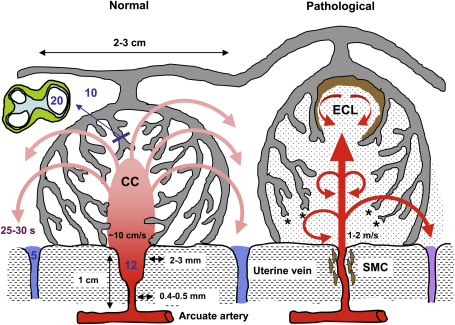
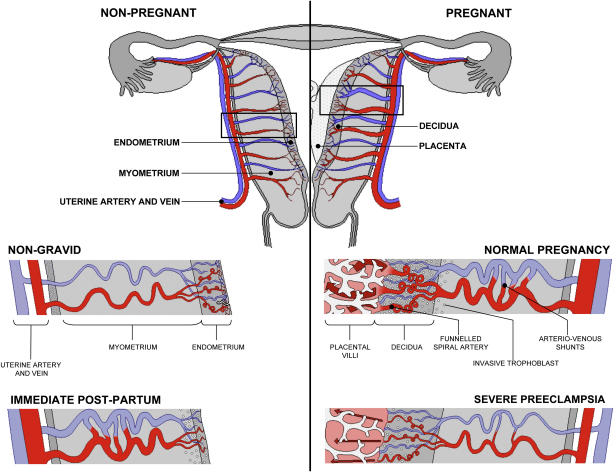
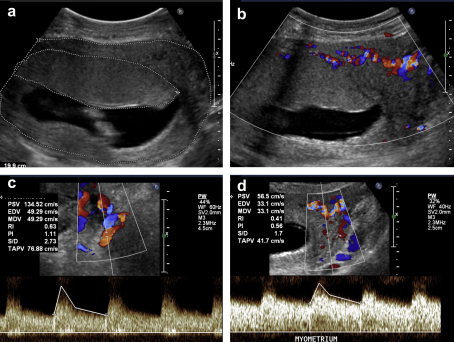
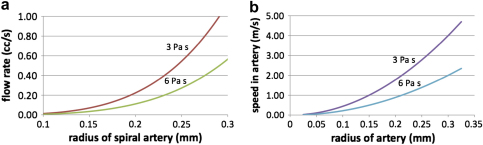
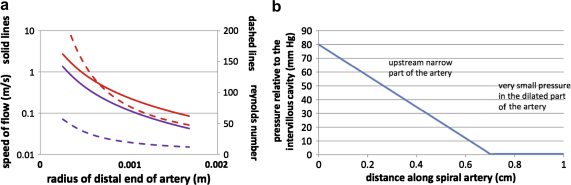
Physiological conversion of the maternal spiral arteries is key to a successful human pregnancy. It involves loss of smooth muscle and the elastic lamina from the vessel wall as far as the inner third of the myometrium, and is associated with a 5-10-fold dilation at the vessel mouth. Failure of conversion accompanies common complications of pregnancy, such as early-onset preeclampsia and fetal growth restriction. Here, we model the effects of terminal dilation on inflow of blood into the placental intervillous space at term, using dimensions in the literature derived from three-dimensional reconstructions. We observe that dilation slows the rate of flow from 2 to 3m/s in the non-dilated part of an artery of 0.4-0.5mm diameter to approximately 10 cm/s at the 2.5mm diameter mouth, depending on the exact radius and viscosity. This rate predicts a transit time through the intervillous space of approximately 25s, which matches observed times closely. The model shows that in the absence of conversion blood will enter the intervillous space as a turbulent jet at rates of 1-2m/s. We speculate that the high momentum will damage villous architecture, rupturing anchoring villi and creating echogenic cystic lesions as evidenced by ultrasound. The retention of smooth muscle will also increase the risk of spontaneous vasoconstriction and ischaemia-reperfusion injury, generating oxidative stress. Dilation has a surprisingly modest impact on total blood flow, and so we suggest the placental pathology associated with deficient conversion is dominated by rheological consequences rather than chronic hypoxia.
母体螺旋动脉的生理性转变是人类成功妊娠的关键。它涉及血管壁直至子宫肌层内三分之一处的平滑肌和弹性膜的缺失,并伴有血管口处5至10倍的扩张。转变失败伴随着常见的妊娠并发症,如早发型子痫前期和胎儿生长受限。在此,我们使用文献中从三维重建得出的尺寸,模拟足月时终末扩张对血液流入胎盘绒毛间隙的影响。我们观察到,根据确切的半径和粘度,扩张会使直径为0.4 - 0.5毫米的动脉未扩张部分的血流速度从2至3米/秒减缓至直径为2.5毫米的血管口处约10厘米/秒。该速度预测通过绒毛间隙的转运时间约为25秒,与观察到的时间非常吻合。模型显示,在没有转变的情况下,血液将以1 - 2米/秒的速度作为湍流射流进入绒毛间隙。我们推测,高动量会破坏绒毛结构,使固定绒毛破裂并产生超声显示的强回声囊性病变。平滑肌的保留也会增加自发血管收缩和缺血再灌注损伤的风险,产生氧化应激。扩张对总血流量的影响出人意料地小,因此我们认为与转变不足相关的胎盘病理主要由流变学后果而非慢性缺氧主导。