Lady Davis Institute for Medical Research, McGill University, Montreal, Quebec, Canada.
J Cell Mol Med. 2010 Apr;14(4):982-91. doi: 10.1111/j.1582-4934.2009.00751.x. Epub 2009 Mar 27.
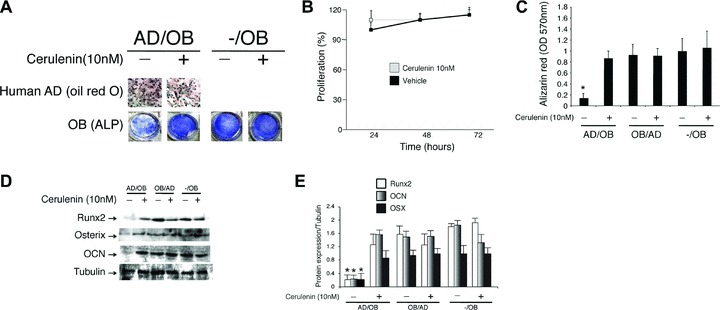
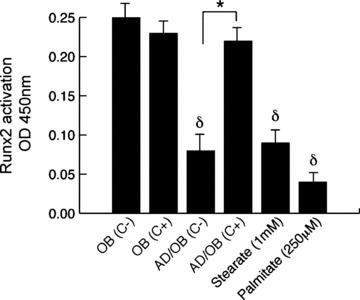
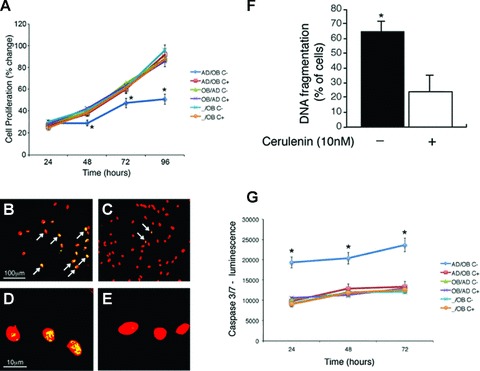
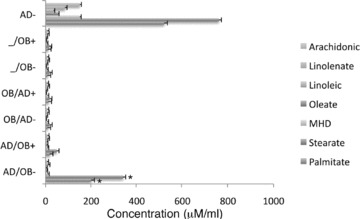
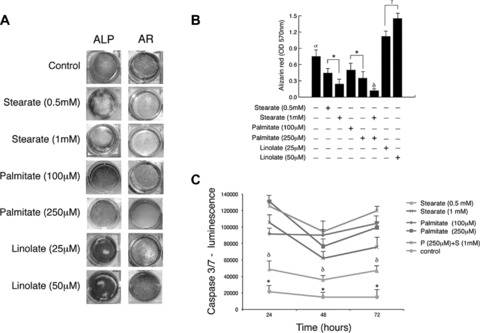
Although increased bone marrow fat in age-related bone loss has been associated with lower trabecular mass, the underlying mechanism responsible remains unknown. We hypothesized that marrow adipocytes exert a lipotoxic effect on osteoblast function and survival through the reversible biosynthesis of fatty acids (FA) into the bone marrow microenvironment. We have used a two-chamber system to co-culture normal human osteoblasts (NHOst) with differentiating pre-adipocytes in the absence or presence of an inhibitor of FA synthase (cerulenin) and separated by an insert that allowed unidirectional trafficking of soluble factors only and prevented direct cell-cell contact. Supernatants were assayed for the presence of FA using mass spectophotometry. After 3 weeks in co-culture, NHOst showed significantly lower levels of differentiation and function based on lower mineralization and expression of alkaline phosphatase, osterix, osteocalcin and Runx2. In addition, NHOst survival was affected by the presence of adipocytes as determined by MTS-formazan and TUNEL assays as well as higher activation of caspases 3/7. These toxic effects were inhibited by addition of cerulenin. Furthermore, culture of NHOst with either adipocyte-conditioned media alone in the absence of adipocytes themselves or with the addition of the most predominant FA (stearate or palmitate) produced similar toxic results. Finally, Runx2 nuclear binding was affected by addition of either adipocyte conditioned media or FA into the osteogenic media. We conclude that the presence of FA within the marrow milieu can contribute to the age-related changes in bone mass and can be prevented by the inhibition of FA synthase.
虽然与年龄相关的骨丢失中骨髓脂肪的增加与小梁骨量减少有关,但导致这种情况的潜在机制尚不清楚。我们假设骨髓脂肪细胞通过将脂肪酸(FA)可逆地合成到骨髓微环境中,对成骨细胞的功能和存活产生脂毒性作用。我们使用双室系统将正常人类成骨细胞(NHOst)与分化前脂肪细胞共培养,在不存在或存在脂肪酸合酶抑制剂(曲古抑菌素)的情况下,通过允许可溶性因子单向运输但防止直接细胞-细胞接触的插入物进行分离。使用质谱法测定上清液中 FA 的存在。在共培养 3 周后,NHOst 的分化和功能明显降低,表现为矿化程度降低,碱性磷酸酶、osterix、骨钙素和 Runx2 的表达降低。此外,脂肪细胞的存在通过 MTS-甲臜和 TUNEL 测定以及 caspase 3/7 的更高激活来影响 NHOst 的存活。这些毒性作用可通过添加曲古抑菌素来抑制。此外,在不存在脂肪细胞的情况下,单独培养 NHOst 与脂肪细胞条件培养基或添加最主要的 FA(硬脂酸或棕榈酸)会产生类似的毒性结果。最后,Runx2 核结合受添加脂肪细胞条件培养基或 FA 到成骨培养基的影响。我们得出结论,骨髓环境中 FA 的存在可能导致与年龄相关的骨量变化,并可通过抑制 FA 合酶来预防。