• 文献检索
  • 文档翻译
  • 深度研究
  • 学术资讯
  • Suppr Zotero 插件Zotero 插件
  • 邀请有礼
  • 套餐&价格
  • 历史记录
应用&插件
Suppr Zotero 插件Zotero 插件浏览器插件Mac 客户端Windows 客户端微信小程序
定价
高级版会员购买积分包购买API积分包
服务
文献检索文档翻译深度研究API 文档MCP 服务
关于我们
关于 Suppr公司介绍联系我们用户协议隐私条款
关注我们

Suppr 超能文献

核心技术专利:CN118964589B侵权必究
粤ICP备2023148730 号-1Suppr @ 2026

文献检索

告别复杂PubMed语法,用中文像聊天一样搜索,搜遍4000万医学文献。AI智能推荐,让科研检索更轻松。

立即免费搜索

文件翻译

保留排版,准确专业,支持PDF/Word/PPT等文件格式,支持 12+语言互译。

免费翻译文档

深度研究

AI帮你快速写综述,25分钟生成高质量综述,智能提取关键信息,辅助科研写作。

立即免费体验

面部裂隙的遗传决定因素:利用来自斯堪的纳维亚半岛的两项全国性腭裂研究对357个候选基因进行分析。

Genetic determinants of facial clefting: analysis of 357 candidate genes using two national cleft studies from Scandinavia.

作者信息

Jugessur Astanand, Shi Min, Gjessing Håkon Kristian, Lie Rolv Terje, Wilcox Allen James, Weinberg Clarice Ring, Christensen Kaare, Boyles Abee Lowman, Daack-Hirsch Sandra, Trung Truc Nguyen, Bille Camilla, Lidral Andrew Carl, Murray Jeffrey Clark

机构信息

Craniofacial Development, Musculoskeletal Disorders, Murdoch Childrens Research Institute, Royal Children's Hospital, Parkville, Australia.

出版信息

PLoS One. 2009;4(4):e5385. doi: 10.1371/journal.pone.0005385. Epub 2009 Apr 29.

DOI:10.1371/journal.pone.0005385
PMID:19401770
原文链接:https://pmc.ncbi.nlm.nih.gov/articles/PMC2671138/
Abstract

BACKGROUND

Facial clefts are common birth defects with a strong genetic component. To identify fetal genetic risk factors for clefting, 1536 SNPs in 357 candidate genes were genotyped in two population-based samples from Scandinavia (Norway: 562 case-parent and 592 control-parent triads; Denmark: 235 case-parent triads).

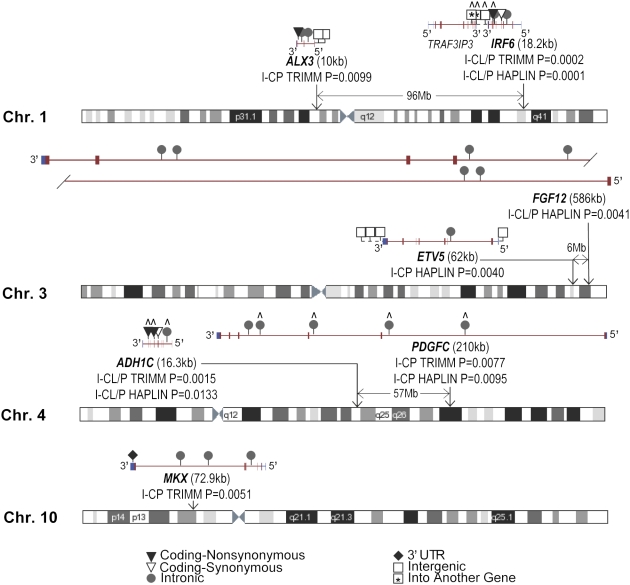
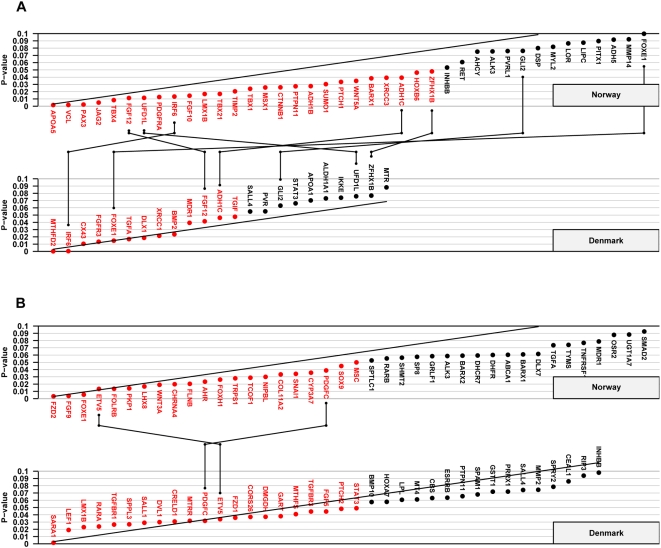
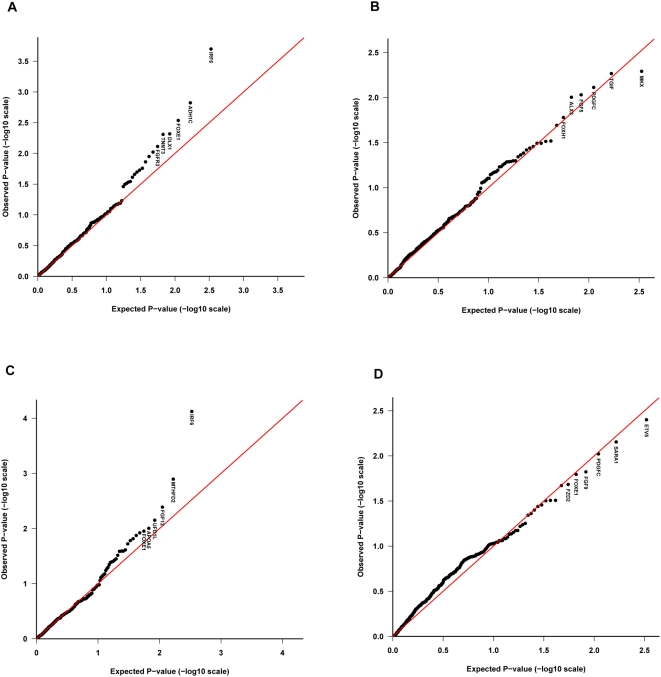
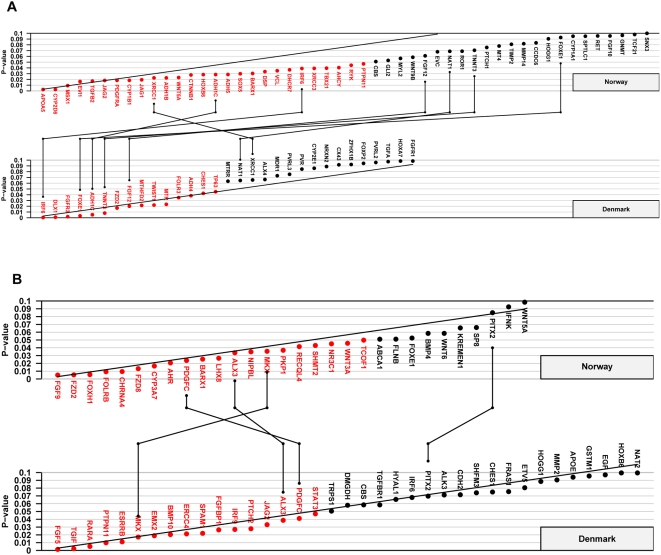
METHODOLOGY/PRINCIPAL FINDINGS: We used two complementary statistical methods, TRIMM and HAPLIN, to look for associations across these two national samples. TRIMM tests for association in each gene by using multi-SNP genotypes from case-parent triads directly without the need to infer haplotypes. HAPLIN on the other hand estimates the full haplotype distribution over a set of SNPs and estimates relative risks associated with each haplotype. For isolated cleft lip with or without cleft palate (I-CL/P), TRIMM and HAPLIN both identified significant associations with IRF6 and ADH1C in both populations, but only HAPLIN found an association with FGF12. For isolated cleft palate (I-CP), TRIMM found associations with ALX3, MKX, and PDGFC in both populations, but only the association with PDGFC was identified by HAPLIN. In addition, HAPLIN identified an association with ETV5 that was not detected by TRIMM.

CONCLUSION/SIGNIFICANCE: Strong associations with seven genes were replicated in the Scandinavian samples and our approach effectively replicated the strongest previously known association in clefting--with IRF6. Based on two national cleft cohorts of similar ancestry, two robust statistical methods and a large panel of SNPs in the most promising cleft candidate genes to date, this study identified a previously unknown association with clefting for ADH1C and provides additional candidates and analytic approaches to advance the field.

摘要

背景

面部裂隙是常见的出生缺陷,具有很强的遗传因素。为了确定胎儿发生裂隙的遗传风险因素,在来自斯堪的纳维亚半岛的两个基于人群的样本中,对357个候选基因中的1536个单核苷酸多态性(SNP)进行了基因分型(挪威:562个病例-父母和592个对照-父母三联体;丹麦:235个病例-父母三联体)。

方法/主要发现:我们使用了两种互补的统计方法,即TRIMM和HAPLIN,来在这两个国家样本中寻找关联。TRIMM通过直接使用病例-父母三联体的多SNP基因型来检测每个基因中的关联,无需推断单倍型。另一方面,HAPLIN估计一组SNP上的完整单倍型分布,并估计与每个单倍型相关的相对风险。对于单纯性唇裂伴或不伴腭裂(I-CL/P),TRIMM和HAPLIN在两个人群中均发现与IRF6和ADH1C存在显著关联,但只有HAPLIN发现与FGF12存在关联(在两个人群中)。对于单纯性腭裂(I-CP),TRIMM在两个人群中均发现与ALX3、MKX和PDGFC存在关联,但只有与PDGFC的关联被HAPLIN识别。此外,HAPLIN识别出与ETV5存在关联,而TRIMM未检测到。

结论/意义:在斯堪的纳维亚样本中重复发现了与七个基因的强关联,并且我们的方法有效地重复了先前已知的在裂隙形成中最强的关联——与IRF6的关联。基于两个具有相似血统的国家腭裂队列、两种稳健的统计方法以及迄今为止在最有希望的腭裂候选基因中的一大组SNP,本研究确定了ADH1C与腭裂的一种先前未知的关联,并提供了额外的候选基因和分析方法以推动该领域的发展。
https://cdn.ncbi.nlm.nih.gov/pmc/blobs/1de9/2671138/22c34236da5b/pone.0005385.g004.jpg
https://cdn.ncbi.nlm.nih.gov/pmc/blobs/1de9/2671138/fdaae967caf1/pone.0005385.g001.jpg
https://cdn.ncbi.nlm.nih.gov/pmc/blobs/1de9/2671138/edbb12490ffc/pone.0005385.g002.jpg
https://cdn.ncbi.nlm.nih.gov/pmc/blobs/1de9/2671138/6e6134e898c3/pone.0005385.g003.jpg
https://cdn.ncbi.nlm.nih.gov/pmc/blobs/1de9/2671138/22c34236da5b/pone.0005385.g004.jpg
https://cdn.ncbi.nlm.nih.gov/pmc/blobs/1de9/2671138/fdaae967caf1/pone.0005385.g001.jpg
https://cdn.ncbi.nlm.nih.gov/pmc/blobs/1de9/2671138/edbb12490ffc/pone.0005385.g002.jpg
https://cdn.ncbi.nlm.nih.gov/pmc/blobs/1de9/2671138/6e6134e898c3/pone.0005385.g003.jpg
https://cdn.ncbi.nlm.nih.gov/pmc/blobs/1de9/2671138/22c34236da5b/pone.0005385.g004.jpg

相似文献

1
Genetic determinants of facial clefting: analysis of 357 candidate genes using two national cleft studies from Scandinavia.面部裂隙的遗传决定因素:利用来自斯堪的纳维亚半岛的两项全国性腭裂研究对357个候选基因进行分析。
PLoS One. 2009;4(4):e5385. doi: 10.1371/journal.pone.0005385. Epub 2009 Apr 29.
2
Maternal genes and facial clefts in offspring: a comprehensive search for genetic associations in two population-based cleft studies from Scandinavia.母系基因与子女的面裂:对来自斯堪的纳维亚的两项基于人群的面裂研究中遗传关联性的全面搜索。
PLoS One. 2010 Jul 9;5(7):e11493. doi: 10.1371/journal.pone.0011493.
3
X-linked genes and risk of orofacial clefts: evidence from two population-based studies in Scandinavia.X 连锁基因与口腔面裂风险:来自斯堪的纳维亚两个基于人群的研究证据。
PLoS One. 2012;7(6):e39240. doi: 10.1371/journal.pone.0039240. Epub 2012 Jun 19.
4
Genetic variants in IRF6 and the risk of facial clefts: single-marker and haplotype-based analyses in a population-based case-control study of facial clefts in Norway.IRF6基因变异与面部裂隙风险:挪威一项基于人群的面部裂隙病例对照研究中的单标记和单倍型分析
Genet Epidemiol. 2008 Jul;32(5):413-24. doi: 10.1002/gepi.20314.
5
Association of candidate genes with nonsyndromic clefts in Honduran and Colombian populations.候选基因与洪都拉斯和哥伦比亚人群中非综合征性裂隙的关联。
Laryngoscope. 2012 Sep;122(9):2082-7. doi: 10.1002/lary.23394. Epub 2012 Jul 2.
6
A new approach to chromosome-wide analysis of X-linked markers identifies new associations in Asian and European case-parent triads of orofacial clefts.一种对X连锁标记进行全染色体分析的新方法,在亚洲和欧洲唇腭裂病例-父母三联体中发现了新的关联。
PLoS One. 2017 Sep 6;12(9):e0183772. doi: 10.1371/journal.pone.0183772. eCollection 2017.
7
Fetal genetic risk of isolated cleft lip only versus isolated cleft lip and palate: a subphenotype analysis using two population-based studies of orofacial clefts in Scandinavia.单纯性唇裂与唇腭裂的胎儿遗传风险:一项基于斯堪的纳维亚两项口面部裂隙人群研究的亚表型分析
Birth Defects Res A Clin Mol Teratol. 2011 Feb;91(2):85-92. doi: 10.1002/bdra.20747. Epub 2010 Dec 7.
8
Evidence of gene-environment interaction for the IRF6 gene and maternal multivitamin supplementation in controlling the risk of cleft lip with/without cleft palate.IRF6 基因与母亲多维元素补充剂在控制唇裂伴/不伴腭裂风险中的基因-环境相互作用的证据。
Hum Genet. 2010 Oct;128(4):401-10. doi: 10.1007/s00439-010-0863-y. Epub 2010 Jul 23.
9
Association Studies Between Regulatory Regions of / Genes and Nonsyndromic Oral Clefts.基因调控区域与非综合征性口腔颌面部裂隙的关联研究
Cleft Palate Craniofac J. 2019 Jul;56(6):778-785. doi: 10.1177/1055665618809244. Epub 2018 Nov 12.
10
Interferon regulatory factor 6 (IRF6) gene variants and the risk of isolated cleft lip or palate.干扰素调节因子6(IRF6)基因变异与单纯唇裂或腭裂的风险
N Engl J Med. 2004 Aug 19;351(8):769-80. doi: 10.1056/NEJMoa032909.

引用本文的文献

1
The impact of developmental genes in non-syndromic cleft lip and/or palate.发育基因在非综合征性唇腭裂中的影响。
J Turk Ger Gynecol Assoc. 2023 Mar 15;24(1):57-64. doi: 10.4274/jtgga.galenos.2022.2021-10-7.
2
Craniofacial development in patients of Tessier No.0 cleft with a bifid nose using 3D computed tomography.使用三维计算机断层扫描技术对伴有鼻裂的第0号泰西埃裂患者的颅面发育情况进行研究。
Front Pediatr. 2022 Aug 24;10:979345. doi: 10.3389/fped.2022.979345. eCollection 2022.
3
Genetics and signaling mechanisms of orofacial clefts.

本文引用的文献

1
Genome scan, fine-mapping, and candidate gene analysis of non-syndromic cleft lip with or without cleft palate reveals phenotype-specific differences in linkage and association results.非综合征性唇裂伴或不伴腭裂的基因组扫描、精细定位及候选基因分析揭示了连锁和关联结果中特定表型的差异。
Hum Hered. 2009;68(3):151-70. doi: 10.1159/000224636. Epub 2009 Jun 11.
2
The PDGF-C regulatory region SNP rs28999109 decreases promoter transcriptional activity and is associated with CL/P.血小板衍生生长因子C调控区单核苷酸多态性rs28999109降低启动子转录活性,并与唇腭裂相关。
Eur J Hum Genet. 2009 Jun;17(6):774-84. doi: 10.1038/ejhg.2008.245. Epub 2008 Dec 17.
3
口腔颌面裂的遗传学和信号机制。
Birth Defects Res. 2020 Nov;112(19):1588-1634. doi: 10.1002/bdr2.1754. Epub 2020 Jul 15.
4
Likely Pathogenic Variants in One Third of Non-Syndromic Discontinuous Cleft Lip and Palate Patients.三分之一非综合征性唇腭裂患者存在可能的致病性变异。
Genes (Basel). 2019 Oct 22;10(10):833. doi: 10.3390/genes10100833.
5
Two novel genes TOX3 and COL21A1 in large extended Malay families with nonsyndromic cleft lip and/or palate.在患有非综合征性唇裂和/或腭裂的大型马来裔家族中发现的两个新基因TOX3和COL21A1 。
Mol Genet Genomic Med. 2019 May;7(5):e635. doi: 10.1002/mgg3.635. Epub 2019 Mar 28.
6
A Genome-Wide Search for Gene-Environment Effects in Isolated Cleft Lip with or without Cleft Palate Triads Points to an Interaction between Maternal Periconceptional Vitamin Use and Variants in .一项针对孤立性唇裂伴或不伴腭裂三联体中基因-环境效应的全基因组搜索表明,孕期维生素使用与……中的变异之间存在相互作用。
Front Genet. 2018 Feb 26;9:60. doi: 10.3389/fgene.2018.00060. eCollection 2018.
7
Analysis of Parent-of-Origin Effects on the X Chromosome in Asian and European Orofacial Cleft Triads Identifies Associations with , and Additional Loci at Xp22.2.亚洲和欧洲口面部裂隙三联体中X染色体亲本来源效应分析确定了与Xp22.2相关的关联及其他基因座。
Front Genet. 2018 Feb 22;9:25. doi: 10.3389/fgene.2018.00025. eCollection 2018.
8
Association of ARID5B Genetic Variants with Risk of Childhood B Cell Precursor Acute Lymphoblastic Leukaemia in Latvia.拉脱维亚ARID5B基因变异与儿童B细胞前体急性淋巴细胞白血病风险的关联
Asian Pac J Cancer Prev. 2018 Jan 27;19(1):91-95. doi: 10.22034/APJCP.2018.19.1.91.
9
Is Chromosome 15q13.3 Duplication Involving CHRNA7 Associated With Oral Clefts?涉及CHRNA7的15号染色体13.3区重复与腭裂有关吗?
Child Neurol Open. 2015 Dec 14;2(4):2329048X15618918. doi: 10.1177/2329048X15618918. eCollection 2015 Oct-Dec.
10
A review of seasonality of cleft births - The Brazil experience.唇腭裂出生季节性回顾——巴西的经验
J Oral Biol Craniofac Res. 2017 Jan-Apr;7(1):2-6. doi: 10.1016/j.jobcr.2016.03.002. Epub 2016 Apr 1.
Oral facial clefts and gene polymorphisms in metabolism of folate/one-carbon and vitamin A: a pathway-wide association study.
口腔面部裂隙与叶酸/一碳单位和维生素A代谢中的基因多态性:全通路关联研究
Genet Epidemiol. 2009 Apr;33(3):247-55. doi: 10.1002/gepi.20376.
4
Disruption of an AP-2alpha binding site in an IRF6 enhancer is associated with cleft lip.IRF6增强子中AP - 2α结合位点的破坏与唇裂相关。
Nat Genet. 2008 Nov;40(11):1341-7. doi: 10.1038/ng.242. Epub 2008 Oct 5.
5
First-trimester maternal alcohol consumption and the risk of infant oral clefts in Norway: a population-based case-control study.挪威孕早期孕妇饮酒与婴儿口腔腭裂风险:一项基于人群的病例对照研究。
Am J Epidemiol. 2008 Sep 15;168(6):638-46. doi: 10.1093/aje/kwn186. Epub 2008 Jul 30.
6
Analysis of Zfhx1a mutant mice reveals palatal shelf contact-independent medial edge epithelial differentiation during palate fusion.对Zfhx1a突变小鼠的分析揭示了在腭融合过程中,腭突架接触无关的内侧边缘上皮分化。
Cell Tissue Res. 2008 Jul;333(1):29-38. doi: 10.1007/s00441-008-0612-x. Epub 2008 May 10.
7
Genome-wide association studies for complex traits: consensus, uncertainty and challenges.复杂性状的全基因组关联研究:共识、不确定性与挑战。
Nat Rev Genet. 2008 May;9(5):356-69. doi: 10.1038/nrg2344.
8
Methods for handling multiple testing.处理多重检验的方法。
Adv Genet. 2008;60:293-308. doi: 10.1016/S0065-2660(07)00412-9.
9
Characterization of apparently balanced chromosomal rearrangements from the developmental genome anatomy project.发育基因组解剖计划中明显平衡的染色体重排的特征分析。
Am J Hum Genet. 2008 Mar;82(3):712-22. doi: 10.1016/j.ajhg.2008.01.011.
10
Genetic variants in IRF6 and the risk of facial clefts: single-marker and haplotype-based analyses in a population-based case-control study of facial clefts in Norway.IRF6基因变异与面部裂隙风险:挪威一项基于人群的面部裂隙病例对照研究中的单标记和单倍型分析
Genet Epidemiol. 2008 Jul;32(5):413-24. doi: 10.1002/gepi.20314.