Division of Cardiovascular Genetics, British Heart Foundation Laboratories, Department of Medicine, Royal Free and UCL Medical School, London, UK.
Nutr Metab Cardiovasc Dis. 2010 Jan;20(1):26-33. doi: 10.1016/j.numecd.2009.02.005. Epub 2009 Apr 28.
Studies have consistently demonstrated that variants in a number of candidate genes are significant determinants of lipid levels in adults. However, few studies have investigated the impact of these variants in children. Therefore, in the present investigation we examined the influence of ten common variants in the genes for lipoprotein lipase (LPL-S447X), cholesterol ester transfer protein (CETP-Taq1B) apolipoprotein (APO) E (epsilon2, epsilon3, epsilon4), APOA5 (-1131C>T and S19W), APOA4 (S347T) and APOC3 (-482C>T; 1100C>T and 3238G>C) on lipoprotein levels children from the Gene-Diet Attica Investigation on childhood obesity (GENDAI).
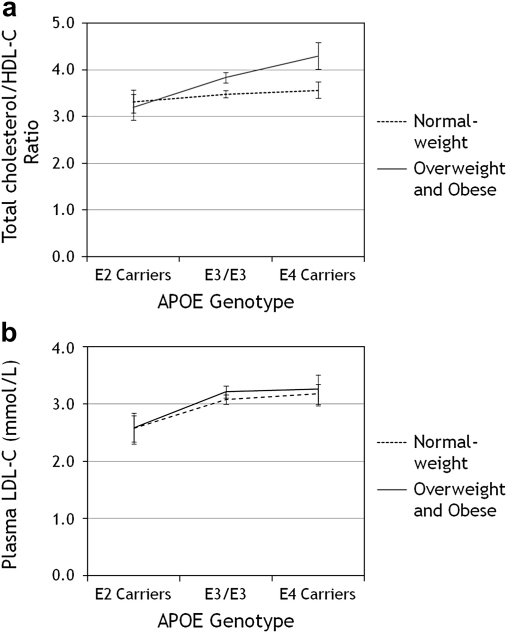
The ten variants selected were genotyped in 882 Greek children, mean age: 11.2+/-0.7 years (418 females and 464 males). Genotypes were assessed using TaqMan technology. Significantly higher total cholesterol (TC) (p=0.0001) and low-density lipoprotein cholesterol (LDL-C) (p<0.0001) were observed in APOE epsilon4 carriers compared to epsilon3/epsilon3 homozygotes and epsilon2 carriers. The association of APOE genotype with TC and high-density lipoprotein cholesterol (HDL-C) ratio (p=0.0008) was further modulated by body mass index. Carriers of the CETP TaqIB B2 allele had significantly higher HDL-C (p<0.0001) and significantly lower TC: HDL-C ratio (p<0.0001) compared to B1/B1 individuals. No significant associations were observed between APOA4, APOA5 and APOC3 variants and serum lipids.
This study demonstrates that these common variants are associated with lipid levels in this healthy paediatric cohort, suggesting that even in these young children there may be potential in predicting their lifelong exposure to an adverse lipid profile.
多项研究一致表明,多种候选基因的变异是成年人血脂水平的重要决定因素。然而,很少有研究调查这些变异在儿童中的影响。因此,本研究在 Gene-Diet Attica Investigation on childhood obesity (GENDAI) 研究中,检查了脂蛋白脂肪酶(LPL-S447X)、胆固醇酯转移蛋白(CETP-Taq1B)、载脂蛋白(APO)E(epsilon2、epsilon3、epsilon4)、APOA5(-1131C>T 和 S19W)、APOA4(S347T)和 APOC3(-482C>T;1100C>T 和 3238G>C)这 10 种常见变异对儿童脂蛋白水平的影响。
选择了 10 种变异在 882 名希腊儿童中进行了基因分型,平均年龄为 11.2+/-0.7 岁(418 名女性和 464 名男性)。使用 TaqMan 技术评估基因型。与 epsilon3/epsilon3 纯合子和 epsilon2 携带者相比,APOE epsilon4 携带者的总胆固醇(TC)(p=0.0001)和低密度脂蛋白胆固醇(LDL-C)(p<0.0001)明显更高。APOE 基因型与 TC 和高密度脂蛋白胆固醇(HDL-C)比值(p=0.0008)的关联受体重指数的调节。CETP TaqIB B2 等位基因携带者的 HDL-C 明显更高(p<0.0001),TC:HDL-C 比值明显更低(p<0.0001),与 B1/B1 个体相比。APOA4、APOA5 和 APOC3 变异与血清脂质之间没有明显的相关性。
本研究表明,这些常见变异与该健康儿科队列的血脂水平相关,这表明即使在这些年幼的儿童中,也可能有潜力预测他们终生暴露于不良血脂谱的情况。