Department of Neurobiology, Duke University Durham, NC, USA.
Front Integr Neurosci. 2009 Mar 9;3:3. doi: 10.3389/neuro.07.003.2009. eCollection 2009.
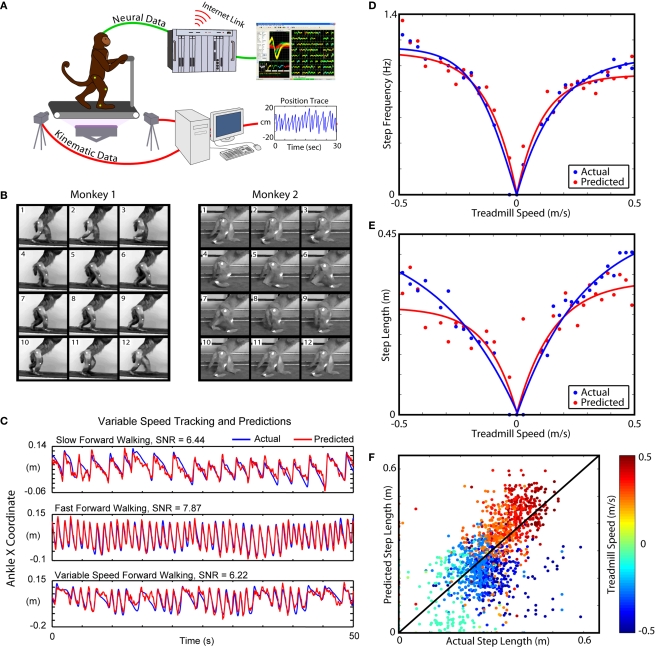
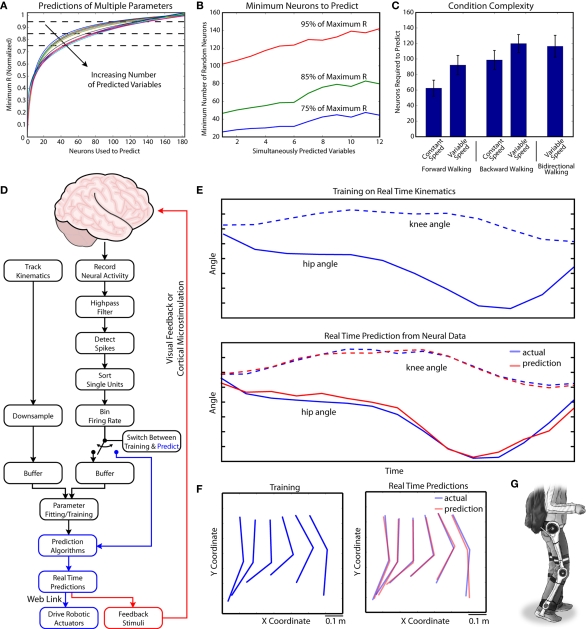
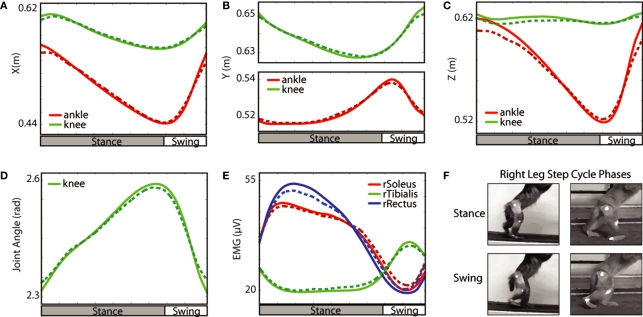
The ability to walk may be critically impacted as the result of neurological injury or disease. While recent advances in brain-machine interfaces (BMIs) have demonstrated the feasibility of upper-limb neuroprostheses, BMIs have not been evaluated as a means to restore walking. Here, we demonstrate that chronic recordings from ensembles of cortical neurons can be used to predict the kinematics of bipedal walking in rhesus macaques - both offline and in real time. Linear decoders extracted 3D coordinates of leg joints and leg muscle electromyograms from the activity of hundreds of cortical neurons. As more complex patterns of walking were produced by varying the gait speed and direction, larger neuronal populations were needed to accurately extract walking patterns. Extraction was further improved using a switching decoder which designated a submodel for each walking paradigm. We propose that BMIs may one day allow severely paralyzed patients to walk again.
由于神经损伤或疾病,行走能力可能会受到严重影响。尽管脑机接口 (BMI) 的最新进展已经证明了上肢神经假体的可行性,但 BMI 尚未被评估为恢复行走的一种手段。在这里,我们证明了从皮质神经元集合中进行慢性记录可以用于预测恒河猴的双足行走运动学——无论是离线还是实时。线性解码器从数百个皮质神经元的活动中提取腿部关节的三维坐标和腿部肌肉肌电图。当通过改变步态速度和方向产生更复杂的行走模式时,需要更大的神经元群体才能准确提取行走模式。使用切换解码器进一步提高了提取效果,该解码器为每个行走范例指定了一个子模型。我们提出,BMI 有朝一日可能使严重瘫痪的患者重新行走。