Mohamad Kusdiantoro, Olsson Mia, van Tol Helena T A, Mikko Sofia, Vlamings Bart H, Andersson Göran, Rodríguez-Martínez Heriberto, Purwantara Bambang, Paling Robert W, Colenbrander Ben, Lenstra Johannes A
Faculty of Veterinary Medicine, Bogor Agricultural University, Bogor, Indonesia.
PLoS One. 2009;4(5):e5490. doi: 10.1371/journal.pone.0005490. Epub 2009 May 13.
Two bovine species contribute to the Indonesian livestock, zebu (Bos indicus) and banteng (Bos javanicus), respectively. Although male hybrid offspring of these species is not fertile, Indonesian cattle breeds are supposed to be of mixed species origin. However, this has not been documented and is so far only supported by preliminary molecular analysis.
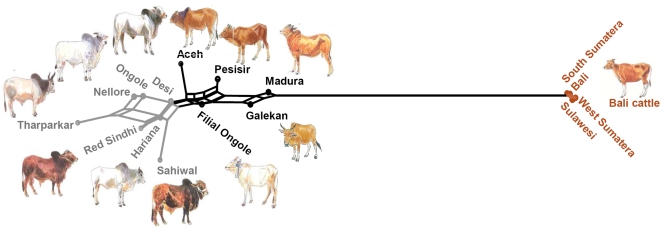
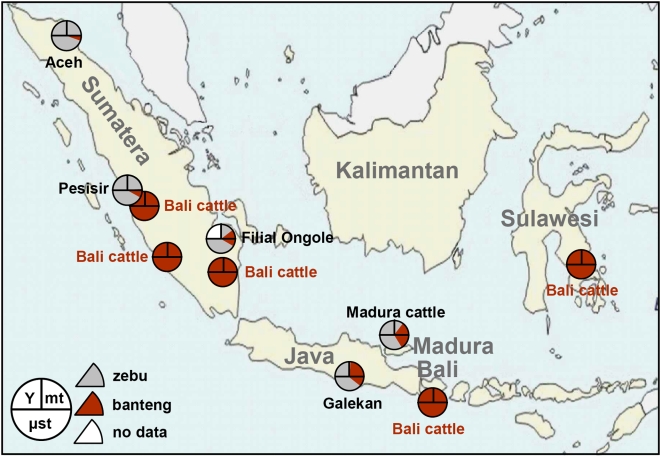
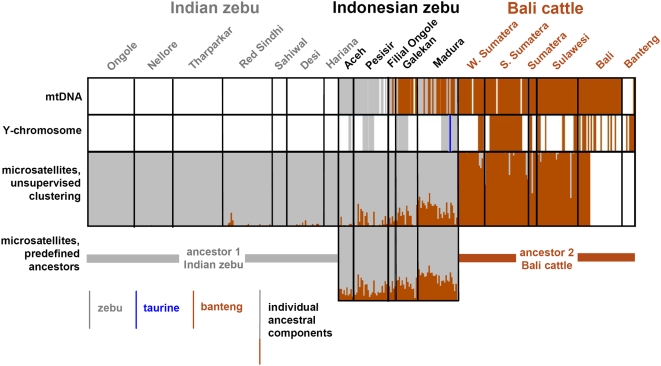
Analysis of mitochondrial, Y-chromosomal and microsatellite DNA showed a banteng introgression of 10-16% in Indonesian zebu breeds. East-Javanese Madura and Galekan cattle have higher levels of autosomal banteng introgression (20-30%) and combine a zebu paternal lineage with a predominant (Madura) or even complete (Galekan) maternal banteng origin. Two Madura bulls carried taurine Y-chromosomal haplotypes, presumably of French Limousin origin. In contrast, we did not find evidence for zebu introgression in five populations of the Bali cattle, a domestic form of the banteng.
Because of their unique species composition Indonesian cattle represent a valuable genetic resource, which potentially may also be exploited in other tropical regions.
两种牛对印度尼西亚的家畜养殖有贡献,即瘤牛(Bos indicus)和爪哇野牛(Bos javanicus)。尽管这两个物种的雄性杂交后代不育,但印度尼西亚的牛品种被认为起源于混合物种。然而,这一点尚未得到记录,目前仅得到初步分子分析的支持。
对线粒体、Y染色体和微卫星DNA的分析表明,印度尼西亚瘤牛品种中有10%-16%的爪哇野牛基因渗入。东爪哇的马都拉牛和加莱坎牛有更高水平的常染色体爪哇野牛基因渗入(20%-30%),并将瘤牛父系血统与主要的(马都拉牛)或甚至完全的(加莱坎牛)母系爪哇野牛起源相结合。两头马都拉公牛携带普通牛Y染色体单倍型,推测起源于法国利木赞牛。相比之下,我们在巴厘牛(爪哇野牛的家养形式)的五个种群中未发现瘤牛基因渗入的证据。
由于其独特的物种组成,印度尼西亚的牛代表了一种宝贵的遗传资源,这一资源在其他热带地区也可能得到开发利用。