Boxall Alistair B A, Hardy Anthony, Beulke Sabine, Boucard Tatiana, Burgin Laura, Falloon Peter D, Haygarth Philip M, Hutchinson Thomas, Kovats R Sari, Leonardi Giovanni, Levy Leonard S, Nichols Gordon, Parsons Simon A, Potts Laura, Stone David, Topp Edward, Turley David B, Walsh Kerry, Wellington Elizabeth M H, Williams Richard J
EcoChemistry Team, University of York, Heslington, York, United Kingdom.
Environ Health Perspect. 2009 Apr;117(4):508-14. doi: 10.1289/ehp.0800084. Epub 2008 Dec 10.
Climate change is likely to affect the nature of pathogens and chemicals in the environment and their fate and transport. Future risks of pathogens and chemicals could therefore be very different from those of today. In this review, we assess the implications of climate change for changes in human exposures to pathogens and chemicals in agricultural systems in the United Kingdom and discuss the subsequent effects on health impacts.
In this review, we used expert input and considered literature on climate change; health effects resulting from exposure to pathogens and chemicals arising from agriculture; inputs of chemicals and pathogens to agricultural systems; and human exposure pathways for pathogens and chemicals in agricultural systems.
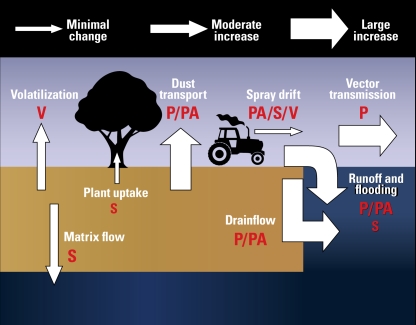
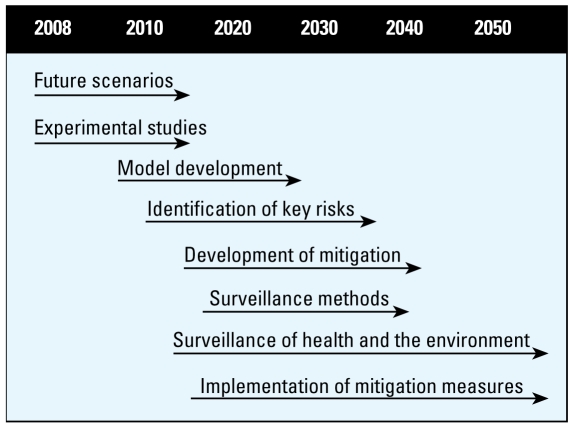
We established the current evidence base for health effects of chemicals and pathogens in the agricultural environment; determined the potential implications of climate change on chemical and pathogen inputs in agricultural systems; and explored the effects of climate change on environmental transport and fate of different contaminant types. We combined these data to assess the implications of climate change in terms of indirect human exposure to pathogens and chemicals in agricultural systems. We then developed recommendations on future research and policy changes to manage any adverse increases in risks.
Overall, climate change is likely to increase human exposures to agricultural contaminants. The magnitude of the increases will be highly dependent on the contaminant type. Risks from many pathogens and particulate and particle-associated contaminants could increase significantly. These increases in exposure can, however, be managed for the most part through targeted research and policy changes.
气候变化可能会影响环境中病原体和化学物质的性质及其归宿和迁移。因此,病原体和化学物质未来带来的风险可能与如今大不相同。在本综述中,我们评估了气候变化对英国农业系统中人类接触病原体和化学物质变化的影响,并讨论了其对健康影响的后续效应。
在本综述中,我们采用了专家意见并参考了关于气候变化的文献;农业中接触病原体和化学物质所导致的健康影响;化学物质和病原体进入农业系统的情况;以及农业系统中病原体和化学物质的人类接触途径。
我们建立了关于农业环境中化学物质和病原体对健康影响的现有证据基础;确定了气候变化对农业系统中化学物质和病原体输入的潜在影响;并探讨了气候变化对不同污染物类型在环境中的迁移和归宿的影响。我们整合这些数据,以评估气候变化对农业系统中人类间接接触病原体和化学物质的影响。然后,我们就未来研究和政策变化提出建议,以应对风险的任何不利增加。
总体而言,气候变化可能会增加人类接触农业污染物的机会。增加的幅度将高度取决于污染物类型。许多病原体以及颗粒和与颗粒相关的污染物带来的风险可能会显著增加。然而,通过有针对性的研究和政策变化,在很大程度上可以应对这些接触增加的情况。